Start with the job that earns a full-size final-year SUV
A full-size SUV earns its space when several difficult jobs happen together, such as carrying adults in all three rows while luggage and a trailer come along. Occasional holiday use usually gives its width, fuel demand, parking burden, and purchase risk too much influence over every ordinary day.
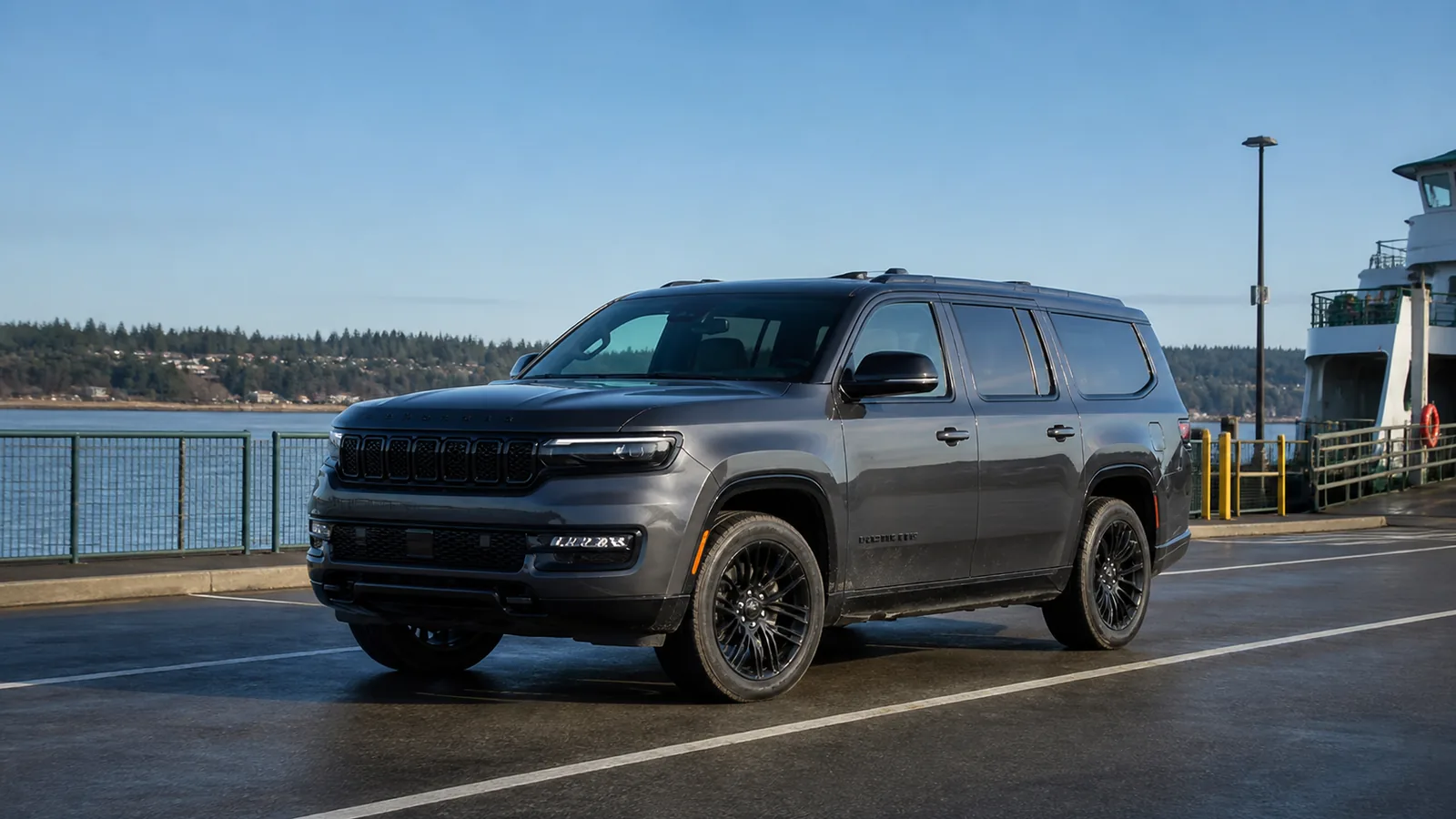
The 2025 Jeep Wagoneer is the final U.S. model year for this vehicle, and the standard 214.7-inch body is the primary subject here.
Wagoneer L appears only when its longer body answers a specific cargo problem, while Grand Wagoneer and Wagoneer S are different vehicles.
Write down the passenger count, child-seat positions, weekly load, garage opening, parking routine, and loaded trailer weight before comparing trims. A smaller current SUV remains the better answer unless the Wagoneer's size solves a repeated problem that the smaller vehicle cannot.
One Hurricane engine still produces configuration-specific results
Every 2025 Wagoneer uses a 3.0-liter Hurricane twin-turbo inline-six with 420 hp, 468 lb-ft, and an eight-speed automatic transmission. Buyers can choose rear-wheel drive or one of three available four-wheel-drive systems, but equipment such as low range, an electronic limited-slip differential, and air suspension does not belong to every vehicle.
The exact EPA evidence is 16 mpg city, 23 highway, and 19 combined for Series III 4x4. That label cannot become a general rating for rear-wheel-drive models, other four-wheel-drive configurations, or Wagoneer L.
Shared engine output tells you what moves the vehicle, while the installed driveline determines traction hardware, fuel label, towing eligibility, and price.
A twin-turbo six is not a V8, and the service book knows it
The Wagoneer uses a 3.0-liter twin-turbocharged inline six producing 420 hp and 468 lb-ft. Plenty of buyers arriving at this vehicle are stepping out of a naturally aspirated V8.
The performance case is settled and not interesting. More torque, arriving lower, from a smaller engine.
The ownership case is the part that catches people. A turbocharged engine runs hotter, works its oil harder and has components a V8 does not have at all.
What changes with two turbochargers
Oil
Interval and specification both matter more, because oil that is late is doing turbocharger bearing duty as well as engine duty. Follow the book rather than a habit formed on a V8.
Cooling
There is more heat to move and more hardware moving it. A cooling system in good order is not optional equipment on this engine.
Warm-up and cool-down
Hard driving immediately from cold, or shutting down straight after a long tow, treats a turbocharged engine worse than it treats a V8.
Towing sharpens all three. A rated 10,000 pounds when properly equipped is a real figure, and using it regularly is exactly the duty cycle that makes maintenance history worth reading closely.
On a used example this becomes a document check rather than a mechanical one. Ask for the service record and look at the intervals rather than the total count of stamps.
The rated 19 mpg combined on the configuration that carries a figure is the last piece. A smaller engine in a vehicle this size does not produce small fuel bills.
The standard body must carry adults and luggage together
Car and Driver found excellent adult third-row space in its tested Series III Super 4x4, which makes the last row more than an emergency seat in that configuration. A buyer still needs to enter through the second row, settle behind the usual front-seat positions, check head and foot room, and repeat the process with any child seats installed.
The standard Wagoneer rides on a 123.0-inch wheelbase, measures 214.7 inches long and 83.6 inches wide, and seats up to eight with a second-row bench, while captain's chairs reduce capacity to seven and change the walk-through path. Those dimensions create generous interior room, but they also make garage clearance, curb placement, door opening, and tight parking part of the cabin test.
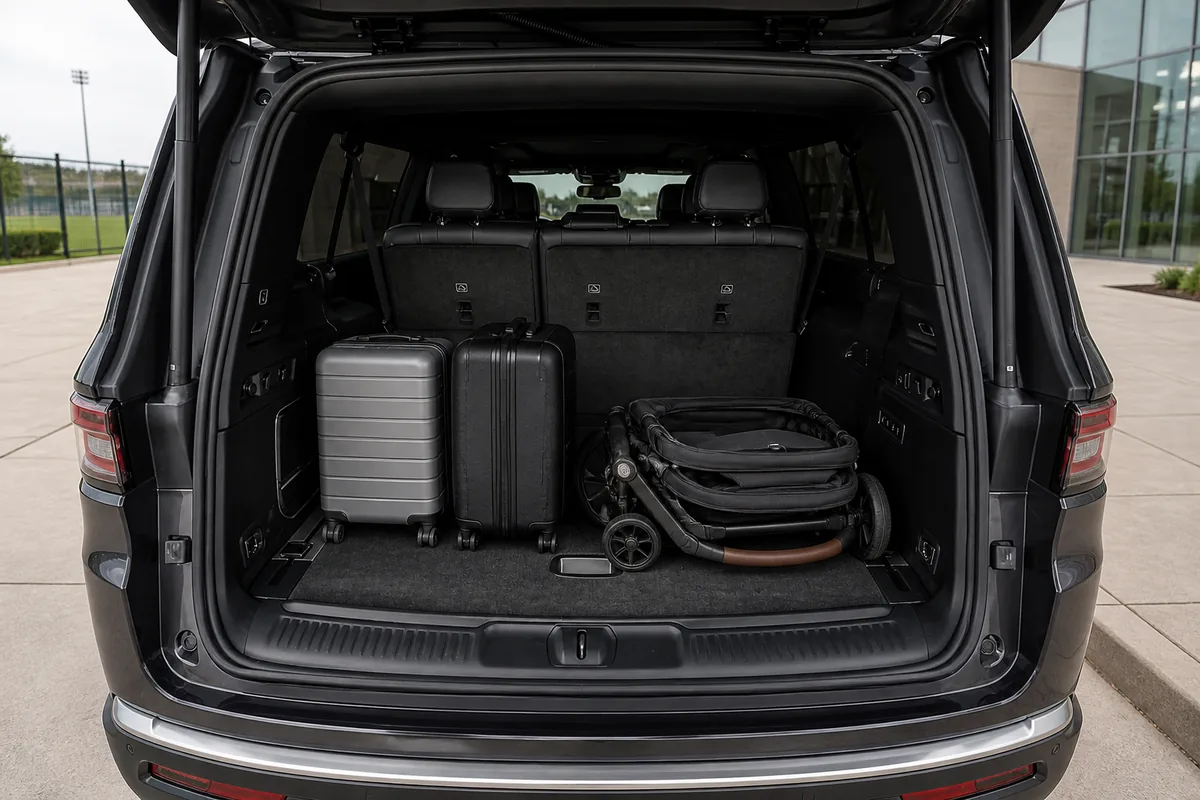
The standard body provides 27 cubic feet behind row three, 71 behind row two, and 117 with both rear rows folded. The useful family trial keeps every needed passenger seat upright, then loads the normal suitcases, stroller, sports bags, or groceries through the liftgate.

The standard body passes only when adults and their routine luggage fit at the same time. Folding a needed row to reach the larger cargo figures proves a packaging shortfall rather than flexibility.
Eight seats, and what the third row is actually for
The Wagoneer seats up to eight, and a seat count is the easiest number in this class to misread. What matters is which of those seats an adult will sit in twice.
Cargo runs 27, 71 and 117 cubic feet behind the third row, behind the second and behind the front. Those three numbers describe three different vehicles.
The two tests a seat count cannot answer
Behind the third row
27 cubic feet sounds generous and is the figure you live with whenever all eight seats are used. Load it with the luggage eight people actually bring, not with a tape measure.
Getting into the third row
Fold and slide the second row yourself, from both sides, with a child seat fitted if you use one. This is where large SUVs separate from each other far more than on volume.
The 71-cubic-foot figure is the one most owners use most often. It is what you get with the third row folded, which is how a large SUV spends the majority of its life.
Decide honestly how many days a year the third row goes up. If the answer is under a dozen, the standard body is the right length and the extra foot of the longer car is money spent on those dozen days.
If the answer is closer to none, the question is whether a third row is needed at all, and the Jeep Grand Cherokee does the rest of this job for considerably less.
If the answer is most weeks, the seat access test matters more than any other paragraph in this review. Bring the people who will use it and let them try, because they will tell you in ten seconds what a specification sheet cannot.
Wagoneer L earns its extra foot only through cargo need
The extra 15.1 cubic feet matters when the standard vehicle repeatedly leaves luggage behind while all three rows remain occupied. It offers little value when the buyer usually travels with row three folded or can solve the occasional overflow with a smaller external carrier.
Wagoneer L stretches the wheelbase to 130.0 inches and overall length to 226.7 inches. It provides 42.1 cubic feet behind row three, 85.3 behind row two, and 130.9 with the rear rows folded, compared with 27 cubic feet behind the standard body's third row.
The longer floor can also take a 4-by-8-foot sheet with the rear rows folded.
| Body | Wheelbase | Overall length | Cargo behind row three |
|---|---|---|---|
| Standard Wagoneer | 123.0 in | 214.7 in | 27 cu ft |
| Wagoneer L | 130.0 in | 226.7 in | 42.1 cu ft |
Take both lengths through the same garage entrance, parking structure, school pickup lane, fuel station, and loading area. Twelve added inches can improve occupied cargo use while making turning space, rear overhang awareness, and daily parking harder.
Choose Wagoneer L only after the standard body's 27-cubic-foot area fails a real upright-row load. The longer model needs a repeated cargo reason, not a larger-number preference.
The road test mixes strong control with full-size penalties
Car and Driver's 2025 Series III Super 4x4 test found strong acceleration, controlled body motions, direct controls, and an excellent adult third row. Those observations belong to that tested configuration, not every wheel, suspension, or driveline combination.
The same test noted a light jiggle on 22-inch wheels, some low-rent plastics, and a 207-foot stop from 70 mph. The wheel result belongs to that 22-inch setup rather than every Wagoneer.
These limits matter because quick acceleration can make a large SUV feel easier to manage than its mass and stopping distance allow.
Its 22-mpg result at 75 mph is a test-specific observation, not an EPA rating or a promise for another trim, load, tire, weather pattern, or speed. Use it as a reason to measure a representative highway route rather than as a fuel budget input.
Test low-speed placement and braking as carefully as acceleration and ride comfort. A full-size SUV must feel manageable in the difficult moments, not only relaxed on an open highway.
The fuel arithmetic on a vehicle this size
A rated 16 city and 23 highway gives 19 combined on the configuration that carries a figure. That is a reasonable result for the size and a large number in absolute terms.
Twelve thousand miles a year at 19 mpg is about 632 gallons. Fifteen thousand takes it to roughly 789.
Gallons a year at 19 mpg combined
- 10,000 miles
- about 526 gallons
- 12,000 miles
- about 632 gallons
- 15,000 miles
- about 789 gallons
- 20,000 miles
- about 1,053 gallons
The turbocharged six earns its efficiency when it is not working. Sitting in traffic or cruising, it behaves like the smaller engine it is.
Loaded with eight people or pulling toward the 10,000-pound limit, it behaves like the large engine the job requires, and the consumption follows. A vehicle used the way this one is marketed will not see its rated figure on those days.
That gap is worth planning for rather than being surprised by. If most of your mileage is the school run, the rated figure is roughly what you will see; if most of it is towing, budget well below it.
The trailer chooses the drivetrain and hardware
Those are configuration ceilings, not promises for every vehicle with the badge. Installed towing equipment, hitch rating, axle and driveline details, tire ratings, payload label, occupants, cargo, tongue weight, and the trailer's actual loaded weight control the safe combination.
A properly equipped standard Wagoneer can tow up to 10,000 pounds in rear-wheel-drive or four-wheel-drive form. Wagoneer L can reach 10,000 pounds with rear-wheel drive, while the L four-wheel-drive ceiling is 9,850 pounds.
| Body and drivetrain | Maximum |
|---|---|
| Standard 4x2 | 10,000 lb |
| Standard 4x4 | 10,000 lb |
| Wagoneer L 4x2 | 10,000 lb |
| Wagoneer L 4x4 | 9,850 lb |
Start with a scale ticket or defensible loaded estimate for the trailer, then add passengers and cargo against the vehicle's payload. Require the VIN-specific build sheet, door labels, owner's information, hitch identification, and written dealer confirmation before relying on a maximum.
The trailer selects the passing Wagoneer configuration before trim preference or discount enters the decision. Reject any vehicle whose labels and equipment cannot prove the required margin.
Mixed crash results and one campaign require exact checks
IIHS results applying to the 2023 through 2025 Wagoneer include Good ratings in the small-overlap and updated side tests, with a Marginal result in the updated moderate-overlap test. Headlights rate Good or Acceptable depending on equipment, and the vehicle does not hold a Top Safety Pick designation.
No NHTSA figures belong here without an exact primary result. Driver-assistance equipment, an IIHS result, and a completed recall remedy answer different questions, so none can substitute for another.
| Evidence | Exact scope | Buyer action |
|---|---|---|
| IIHS crash tests | 2023-25 applicability with mixed G / M / G results | Read each test rather than inventing one overall score |
| Headlights | Good or Acceptable by equipment | Confirm the exact installed lamps |
| Recall 25V593 / 77C | Certain MY2022-25 vehicles with door DLO trim that may detach | Check VIN and completed remedy |
| Basic warranty | 3 years / 36,000 miles | Confirm in-service date and remaining term |
| Powertrain and roadside | 5 years / 60,000 miles | Read exclusions and transfer terms |
| Corrosion | 3 years unlimited all sheet metal, 5 years unlimited outer panels | Confirm the written definition and condition |
Campaign 25V593, also identified as 77C, covers certain 2022 through 2025 vehicles because door daylight-opening trim may detach. A VIN lookup and repair record determine applicability, while the campaign count does not establish general reliability.
Confirm the exact headlights, recall remedy, in-service date, and remaining written coverage before purchase. These checks bound specific risks without predicting long-term ownership.
A short life with a loud first year
The Wagoneer has only existed since 2022, so its record is small. It is not quiet.
Owners filed 575 complaints across model years 2022 to 2026. The launch year alone carries 256 of them.
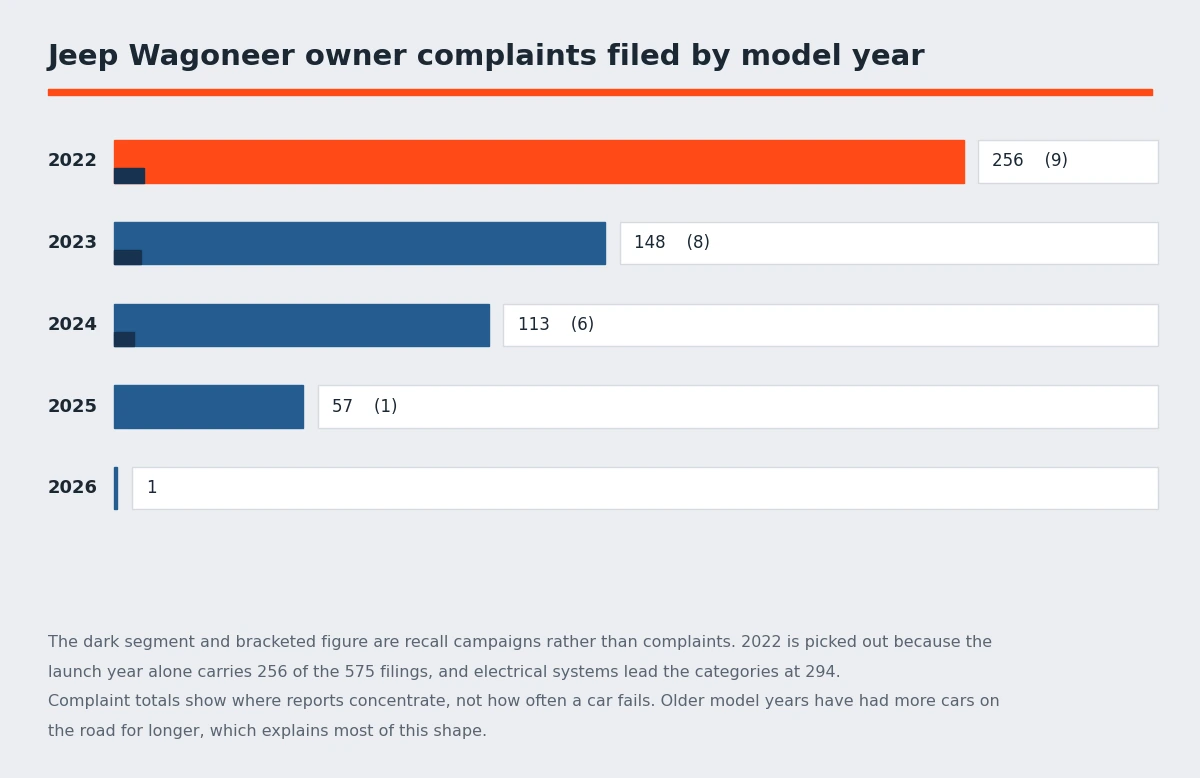
Electrical systems lead every category at 294 filings, which is more than half of the total. Engine sits second at 175 and brakes third at 92.
The recall record has the same shape. Twelve distinct campaigns touch the run and nine of them reach the 2022 car, naming exterior trim, the reversing camera display and a rear seat-belt buckle.
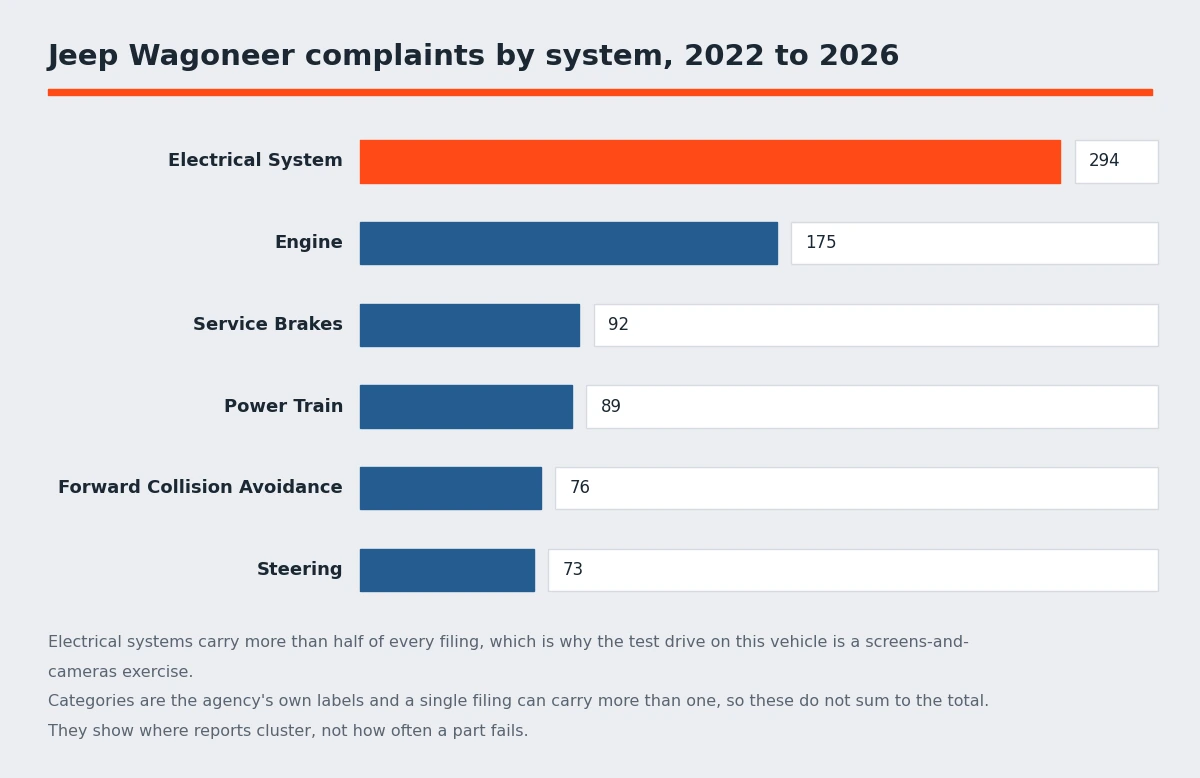
The practical reading is narrow. An electrical complaint is rarely a reason to reject a vehicle outright, but on this one it is the system to exercise hardest on the test drive, from the screens to the cameras to every seat memory.
Discontinued status raises the proof required for value
Final-year status makes the current transaction and remaining written coverage more important, but it does not support a claim about future scarcity or resale.
This profile also has no evidence for a mature reliability verdict or five-year cost forecast.
Those deeper used, reliability, problem, recall-history, and cost decisions need their own current evidence.
For 2025, Jeep reduced the standard Wagoneer entry price by $3,000 from the prior model year. MSRP excluding the separate $2,000 destination charge began at $59,945 for standard 4x2 and $62,945 for standard 4x4.
Series II listed at $63,945 and $66,945, while Series III 4x4 listed at $73,945.
Wagoneer L launch prices began at $62,945 for 4x2 and $65,945 for 4x4, with L Series II 4x4 at $69,945 and L Series III 4x4 at $76,945. These historical launch figures organize configurations, but only a current written quote establishes today's transaction.
Buy the discontinued 2025 Wagoneer only when its unusual combination of occupied space and verified towing solves a repeated job. Otherwise, its physical and lifecycle costs outweigh capability that remains unused.
A large price falling fast, against a heavy electrical record
The Wagoneer launched between $59,945 and $76,945 before destination. It ended after the 2025 model year, which puts every one of them on a curve rather than a price list.
That is the opportunity and the risk in the same sentence. A vehicle that expensive loses a great deal of money in its first few years, and somebody else has already paid most of it.
What makes this one different from any other steeply depreciating large SUV is where its complaints sit. Electrical systems carry 294 of 575 filings, and this is a vehicle whose seats, screens, cameras and driver aids are almost all electrical.
So the test drive on this vehicle is longer than usual. Every screen, every camera view, every seat adjustment and every driver aid gets exercised before the price is discussed.
The mechanical side is a shorter conversation. One Hurricane twin-turbo six of 420 hp and 468 lb-ft runs the whole range, and the towing figure of 10,000 pounds when properly equipped does not vary with trim.
Fuel is the other constant. A rated 19 mpg combined on the configuration that carries a figure is the number to plan around, and a heavy body at highway speed will not beat it.