Compact dimensions must solve the daily package first
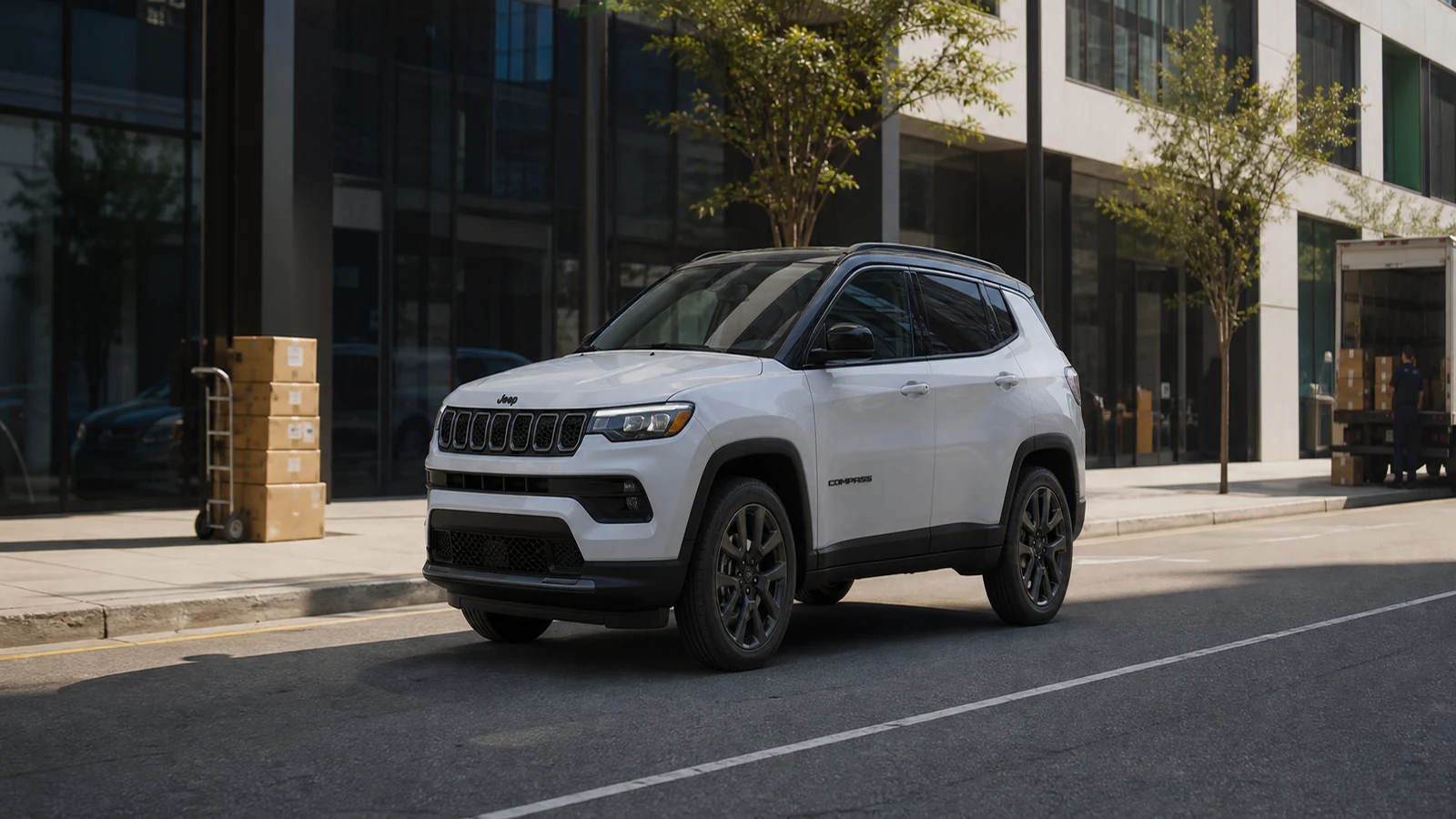
The 2026 Jeep Compass is a five-seat compact SUV that measures 173.4 inches long on a 103.8-inch wheelbase. Its 80.0-inch mirror width and 64.8-inch height with roof rails belong in the garage, parking-space, and car-wash check before styling or trim enters the decision.
Front and rear legroom measure 41.8 and 38.3 inches, but a number cannot prove comfortable access around a rear-facing child seat or a tall front occupant. Set both front seats for their regular drivers, then load every passenger who rides often.
Daily package
- Overall length
- 173.4 in
- Wheelbase
- 103.8 in
- Width with mirrors
- 80.0 in
- Height with roof rails
- 64.8 in
- Front / rear legroom
- 41.8 / 38.3 in
- Seats-up / folded cargo
- 27.2 / 59.8 cu ft
The cargo area holds 27.2 cubic feet with the rear seat upright and 59.8 with it folded. Keep the seat upright for the decisive trial and bring the stroller, grocery bins, pet equipment, or work cases that repeat most often.
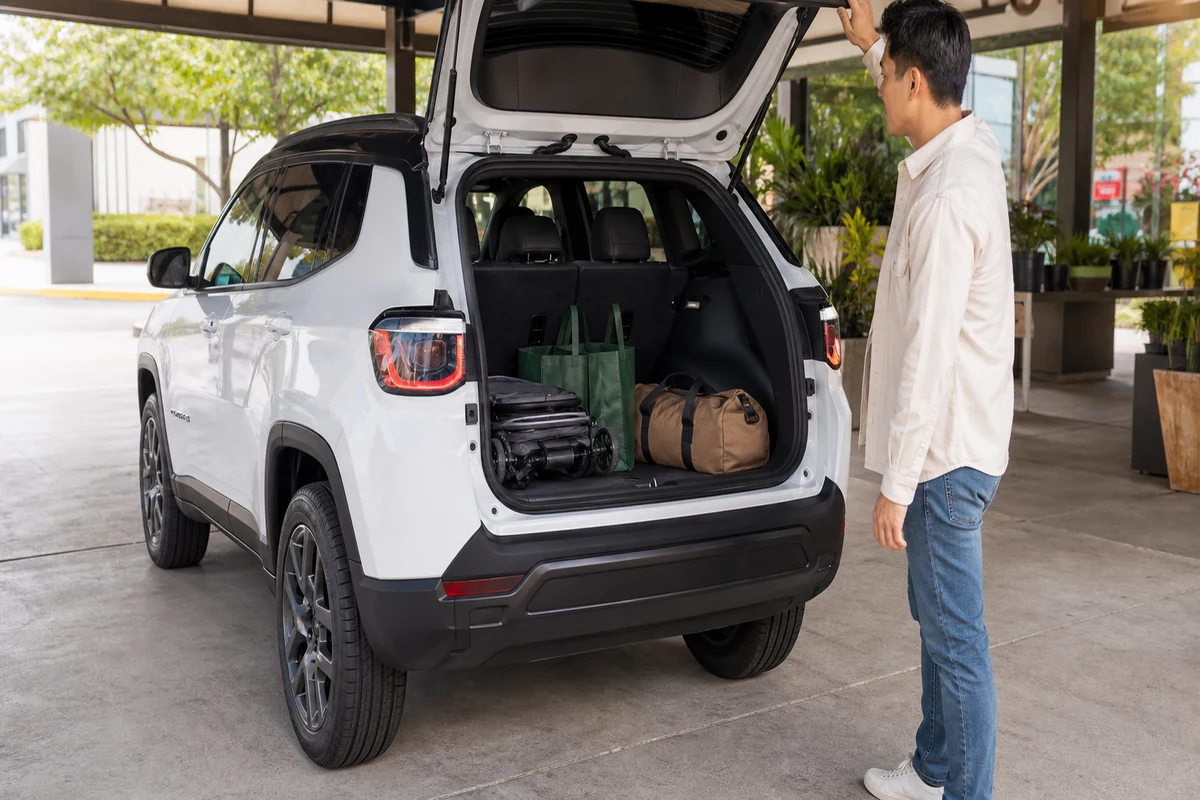
A maximum folded volume describes occasional hauling after passenger capacity has been surrendered. Check the liftgate clearance, load-floor shape, rearward view, and whether the parcel cover still fits over the normal load.
The Compass earns its compact footprint only when passengers, seats-up cargo, and the real parking space all work together. A buyer who must fold the rear seat every week has found a packaging limit rather than a feature benefit.
One turbo powertrain sets a clear baseline
Every U.S. 2026 Compass uses one 2.0-liter direct-injection turbo four-cylinder with stop/start. It produces 200 hp at 5,000 rpm and 221 lb-ft from 1,750 to 4,250 rpm through the 8F30 eight-speed automatic.
The current EPA label is 23 mpg city, 31 highway, and 26 combined. Older fleet material showing 24 city and 32 highway is stale for this decision, and road conditions cannot turn either laboratory label into a personal fuel promise.
There is no U.S. front-wheel-drive, manual, hybrid, plug-in-hybrid, or electric branch to compare. That simplifies ordering, but it also means the test drive must settle throttle response, stop/start behavior, shift timing, and highway passing with the only factory powertrain available.
Use 23/31/26 as the comparison baseline and test the exact vehicle on the route it will repeat. Tires, temperature, speed, traffic, hills, and load can move actual consumption away from the label.
One nameplate, two very different cars either side of 2023
Everything above describes the current hardware. A used lot holds two Compasses, and the line between them falls in 2023.
Before that the engine was a 2.4-liter with no turbocharger, making 177 hp and 172 lb-ft through a nine-speed automatic. Front-wheel drive was offered on the lower trims.
| Item | 2017 to 2022 | 2023 onward |
|---|---|---|
| Engine | 2.4L, naturally aspirated | 2.0L turbocharged |
| Output | 177 hp / 172 lb-ft | 200 hp / 221 lb-ft |
| Transmission | 9-speed automatic | 8-speed automatic |
| Drivetrain | front-wheel drive available on lower trims | four-wheel drive standard |
The gain is not only the 23 horsepower. Torque arrives lower and the eight-speed has less to do, which is what a driver notices pulling out of a junction rather than on a spec sheet.
Economy moved the same way. The turbo car gained roughly two mpg across the board despite the extra output, so the older engine is not even the cheaper one to run.
This split matters more than any trim decision on a used lot. A 2022 Latitude and a 2023 Latitude look alike in a listing photograph and are different cars underneath.
It also lines up with the complaint record further down. The nine-speed and the 2.4 carry the loud model years, and the quiet ones start where the new hardware does.
One consequence catches people out. If a front-wheel-drive Compass is what the budget wants, it has to be a 2022 or older car, because four-wheel drive became standard with the new engine.
Pavement manners decide most Compass miles
Most Compass owners will spend more time on patched streets and highways than on loose terrain. The useful drive begins with a cold start and includes a tight parking maneuver, broken pavement, a merge, a sustained cruise, a grade, and several controlled stops.
Daily-road trial
- ParkingCheck mirror width, rear corners, camera view, and steering effort
- Broken pavementJudge impact noise, body motion, and steering correction
- MergeTest response from a rolling speed and note shift timing
- HighwayListen for wind, tire, and engine noise at the normal cruise
- GradeWatch whether the transmission holds or hunts between ratios
- BrakingCompare initial response and confidence through a firm legal stop
Repeat the most important section with the passengers or cargo normally carried. Added load can change acceleration, braking, ride, and headlamp aim, while a larger wheel and tire package can feel different from the trim tested in a review.
Use the same route for each shortlisted trim and keep the climate control operating as it would every day. A brief loop on smooth streets cannot reveal highway noise, poor seat support, intrusive driver alerts, or low-speed transmission behavior.
Accept the Compass only when the exact wheel, tire, seat, and powertrain configuration remains comfortable on the roads used most. Trail hardware cannot repay a tiring commute that happens five days each week.
Active Drive earns value in ordinary bad conditions
Every U.S. 2026 Compass includes Jeep Active Drive 4x4 with a rear-axle disconnect. The system can disengage the rear driveline when four-wheel traction is unnecessary, then reconnect it when conditions and control logic call for more driven wheels.
That automatic operation can help on repeated rain, snow, loose access roads, or a steep unpaved driveway. It does not shorten stopping distance beyond the grip available from the tires, and it cannot make excessive speed appropriate for the surface.
Ordinary 4x4 value
- Identify the weather and access conditions that recur each season
- Inspect the exact tire model, size, tread, and cold pressure
- Test mode selection and dashboard feedback without seller coaching
- Confirm smooth operation during tight low-speed turns
- Price the system as daily traction support, not a promise of off-road use
Regular Compass trims list 8.1 inches of ground clearance and a 16-inch water-fording claim under specified conditions. Those figures do not authorize entry into moving, hidden, or unfamiliar water, where depth, current, surface, and exit conditions may differ from the controlled claim.
Standard Active Drive earns value when it solves a known weather or access problem without asking the buyer to purchase a specialist trim. Drivers on mild paved routes should still compare its price and fuel use with road-focused alternatives.
Trailhawk needs a known terrain threshold
Trailhawk adds Active Drive Low, a 20:1 crawl ratio, Rock mode, hill descent control, skid plates, an off-road suspension, and 8.6 inches of ground clearance. These are functional changes, but each should map to an obstacle or surface the owner can name.
| Trailhawk hardware | Practical job | Boundary |
|---|---|---|
| Active Drive Low and 20:1 crawl ratio | Controlled low-speed progress | Not a mechanical low-range transfer case claim |
| Rock mode and hill descent control | Calibrated traction and speed support | Driver still chooses the line and speed |
| Skid plates and off-road suspension | Added protection and control margin | Do not use protection as permission to strike obstacles |
| 8.6-inch clearance | More underbody margin than regular trims | Exact tire, load, and obstacle still matter |
| 19-inch water claim | Manufacturer-stated controlled-condition depth | Walk away from unknown depth, current, or exit |
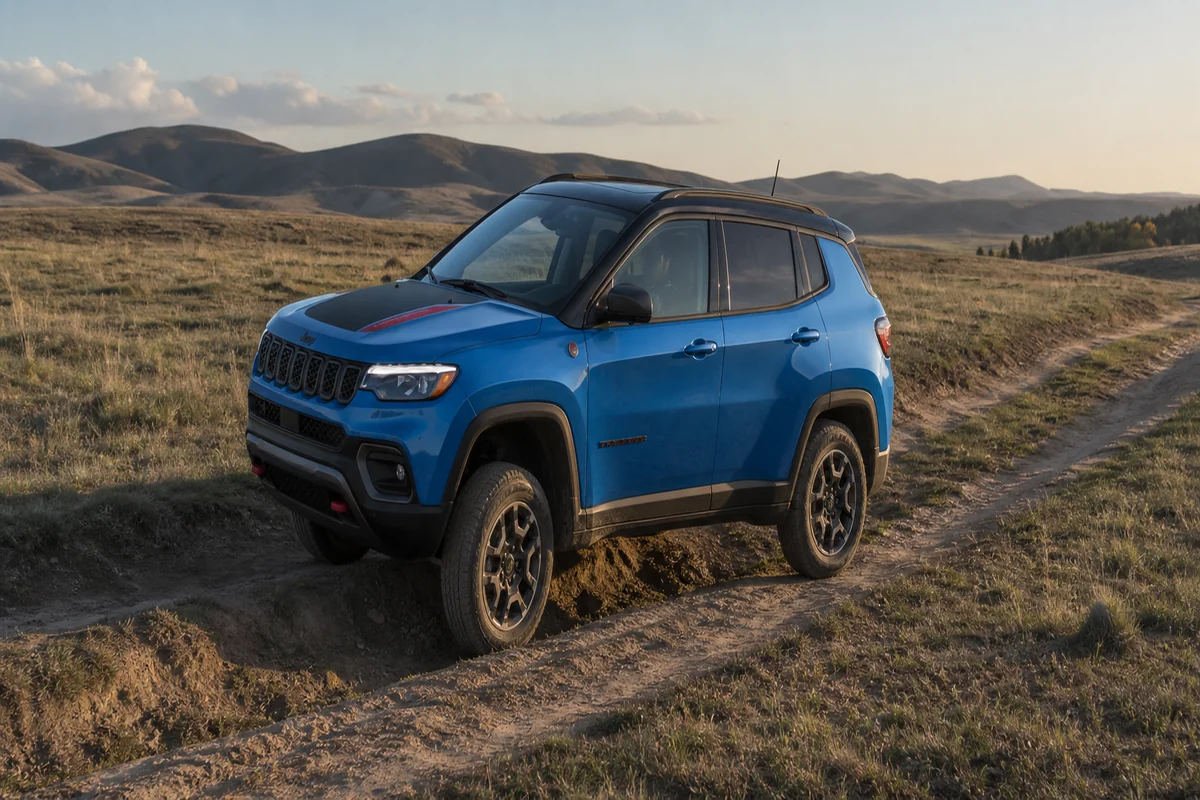
The appropriate test is modest and legal. Walk the route, identify a bypass, inspect the approach and underbody afterward, and stop before water or an obstacle whose depth and surface cannot be verified.
Maximum towing is 2,000 pounds when properly equipped, subject to the exact build, vehicle labels, hitch, payload, and loaded trailer. Trailhawk hardware does not raise a rating simply because it looks more capable.
Buy Trailhawk only when its additional programming, protection, and clearance solve a repeated route. Scenic gravel roads and winter pavement may need good tires and standard Active Drive more than the specialist package.
The exact safety record is mixed, not one grade
NHTSA vehicle 20923 gives the exact 2026 Jeep Compass 4WD four stars overall. It lists four stars for frontal crash, five for side crash, and three for rollover, with a 20.4 percent rollover risk and no tip in the dynamic maneuver.
| Authority and test | Exact result | Buyer consequence |
|---|---|---|
| NHTSA overall | 4 stars | Summary does not replace category results |
| NHTSA frontal / side | 4 / 5 stars | Side performance is stronger than frontal |
| NHTSA rollover | 3 stars, 20.4%, no tip | High-body handling remains relevant |
| IIHS small overlap | Good | Strong result in that test |
| IIHS updated moderate / updated side | Poor / Marginal | Material exact-year weaknesses |
| IIHS whiplash, headlights, pedestrian | Acceptable | Inspect equipment and test lamps at night |
| IIHS vehicle-to-vehicle prevention, belts, LATCH | Marginal | Verify alerts, braking support, and child-seat fit |
IIHS applies those mixed results to the 2026 Compass and publishes no overall grade or Top Safety Pick designation for it. A Good small-overlap result cannot erase a Poor updated moderate-overlap result, and an overall NHTSA score cannot supply an IIHS award.
Check the exact trim's driver-assistance equipment, then perform a legal night drive on straight roads and curves. Install the household child seat in the intended position and confirm that anchors, belt routing, front-seat position, and access all work together.
The safety evidence supports a conditional decision rather than a single reassuring label. Keep the weak and Marginal categories visible when comparing the Compass with another exact model year.
Warranty and clean recall search do not predict reliability
The 2026 warranty provides three years or 36,000 miles of basic coverage and five years or 60,000 miles of gas-powertrain coverage and roadside assistance, subject to the booklet's terms. Confirm the original in-service date, mileage, exclusions, maintenance duties, and transfer status on the exact vehicle.
The exact 2026 recall search showed zero campaigns as of August 12, 2026. That dated result means no campaign appeared in that search at the cutoff, not that a future recall or an individual defect is impossible.
The current 2.0-liter turbo and eight-speed combination has been used in the Compass since model year 2023, so long-term evidence is more limited than for a powertrain with a decade of comparable service. Warranty terms, recall records, complaints, service history, and inspection findings answer different questions and should not be merged into one score.
No mature failure-rate verdict is justified for the 2026 Compass. Use the written warranty and current VIN search as boundaries, then inspect and drive the exact vehicle instead of borrowing a reputation from an older engine or another market.
That limit applies to this model year and not to the nameplate. The ten years behind it have a record worth reading, and the next section reads it.
Ten model years of filings, and one that stands apart
The 2026 car is new enough that its own record proves little. The nameplate is not, and the difference is worth using rather than hiding behind.
Owners have filed 2,049 complaints against Compass model years 2017 through 2026. One year carries 936 of them.
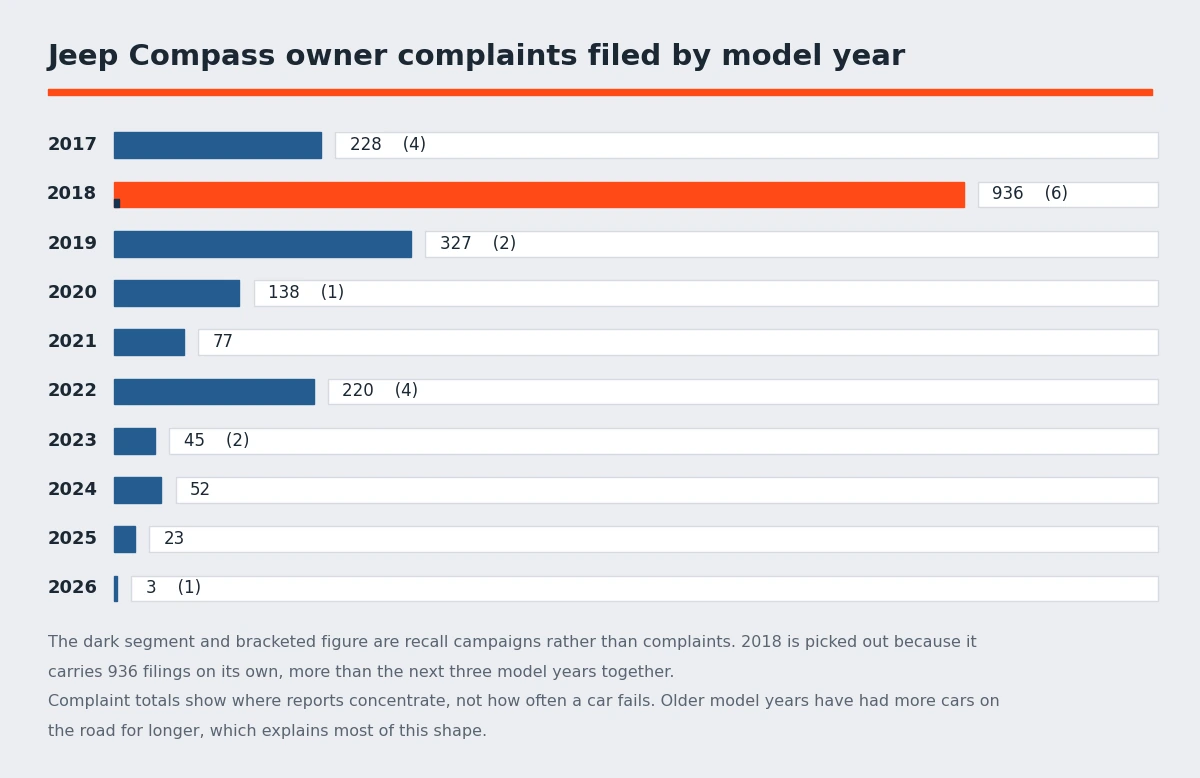
That 2018 figure is not a rounding difference. It is more than the 2019, 2020 and 2021 cars put together, on a car that had only been on sale for a year.
Two categories dominate across the whole run. Engine leads at 849 filings and electrical systems sit almost level at 844, which between them account for four filings in every five.
The recall record follows a similar shape. Fifteen distinct campaigns touch the run, with six of them reaching the 2018 car, and the components named most often are the instrument cluster, a brake caliper and the wiper linkage.
The fall after 2019 is real but partly ordinary. Filings drop as exposure drops, so the 2024 and 2025 numbers say less about those cars than the 2018 number says about that one.
Which used Compass years to start from, and which to walk past
Most people reading a Compass review will look at a used one before they finish. The record above turns into a short list once you stop reading it as a score.
Start with 2023 or later if the budget reaches. That is when the current 2.0-liter turbo and eight-speed arrived, and it is also where filings drop to a handful a year.
Reading a used Compass listing against the record
- Treat a 2018 car as needing more evidence than a cheaper price can offset
- Ask for the instrument cluster campaign to be confirmed complete on 2017 and 2018 cars
- Have the front brakes inspected on a 2018, because a caliper campaign reached that year
- Check the wipers through a full sweep on 2019 and 2020 cars before agreeing a price
- Run the exact vehicle identification number rather than trusting the model year alone
The 2021 car is the quiet one in the middle, at 77 filings. It shares the older powertrain but sits well clear of the launch-year noise.
None of this makes a 2018 Compass unbuyable. It makes it a car to buy with a completed campaign history and an inspection, rather than on price alone.
What it costs to run, and the one job it cannot do
A rated 23 city, 31 highway and 26 combined is what the current Compass returns, on premium-free regular fuel and with four-wheel drive standard. For a small SUV that drives all four wheels, that is a fair result.
The figure is worth more than it looks because there is no front-wheel-drive version to flatter it. A rival quoting better economy is often quoting a two-wheel-drive car.
Warranty is three years or 36,000 miles basic and five years or 60,000 miles on the gas powertrain and roadside assistance, subject to the booklet. Those run from the in-service date, which is the number to confirm on any car that sat on a lot.
Turn 26 mpg and your real mileage into a yearly bill
Then there is the limit nobody advertises. Maximum towing is 2,000 pounds when properly equipped, which is enough for a small utility trailer and not enough for much else.
That single number decides more purchases than the trim walk does. If towing is on your list at all, settle it before anything else in this review matters.
When 2,000 pounds is the thing that rules the Compass out, the Jeep Grand Cherokee is the nearest answer wearing the same badge.
Choose the least costly trim that clears every task
Jeep advertised the 2026 Latitude at $29,550, Latitude Altitude at $31,665, Limited at $33,560, Trailhawk at $34,060, and Limited Altitude at $35,555 when this review was researched. Those displayed MSRPs exclude destination, while a separate current observation showed a $1,995 destination charge.
Do not add that observation to every trim and present the result as a permanent delivered price. Require a written quote that identifies the VIN, trim, options, destination treatment, incentives, dealer charges, taxes, and fees.
The Compass has a coherent reason to exist when a buyer wants compact dimensions and standard four-wheel drive in the same vehicle. Its case weakens when the household needs more seats-up cargo, smoother road manners, stronger mixed-test safety results, or a lower transaction price.
Choose the least costly exact trim that passes the package, road, traction, safety, warranty, and price checks. Trailhawk capability and appearance equipment should never become substitutes for a failed daily task.