Start with the VIN, charger and actual offer
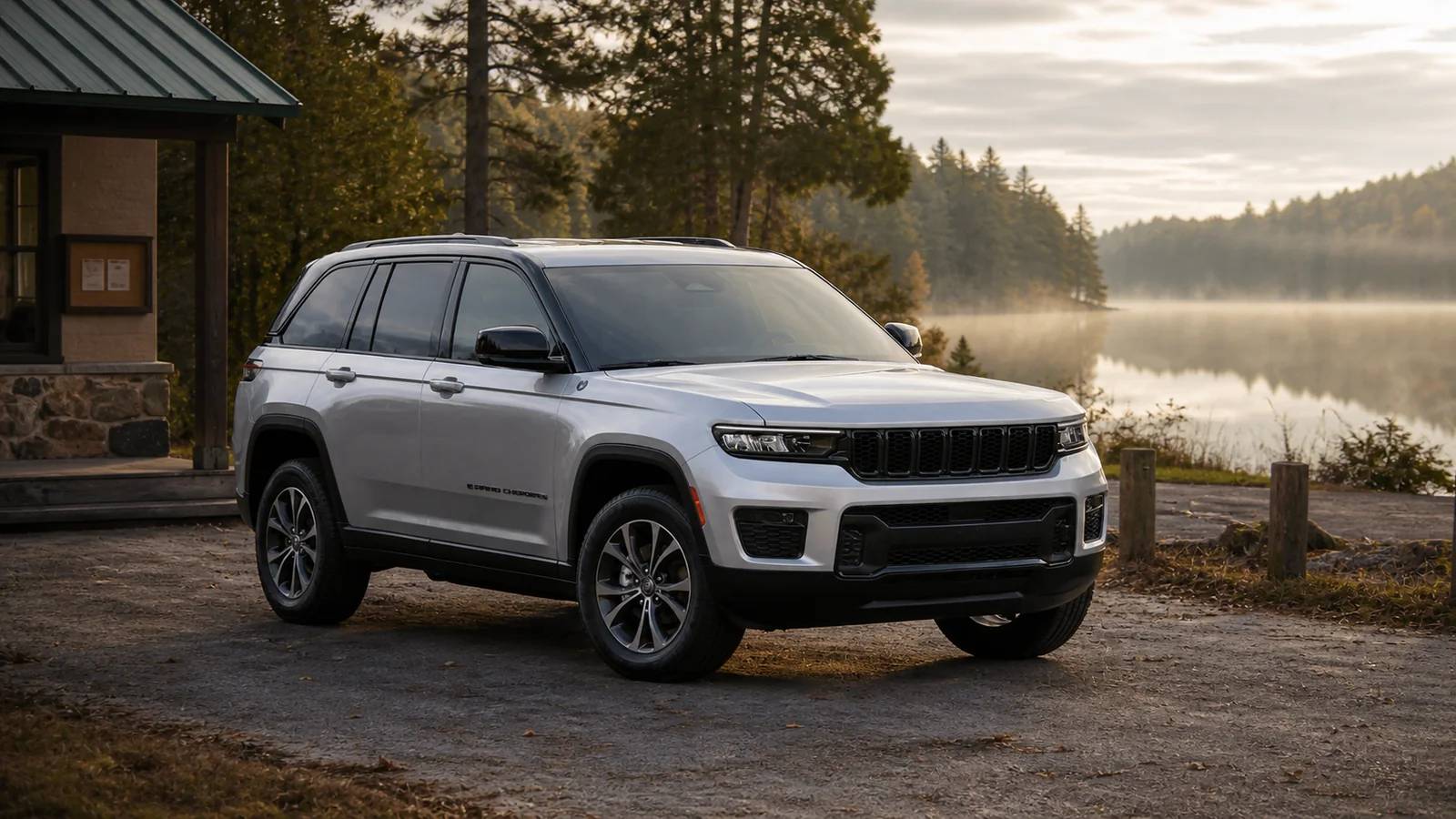
The 2025 Jeep Grand Cherokee 4xe is the final U.S. model year of this plug-in-hybrid Grand Cherokee. Jeep now says the Grand Cherokee 4xe is no longer in production, although limited dealer inventory may remain, so its old window sticker is a historical benchmark rather than today's value.
Begin with the complete VIN and a current NHTSA or Mopar campaign lookup. Relevant records include the 25V741 high-voltage battery campaign, the 25V766 engine campaign, and the 26V328 occupant-restraint-controller update, but only the VIN record establishes what applies to one vehicle.
An open 25V741 record is a hard stop because NHTSA tells affected owners to park outside, away from structures, and not charge until the remedy is completed. A prior repair under an older battery campaign does not replace the newer remedy when the VIN is included again.
For 25V766, ask for the final remedy invoice, not an appointment promise. NHTSA's current record describes a software update and replacement of the block or engine when necessary, while 26V328 calls for an occupant-restraint-controller software update.
Purchase gate before the test drive
- Match the VIN to a 2025 Grand Cherokee 4xe and save a current campaign lookup
- Require completed-repair invoices for every applicable campaign
- Confirm a practical overnight charging location and 240V charging window
- Record the original in-service date and remaining warranty by mileage and time
- Obtain a written out-the-door offer and compare it with discontinued-model alternatives
The charging plan is the second gate. A buyer who cannot charge where the vehicle normally sleeps will use the gasoline engine more often and lose much of the reason to carry the battery and extra drivetrain hardware.
The offer is the third gate. Do not continue when the VIN has an unresolved safety instruction, charging is impractical, or the seller prices the 4xe as though production never ended.
Twenty-six electric miles only work when charging is routine
EPA lists 26 miles of electric range for the exact 2025 Grand Cherokee 4xe 4WD record. That label can cover a school run, local commute, or errands, but it does not promise 26 miles in every temperature, at every speed, or with every accessory load.
List the trips the vehicle repeats for five working days and one typical weekend. Count each place where the Jeep can remain parked long enough to charge, then separate trips that fit inside one charge from trips that will start the gasoline engine.
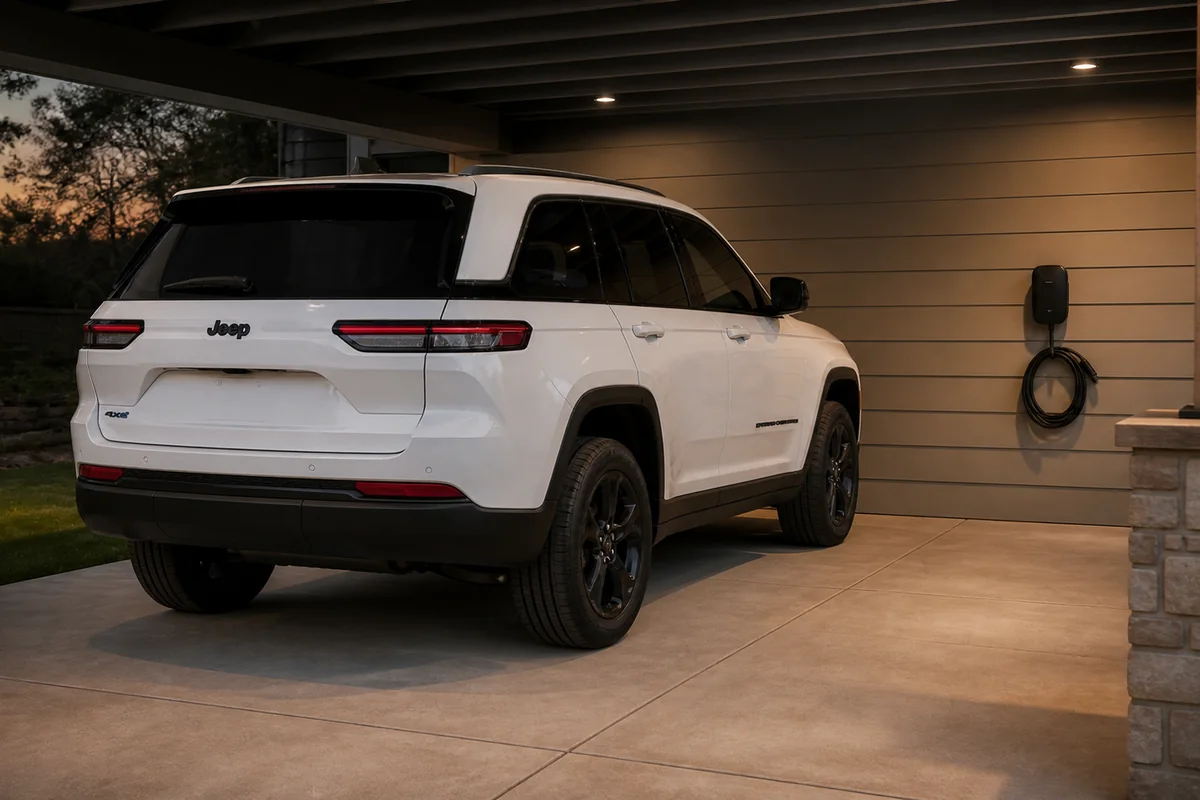
EPA lists 3.4 hours for a full charge at 240 volts under its test assumptions. A normal overnight window is longer than that, but cable reach, circuit capacity, shared parking, utility schedules, and the owner's departure time still determine whether charging actually happens.
Test the electric week
- Map the routeWrite down the miles for work, school, shopping and regular appointments
- Mark charging nightsCount only locations where the vehicle can connect reliably and legally
- Add a bufferAllow for temperature, speed, elevation, cabin heating or cooling and detours
- Count gasoline startsIdentify trips that exceed the usable electric distance or begin without a full charge
- Price both fuelsApply the household electricity rate and local gasoline price to their separate miles
A useful test drive begins with a known state of charge. Drive part of the normal route in electric mode, check whether cabin heating or cooling changes the estimate quickly, and observe when the engine joins without forcing an artificial demonstration.
Public charging may rescue an occasional trip, but a short-range PHEV should not depend on a special public stop every evening. The time and fees can erase the convenience that the electric portion was meant to add.
The 4xe earns its complexity when the buyer can plug in most nights and replace frequent gasoline miles. If most weekly trips begin uncharged or run far beyond the electric label, evaluate it as a 23-mpg SUV instead.
After the battery, this becomes a 23-mpg SUV
EPA gives the 2025 4xe a 56-MPGe combined rating while it uses electricity and gasoline. MPGe expresses energy consumption in a gasoline-equivalent unit.
It is not the gasoline MPG the Jeep returns after the usable battery charge is gone.
The gasoline figures are 23 mpg city, 24 highway, and 23 combined. EPA also lists 470 miles of total range, which makes long travel possible without planning every stop around a charger, but those miles increasingly depend on gasoline.
| Operating state | Official measure | Buyer input | Decision consequence |
|---|---|---|---|
| Charged plug-in use | 56 MPGe combined | Electricity rate, charging losses and electric miles | Strongest case when repeated trips stay within the charge |
| Electric label | 26 miles | Route, weather, speed and accessory load | Planning ceiling, not a guaranteed daily result |
| Gasoline operation | 23/24/23 mpg | Fuel price and miles beyond the charge | Ordinary efficiency for a heavy two-row SUV |
| Long-trip flexibility | 470-mile total range | Fuel stops, charging opportunities and trip length | Convenient, but not proof of low energy cost |
Use a utility bill to find the household price per kilowatt-hour and include charging losses rather than pricing only energy stored in the battery. For gasoline miles, use the local pump price and the 23-mpg combined figure as the starting point unless a repeatable owner log supports something more specific.
Do not add the 56-MPGe and 23-mpg values or compare them as though they share one unit. A household that drives mostly short charged trips can consume little gasoline, while a household that drives long uncharged routes can see little benefit from the plug.
The same distinction matters during a test drive. Ask the seller to show battery state and fuel level before the drive, because a short fully charged demonstration cannot reveal how the engine behaves after the electric portion is depleted.
Judge the 4xe with two energy budgets: one for charged miles and one for gasoline miles. The purchase case weakens quickly when the second budget covers most of the week.
Trim choice changes value, towing and trail hardware
Jeep's archived 2025 material showed a $60,490 starting MSRP for the Grand Cherokee 4xe. Cars.com's contemporaneous list, which included a $1,795 destination fee, placed the base at $62,285 and the Anniversary Edition at $65,280, so price basis must be stated before two numbers are compared.
Trailhawk was $67,980 on that destination-inclusive list and was the 4xe-only off-road branch. It added the terrain hardware that matters to buyers who repeatedly use rough access roads, while Overland at $75,275 and Summit at $76,465 shifted the money toward cabin materials, comfort, and technology.
| Trim | Historical destination-inclusive price | Capability or value change | Buyer test |
|---|---|---|---|
| Base 4xe | $62,285 | Lowest entry to the same 375-hp plug-in system | Compare the actual offer with simpler gas or hybrid SUVs |
| Anniversary Edition | $65,280 | Appearance and convenience package | Pay only for features used every week |
| Trailhawk | $67,980 | Low-range terrain hardware and higher tow ceiling | Reproduce the access road or trail need |
| Overland | $75,275 | More comfort and luxury equipment | Test seats, air suspension and wheel ride |
| Summit | $76,465 | Highest luxury and driver-assistance content | Require a large discount and inspect every fitted system |
These are final-year references, not today's transaction values. A leftover vehicle has aged while sitting, and a used vehicle has an in-service date, mileage, tire age, battery history, financing terms, and condition that change its value.
Trim also changes towing. Base and Anniversary Edition figures were up to 3,500 pounds, while Trailhawk, Overland, and Summit could reach 6,000 pounds when properly equipped, so a lower trim cannot inherit the higher limit.
Start with the least expensive trim that performs the real task. Trailhawk hardware is wasted when the vehicle never leaves maintained roads, while a Summit premium is difficult to defend when the buyer does not value its seats, audio, cameras, or assisted-driving equipment.
The right 4xe is the cheapest exact trim whose hardware solves a repeated problem, bought at a price that acknowledges discontinuation. A familiar badge and a large discount percentage do not prove the final number is good.
Quick acceleration does not erase the extra mass
The plug-in system combines a turbocharged 2.0-liter four-cylinder, two electric motors, a 400-volt battery, and an eight-speed automatic for 375 hp and 470 lb-ft. The torque gives the 4xe an immediate response that the regular V6 Grand Cherokee cannot match.
Car and Driver recorded 5.3 seconds from zero to 60 mph in a current-generation 4xe test. Treat that as a dated, tested-vehicle result rather than a promise for every 2025 trim, tire, load, temperature, and battery state.
Road-test reference points
- Powertrain
- Turbo 2.0L four plus two electric motors
- Combined output
- 375 hp and 470 lb-ft
- Transmission
- 8-speed automatic
- Drive system
- Standard four-wheel drive with low range
- Instrumented context
- 5.3-second 0-to-60 result in a current-generation test vehicle
Start the road test in a parking lot and move through light traffic with the audio off. Check accelerator response, the engine's arrival, transmission shifts, brake-pedal consistency, camera views, and the effort required to place the wide body near curbs.
Then cross a patched road and one sharp expansion joint at normal speed. The battery adds useful electric operation and power, but it also adds mass, so quick acceleration cannot establish whether the suspension controls repeated impacts cleanly.
Brake blending deserves several stops from different speeds. The pedal should remain predictable as regenerative braking and friction braking share the work.
Any warning lamp, inconsistent response, vibration, or pull requires diagnosis before purchase.
Finish with a highway merge and a steady cruise after the usable electric range falls. Listen for engine coarseness, hunting shifts, wind noise, tire noise, and changes in response that a short charged demonstration can hide.
Buy the exact vehicle only when its powertrain transitions, ride, steering, and brakes remain convincing on roads you repeat. The acceleration number is one result, not the road-test verdict.
Trailhawk capability is useful only when the route demands it
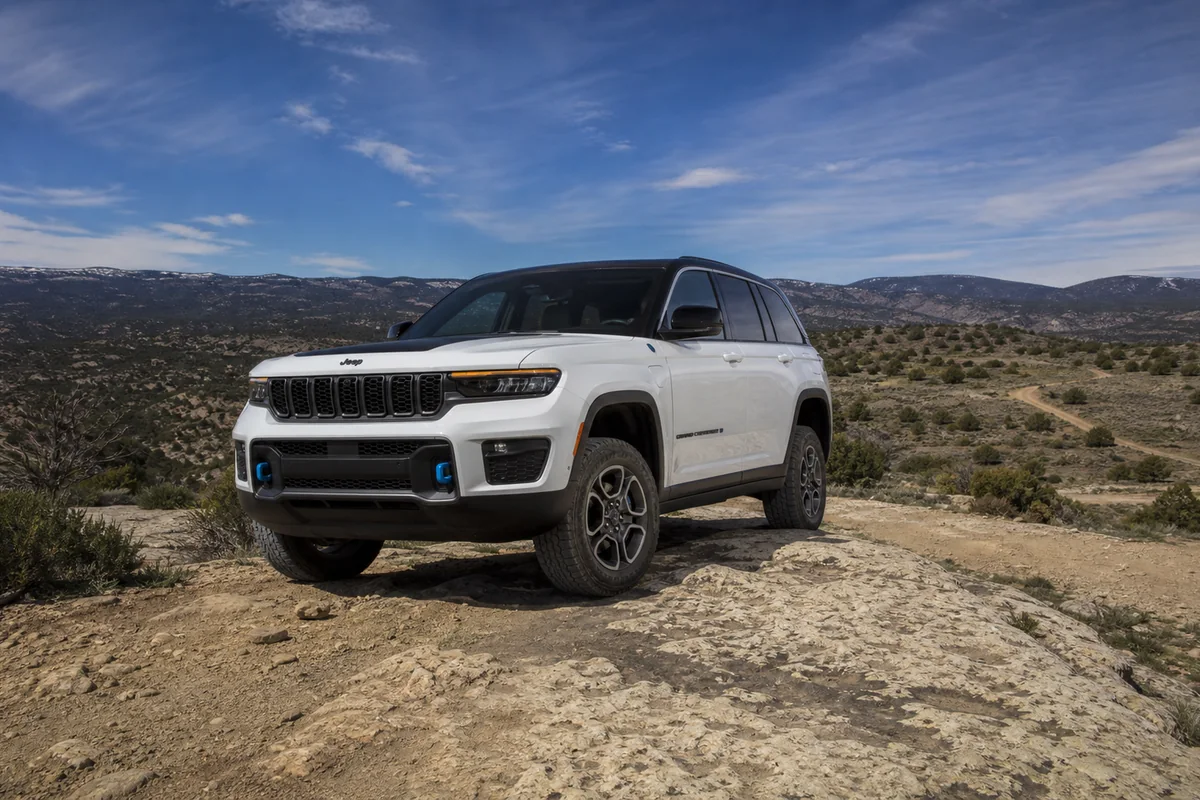
Every 2025 Grand Cherokee 4xe used four-wheel drive, and the system retained a two-speed transfer case rather than offering only a road-biased traction mode. Trailhawk added the equipment that turns that architecture into a more specialized terrain tool.
Jeep quoted up to 10.9 inches of ground clearance and up to 24 inches of water fording under specified conditions. Those are manufacturer capability claims, not permission to enter unknown water or ignore tire, weather, recovery, and trail restrictions.
Match hardware to the task
- Identify the rough road, grade, surface or seasonal condition that requires low range
- Check underbody protection, tires, wheels, recovery points and air-suspension operation
- Reproduce a modest obstacle at low speed without scraping or warning messages
- Match the exact trim to its 3,500-pound or 6,000-pound tow rating
- Read the door-jamb payload label before adding passengers, cargo, hitch and tongue weight
- Confirm trailer brakes, wiring, hitch approval and loaded trailer mass
A safe evaluation uses a modest dry obstacle with a visible bypass. Watch wheel placement, camera usefulness, low-speed throttle control, clearance, suspension movement, and any contact under the vehicle rather than trying to reproduce a marketing maximum.
For towing, loaded trailer mass is only one constraint. Passengers, interior cargo, accessories, hitch hardware, and tongue weight consume payload, while the certification labels and owner's information set limits that a trim brochure cannot replace.
Trailhawk also trades against daily use. All-terrain tires, specialized hardware, wheel choice, ride calibration, and replacement cost still matter during highway travel and commuting, even when the vehicle performs well on a trail.
Choose Trailhawk when a real route needs its hardware, and rely on 6,000 pounds only when the exact build and load math support it. Otherwise a simpler trim or a different tow vehicle is the cleaner choice.
The two-row cabin protects space but not every load
The Grand Cherokee 4xe is a five-seat, two-row SUV rather than the longer three-row Grand Cherokee L. Jeep lists 38.2 inches of rear legroom, but adult comfort also depends on the front-seat position, foot space, cushion shape, roof clearance, and door opening.
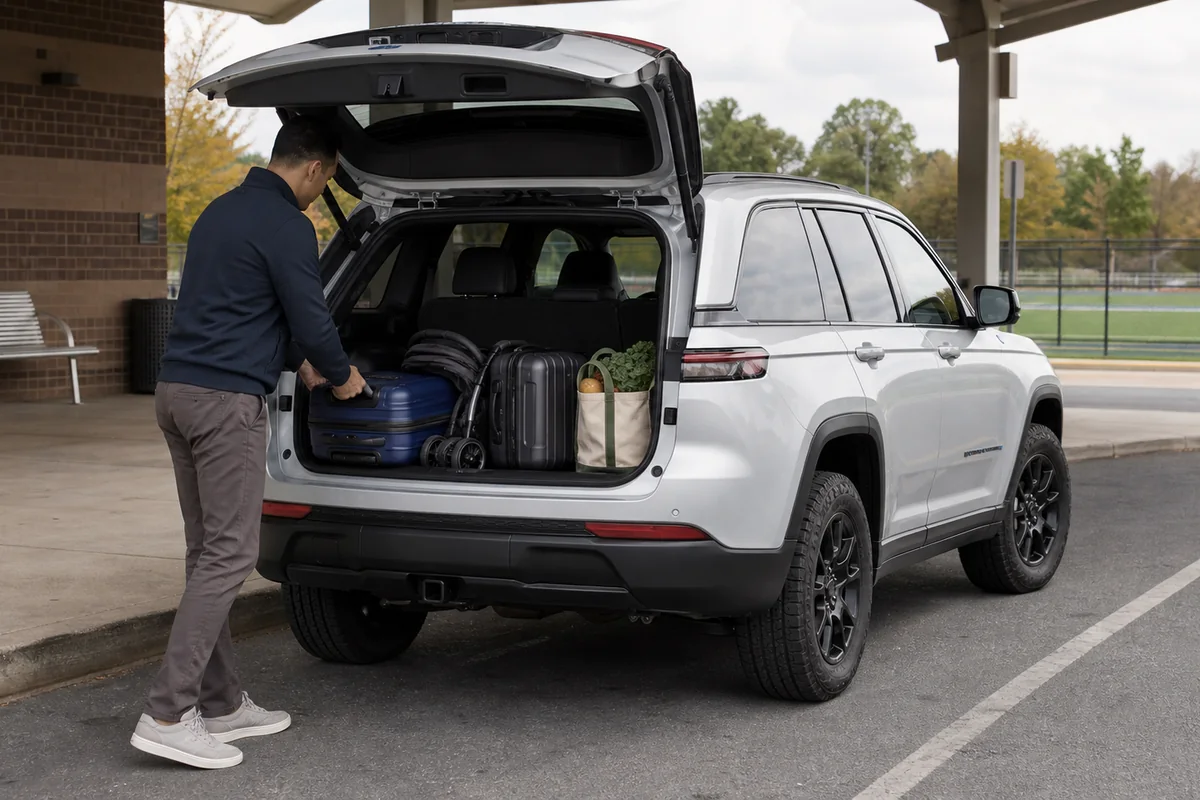
Cargo volume is 37.7 cubic feet behind the upright second row and 70.8 cubic feet with it folded. The smaller number is the daily figure because it preserves all five seating positions.
Set the driver's seat for the normal driver, then have the tallest regular rear passenger enter and buckle in. Check knees, feet, headroom, door access, seatback angle, center-seat width, vents, charging ports, and whether a child restraint changes front-seat space.
Open the hatch with the second row upright and bring the rigid object that creates the hardest monthly load. A folded stroller, two carry-ons, and a grocery tote reveal floor height, hatch shape, width between intrusions, tie-down access, and rear sightline more clearly than maximum volume alone.
Keep heavy objects low and secure, and avoid loading above the seatbacks without suitable restraint. Folding the second row increases volume but removes passenger positions, so test the split-fold arrangement when one rear passenger and one long object need to travel together.
The high-voltage battery does not eliminate the Grand Cherokee's useful two-row cargo area, but a measurement cannot prove that the opening accepts the household's actual items.
Judge practicality with the normal people and cargo in the vehicle at the same time. The maximum 70.8-cubic-foot figure describes an occasional state, not a five-person trip.
A five-star headline still needs the IIHS detail
NHTSA vehicle ID 20166 identifies the 2025 Jeep Grand Cherokee 4xe SUV with four-wheel drive. Its record lists five stars overall, five for the frontal category, five for side, and four for rollover.
Those categories do not erase the separate IIHS results. IIHS lists a Good driver-side small-overlap result that applies to 2022 through 2026 Grand Cherokees, while its updated moderate-overlap test is Poor and applies to 2022 through 2025.
| Authority and test | Result | Applicability | What the buyer should retain |
|---|---|---|---|
| NHTSA overall | 5 stars | Exact 2025 4xe 4WD identity | Strong federal headline, not a substitute for each subtest |
| NHTSA frontal and side | 5 stars each | Exact record | Category results remain separate from rollover |
| NHTSA rollover | 4 stars | Exact record | Do not flatten to the overall score |
| IIHS driver-side small overlap | Good | 2022 through 2026 | Strong result for the tested configuration |
| IIHS updated moderate overlap | Poor | 2022 through 2025 | Rear-passenger head, neck and chest measures weaken the family case |
| IIHS updated side | Good | 2023 through 2026 vehicles built after March 2023 | Build-date applicability matters |
| IIHS headlights | Good or Acceptable | Varies by 2023 through 2025 trim equipment | Confirm the exact lamps |
The Poor updated moderate-overlap result matters because IIHS reported rear-passenger injury concerns rather than a cosmetic scoring difference. A family carrying adults or children in back should keep that limitation visible beside the five-star headline.
IIHS also varies headlight results by trim and equipment, so a Summit or Trailhawk cannot borrow the result of a different lamp. Verify the exact build and applicability notes instead of using a model-wide adjective.
Driver-assistance features answer another question. Automatic braking, blind-spot monitoring, adaptive cruise control, and lane support may help avoid or manage some situations, but their presence does not change the crash-test result.
The honest safety conclusion contains both facts: NHTSA lists a five-star overall result, and IIHS found a Poor updated moderate-overlap result. A buyer should not discard either one.
Warranty helps, but completed remedies matter first
The 2025 Jeep warranty manual gives the vehicle a 3-year or 36,000-mile Basic Limited Warranty from its original in-service date. The exact booklet and VIN record determine the remaining basic and powertrain coverage on a leftover or used example.
For the high-voltage battery, the manual lists 8 years or 100,000 miles in non-TZEV states. Eligible vehicles certified, sold, and registered under the listed TZEV rules can receive 10 years or 150,000 miles, so state and vehicle certification must be verified rather than assumed.
The battery warranty also excludes gradual capacity loss. Coverage for a failed covered component therefore does not promise that the battery will retain its original electric range throughout the term.
Warranty and recall remedies answer different questions. A warranty limits the cost of specified failures during a term, while a completed campaign addresses one defined safety defect.
Neither establishes a model-year failure rate or proves that an individual vehicle has been maintained well.
Ask for service records, charging history when available, tire age and wear, underbody condition, diagnostic scan results, warning-light history, and documentation for any engine or battery replacement. Match every invoice to the VIN and verify that software campaigns show completed status in the current system.
Ownership cost still needs the transaction price, financing, electricity, gasoline, insurance, registration, tires, maintenance, repairs, annual mileage, and expected resale. The available evidence does not support a universal five-year total.
Remaining warranty is useful, but completed remedies and a clean exact vehicle come first. Walk away when the seller cannot document either one.
Buy only when charging, remedies and price all pass
The 2025 Grand Cherokee 4xe fits a buyer whose repeat trips stay near the 26-mile electric label, whose parking supports dependable overnight charging, and who values standard four-wheel drive or trim-specific trail and towing hardware.
It also requires tolerance for complexity. The buyer must accept 23-mpg combined gasoline operation on longer uncharged drives, verify current safety remedies, and price the vehicle as a discontinued model rather than an active new-car program.
Before signing, repeat the full drive with a known battery state, load the cargo area, seat the regular passengers, inspect the underbody and tires, and save the VIN lookup, invoices, warranty start date, window sticker, and written out-the-door price.
Do not let an advertised discount replace comparison shopping. Compare the actual transaction with simpler gasoline, conventional-hybrid, and current plug-in alternatives that meet the same passenger, cargo, terrain, and towing tasks.
Buy only when charging, completed remedies, physical fit, and the final price all pass together. One failed gate is enough reason to choose a different vehicle.