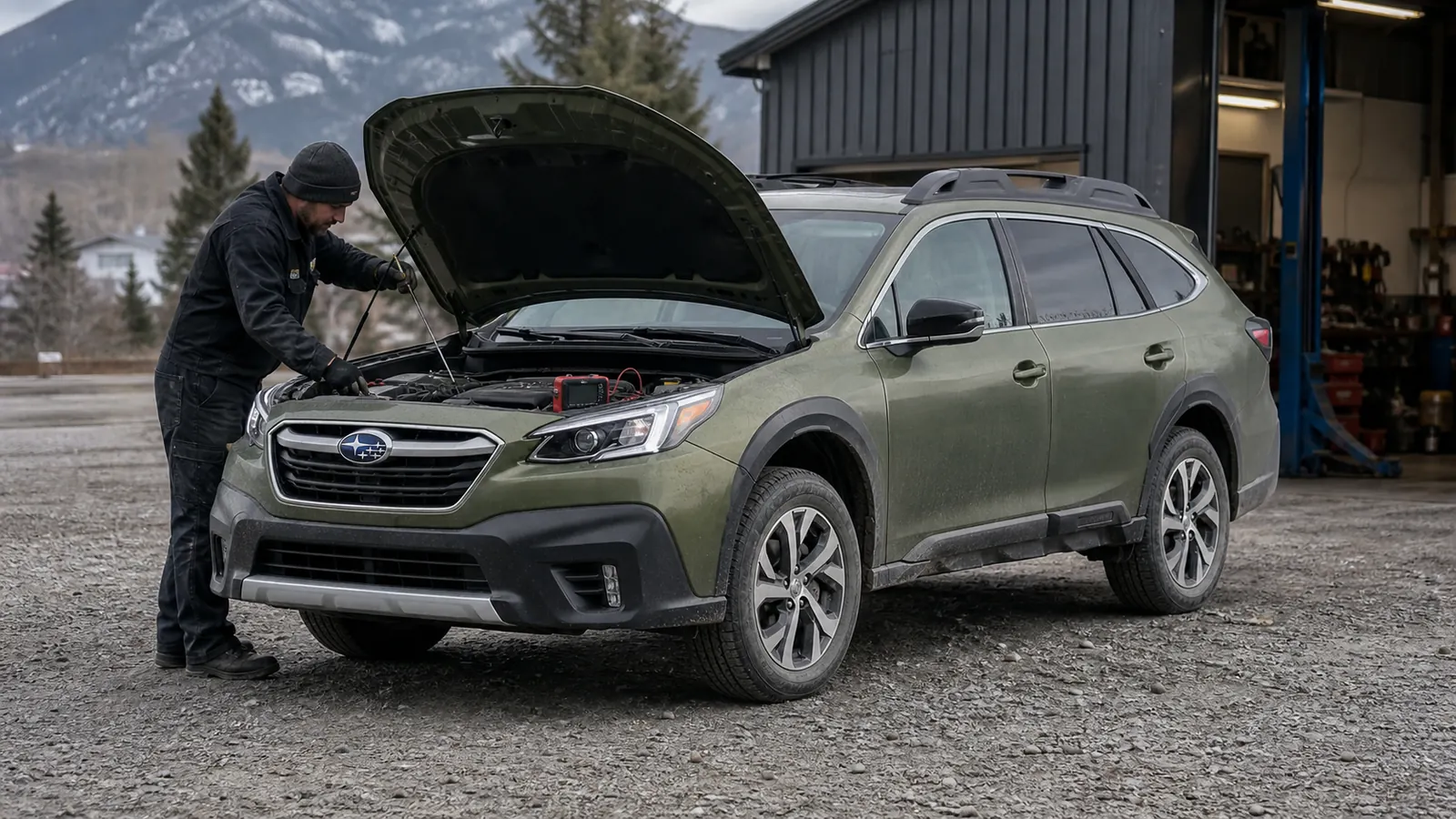
The risk changes with the generation, not the badge
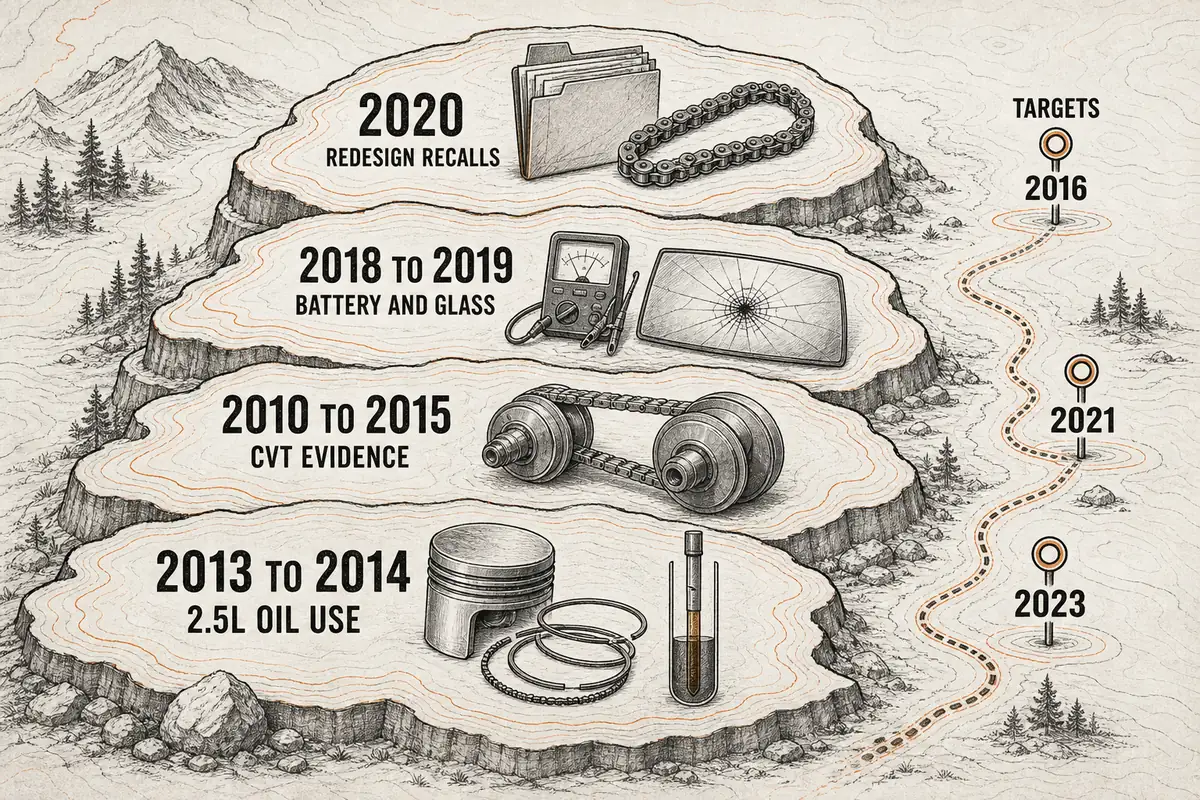
A used Outback can be a durable all-weather car, but one answer does not fit every generation. The 2013 and 2014 warning centers on the 2.5-liter FB engine and its oil-control rings.
Cars from the later fifth generation move the concern toward battery drain and cracked-glass reports.
The 2020 redesign adds its own first-year recall list.
The counts below came from the NHTSA complaint API for the Outback and the matching recall API on July 12, 2026. A report count is not a failure rate because NHTSA does not divide complaints by the number of vehicles still on the road.
It is useful for finding where owners repeatedly describe the same system.
| Year | NHTSA complaints | NHTSA recalls | Main evidence | Starting verdict |
|---|---|---|---|---|
| 2013 | 295 | 12 | Oil use, engine and powertrain reports | Avoid without engine proof |
| 2014 | 208 | 10 | Oil use plus older-generation recall load | Avoid without engine proof |
| 2018 | 803 | 3 | Visibility and electrical reports | Inspect carefully |
| 2019 | 1,029 | 3 | Electrical, visibility, fuel-pump recalls | Inspect carefully |
| 2020 | 890 | 6 | Visibility, electrical and transmission-chain recalls | Avoid if history is incomplete |
The numbers point you toward the inspection.
They do not condemn every example.
Use the year to choose the test, then let the VIN and physical evidence decide the individual car.
The 2013 and 2014 2.5-liter engine is the hard warning
Excessive oil consumption is the most expensive well-documented concern in this group. Subaru bulletin 02-143-13R says some 2013 Legacy and Outback 2.5-liter engines received revised oil-control piston rings after findings of unanticipated ring wear.
Subaru later published bulletin 02-157-14R for 2013 and 2014 Legacy and Outback models, with a controlled oil-consumption test and short-block replacement procedure when a car failed the standard.
CarComplaints lists 24 owner reports for the specific 2013 excessive-oil-use complaint, with an average reported repair cost of $1,590 and average mileage near 59,350 miles.
Its 2014 page records fewer reports, but the same engine family and service procedure apply.
Those submissions are a case series, not a prediction for every car.
The former extended coverage has expired for these model years, so the paperwork now matters more than the old warranty language.
A replacement short block can make one of these cars viable, but only when the VIN, date, mileage, and shop invoice agree.
A vague claim that the dealer fixed it years ago is not enough.
Separate oil burning from an external leak before assigning a repair. Inspect the cam-carrier seams, timing cover, oil pan, drain plug, filter area, and the lower splash shield for wet oil.
Blue smoke after a long downhill coast or after idling points toward oil entering the combustion chamber, while fresh oil on the undertray may point toward a seal or service leak.
Both cost money, but they lead to different repairs.
Spark-plug condition and scan data add another layer. Oil-fouled plugs, misfire history, a damaged catalytic converter, or a low-oil event make a seller's top-off explanation less reassuring.
A compression or leak-down test can help when the engine runs poorly, though Subaru's controlled consumption test remains the more direct evidence for how quickly the engine uses oil over distance.
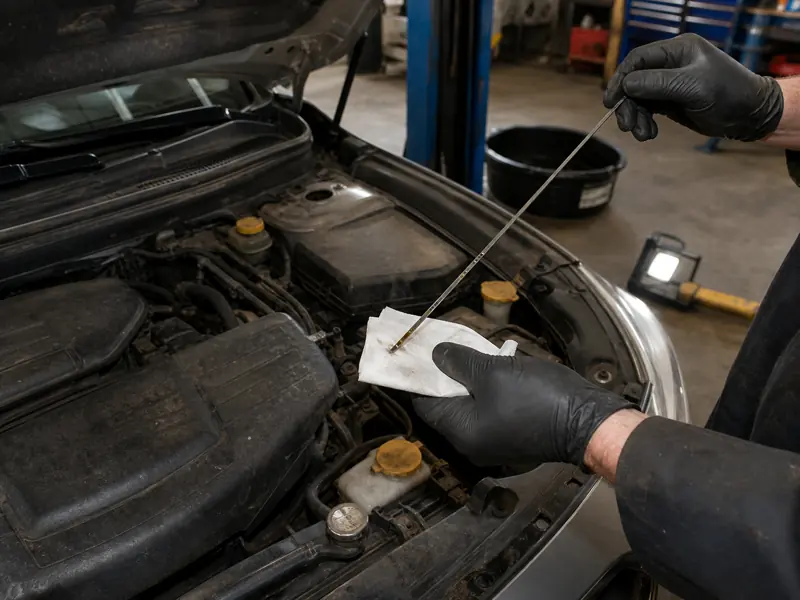
A clean dipstick reading at one visit cannot prove low consumption over thousands of miles. Ask how much oil the owner adds between changes and compare that answer with dated receipts.
Walk away when the low-oil light history, top-off record, or exhaust smoke contradicts the seller's story.
The 2010 through 2015 CVT needs its own evidence
Oil use is only half of the 2013 and 2014 decision. Subaru bulletin 16-107-17 extended CVT warranty coverage for 2010 through 2015 Legacy and Outback models.
An extension does not prove every transmission is defective, but it gives you a precise reason to test engagement, low-speed behavior, and service history.
- 2010Fourth-generation Outback introduces the Lineartronic CVT on the 2.5-liter car
- 2010-2015Subaru later extends CVT powertrain coverage under bulletin 16-107-17
- 2013-2014Oil-consumption inspection overlaps with the CVT check on 2.5-liter cars
- 2015New generation arrives, while the listed CVT extension still includes this model year
Start the road test cold. Shift from Park to Reverse and Drive, then use light throttle through neighborhood speeds.
Shudder, delayed engagement, a rising engine speed without matching acceleration, warning lights, or fluid seepage deserves a specialist diagnosis before purchase.
A seller may call every sound normal CVT behavior.
That is too broad. A CVT can hold engine speed during acceleration without being faulty, but it should still engage cleanly and deliver smooth, consistent drive.
Compare the car with the broader gas powertrain field only after its own transmission behavior is clear.
Ask whether the CVT fluid was serviced, where the work was done, and which fluid was used. A generic quick-lube receipt carries less weight than a Subaru or specialist invoice that identifies the transmission and fluid specification.
Check the scan for stored or pending transmission codes even when the dashboard is clear, then repeat low-speed turns after the unit is warm.
The 3.6-liter six-cylinder cars do not share every engine concern with the 2.5-liter cars, but their transmission and recall histories still need VIN-level review.
Confirm the engine and transmission fitted to the listing before applying a checklist, because a trim badge or seller description can be wrong.
Do not use the Outback's reputation to explain away a repeatable shudder or delay.
Battery and glass evidence decide a 2018 or 2019
The later fifth-generation cars shift the inspection away from piston rings. NHTSA recorded 803 complaints for 2018 and 1,029 for 2019 in the July 2026 API snapshot.
Visibility and electrical systems form the largest groups for both years. CarComplaints separately lists 56 owner reports for the 2018 dead-battery issue and 26 combined reports across two cracked-windshield categories.
The Subaru battery settlement covered 2015 through 2020 Outback models, along with several other Subaru lines.
That coverage range is evidence that battery history belongs in the inspection.
It does not mean every covered vehicle suffered a drain.
Ask how many batteries the car has used, whether the charging system and parasitic draw were tested, and whether any telematics or control-module work was performed.
A large new battery can hide a drain for a few weeks.
It does not identify the cause.
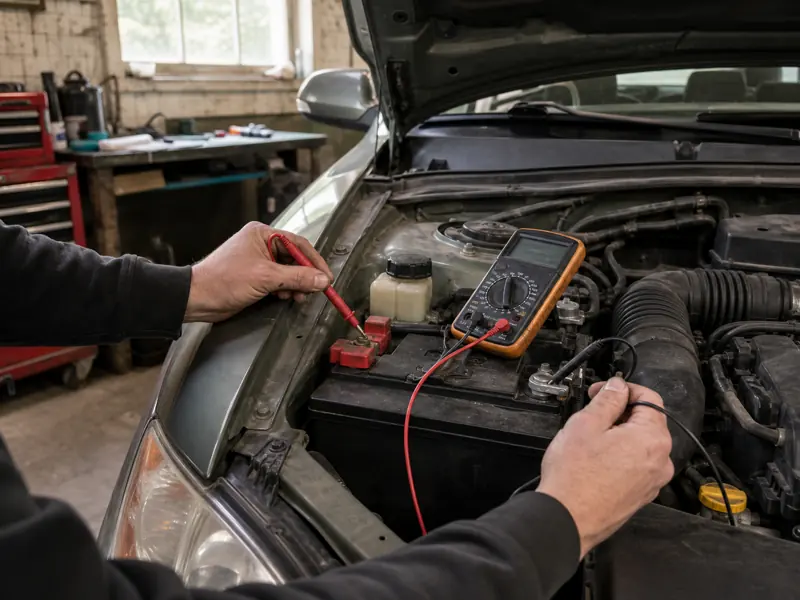
A proper draw test begins only after the car's computers have gone to sleep. Opening a door, waking the keyless-entry system, or checking too soon can make normal module activity look like a fault.
The technician should record the stabilized draw and isolate the circuit when it stays excessive, rather than replacing another battery without a diagnosis.
Review how the car was used. Repeated short trips can leave any battery undercharged, while a car that dies after several parked days points toward a different pattern.
Ask whether the rear hatch was left open, whether accessories were hardwired, and whether the telematics unit, audio system, or charging software received service.
Remove aftermarket dash cameras or trackers from the equation during testing.
Inspect every windshield edge in clean daylight. Look for repaired chips, long cracks, poor molding fit, wind noise, water marks, and camera calibration paperwork after replacement.
EyeSight-equipped cars need correct glass installation and calibration.
A battery receipt or glass invoice is useful only when it names what was diagnosed and what was corrected.
The 2020 redesign needs six recall checks
The 2020 Outback started a new generation, and NHTSA lists six recalls for that model year in the July 2026 snapshot.
They include rearview-display software, transmission control programming that could allow drive-chain slip, a low-pressure fuel pump, a brake-pedal bracket, and a passenger occupant-detection sensor.
Some transmission campaigns overlap because Subaru issued more than one campaign as the remedy developed.
This year deserves more caution than a simple complaint total shows. A used 2020 can drive well after its campaigns are complete, but an open recall or missing repair record removes the reason to accept first-year complexity.
Run the 17-character VIN through NHTSA's recall lookup and ask a Subaru dealer to print the completed campaign history.
Check the center display, backup camera, Bluetooth connection, climate controls, and steering-wheel switches during one uninterrupted drive.
Cycle the car off and back on after the test. Confirm smooth acceleration from a stop and scan every module, not only the engine computer.
2020 proof to collect
- VIN campaign printout
- All applicable recalls completed
- Transmission behavior
- No chain-slip code, flare, judder, or delayed drive
- Display operation
- Camera and controls start correctly more than once
- Passenger safety
- Occupant-detection campaign checked by VIN
A completed recall can be a positive because the remedy is documented and free. Skip a 2020 when the seller refuses a VIN check, a full scan, or a cold test drive.
Better Outback years still need a reasoned choice
The strongest used targets are 2016, 2021, and 2023, with different tradeoffs. A 2016 sits after the oil-control-ring years and before the 2018 and 2019 report peaks, though it remains inside the battery-settlement range.
A 2021 gives you the newer platform after its launch year, but its VIN still needs transmission-chain and passenger-airbag campaign checks.
A 2023 has fewer accumulated NHTSA complaints and only two listed recalls in the snapshot, though it costs more and has had less time to reveal age-related faults.
Choose 2016 when purchase price matters and a battery draw test is clean. Choose 2021 when you want the newer cabin and can prove every campaign is closed.
Choose 2023 when the higher price buys a younger car with a simpler documented history.
None is exempt from collision, flood, tire, or maintenance checks.
Mileage changes the choice inside each target year. A high-mile 2016 with complete differential, brake, coolant, and CVT records can be easier to price than a low-mile car with gaps.
A 2021 that spent years on short trips may need more battery scrutiny than its odometer suggests.
A 2023 still needs evidence of oil changes, tire rotations, recall completion, and body repair.
Do not call a year better only because fewer complaints have accumulated. Newer cars have had less time to age and fewer miles in service.
The recommendation reflects the available report pattern, known campaigns, and distance from the clearest engine-risk years.
It cannot guarantee how a recent model will behave at 150,000 miles.
The Subaru model range explains why standard all-wheel drive drives demand in snow states. The wagon body layout and five-seat field help you decide whether that packaging is worth paying for before you narrow the model year.
A safer year with poor records is still a worse buy than a fully documented car that passes the correct tests.
Make the inspection match the Outback's all-wheel-drive hardware
Four matching tires matter on every Outback. Measure tread depth at several points and compare all four sidewalls for brand, model, size, load rating, and date code.
A new pair on one axle and worn tires on the other can signal deferred maintenance and may stress the all-wheel-drive system.
Use the all-wheel-drive comparison to understand what the hardware helps with, then inspect the parts that pay for that capability.
Look for torn axle boots, leaks at the differentials, wheel-bearing noise, underbody impact, and rust around suspension mounting points.
Snow-country usefulness often comes with road-salt exposure.
Raise the car and inspect the front and rear subframes, control-arm mounting points, exhaust flanges, brake lines, and heat shields.
Surface discoloration is different from scaling metal, swollen seams, or weakened mounting points. Photograph serious corrosion so the shop can explain whether it is cosmetic, repairable, or structural.
During the road test, use smooth pavement first so tire noise does not hide a bearing hum.
Then include a rough section to expose worn bushings, loose heat shields, and strut noise. Make several tight parking-lot turns without full-throttle loading and confirm there is no binding or hopping.
Use a tire-pressure check before judging pull or steering feel, because one low tire can imitate an alignment problem.
Follow a fixed order:
- Check oil level, coolant, and the ground beneath the car before startup
- Measure battery resting voltage and test charging output after startup
- Drive from cold through parking-lot turns, steady cruising, and moderate acceleration
- Listen for wheel-bearing hum that changes when the car is gently loaded left or right
- Scan engine, transmission, ABS, airbag, EyeSight, and body-control modules
- Verify four matching tires and compare tread depth across the set
- Inspect windshield replacement marks, water entry, and camera calibration records
A pre-purchase inspection should record findings in writing. The new versus used checklist helps organize title and payment checks, while a shop handles oil consumption, parasitic draw, chassis, and scan data.
Pay for diagnosis before you inherit a repair pattern that the seller already knows.
Read complaints as leads, then verify the individual VIN
NHTSA complaints are owner submissions. One report may name several components, and the database can grow as owners file new information.
Recall counts also need context because one vehicle may qualify for only some campaigns based on build date, equipment, or prior repair.
The evidence used here comes from NHTSA complaint and recall API results, Subaru service bulletins filed with NHTSA, the court-supervised battery settlement site, CarComplaints owner-report categories, and RepairPal's Outback data.
RepairPal rates the Outback 3.5 out of 5 and reports an average annual repair cost of $607 across model years.
Those fleet-level figures describe the nameplate, while the service bulletins and year counts tell you where to look on a specific car.
For recall work, the VIN result outranks a generic year list. For oil use, a controlled test and dated records outrank a clean engine bay.
For battery drain, a measured draw and repair order outrank a recent battery sticker. The ownership research archive can help you keep those evidence types separate as more model-specific checks are published.
The final Outback buying filter
A 2013 or 2014 needs documented engine evidence before it deserves a road test. A 2018 or 2019 needs battery, glass, and electrical proof before you accept its mileage.
A 2020 needs a closed recall history and a clean transmission scan before you accept the newer cabin.