The worst year is not one fault
Ranked by volume the record has two peaks, and they are almost the same height.
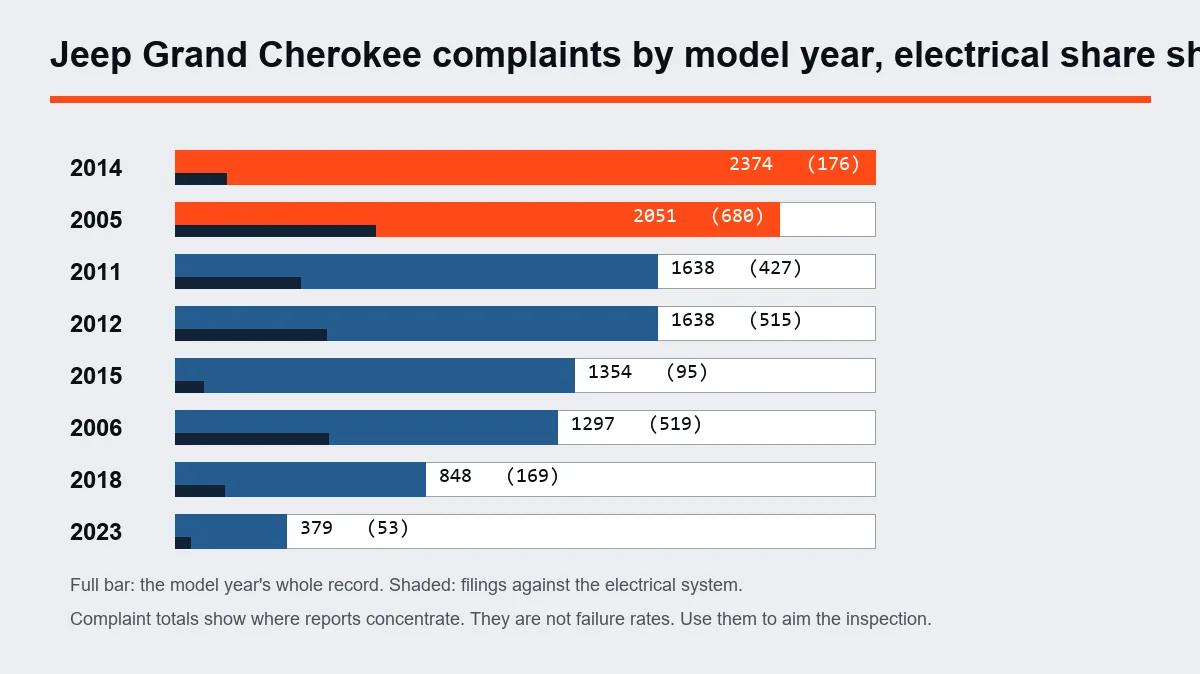
The 2014 car holds 2,374 filings and the 2005 car 2,051. The 2011 and 2012 cars follow at 1,638 each.
Now look at the shading. Electrical accounts for 680 of the 2005 record and only 176 of the 2014 one.
So the two peaks are not the same problem at different times. They are different problems that happen to produce similar totals.
The gap between them matters as much. The 2016 car falls to 308 filings, which is a different vehicle in every practical sense.
A smaller Jeep carries the bigger record
Search for problem years on a Jeep and the two nameplates blur together. The database does not blur them at all.
For 2014 the Grand Cherokee holds 2,374 filings. The Jeep Cherokee of the same year holds 2,641, which is more.
Two Jeeps, one model year, nothing in common
2014 Grand Cherokee
2,374 filings, led by rollaway, head restraints and electrical faults from three unrelated campaigns
2014 Cherokee
2,641 filings, led by power train at 1,464, which is a gearbox story the Grand Cherokee never had
Shared filings
None. Compare the two sets by report number for 2014, 2019 or 2022 and not one appears in both
2019 onward
The Grand Cherokee falls to 362 filings while the Cherokee holds 1,617, more than four times as many
Read the Cherokee power train reports and the theme is consistent. Of those 1,464 filings, 890 name the transmission and 336 describe the vehicle jerking, lurching, bucking or hesitating.
The two nameplates fail in different places, in different decades, for different reasons. Nothing learned about one transfers to the other.
That matters while searching rather than while buying. A ranking that says Jeep Cherokee without the word Grand is describing a gearbox problem, not the vehicle on this page.
Before the electrical era there was a brakes era
The oldest cars in this record are larger than either peak above, and no year list covers them because the vehicles are now old enough to have mostly left the road.
The 1999 car holds 2,113 filings and the 2000 car 1,885. Service brakes lead both, at 591 and 435.
Read the 1999 brake filings and one description dominates. 294 of the 591 describe rotors warping, or a pedal and steering wheel that pulsate under braking.
What follows is repetition rather than repair. Two hundred and thirty eight of them record rotors being replaced, resurfaced or worn out early, several owners more than once.
Then the leading category changes without the totals falling much. Air bags lead the 2002 car at 445 filings and the 2004 car at 278.
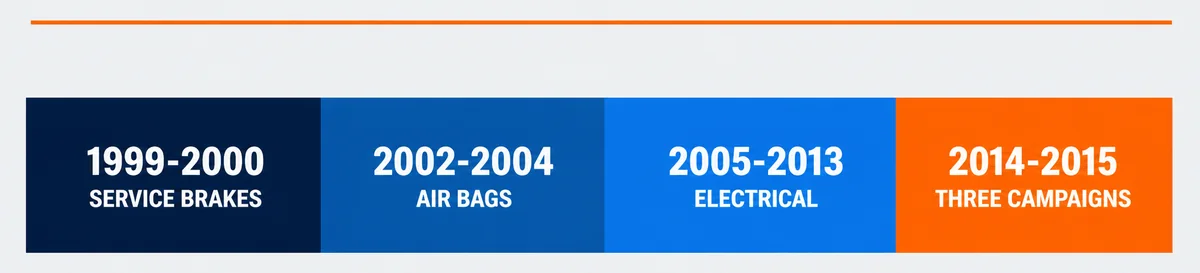
So this nameplate has had four distinct leading categories across its life: brakes, air bags, electrical, and then the 2014 cluster. None of them predicts the next.
For a buyer today the practical value of that history is small. A car of that age is judged on corrosion and service records, not on which fault its model year is famous for.
Electrical leads nine consecutive model years
The era most people mean when they warn about this car runs from 2005 to 2013.
Electrical is the leading category in every one of those nine model years without a break. It peaks early and stays high.
What owners describe is a vehicle behaving unpredictably rather than failing outright, with stalling, no-starts and accessories operating on their own.
One campaign from the period is worth naming because its interim advice is unusual. Campaign 14V438 covers an ignition switch that can move out of the run position, and owners were told to keep the key clear of their knee and remove everything else from the keyring.
That advice tells you the nature of the era. On these cars the electrical system is the vehicle's defining characteristic, so any car from that span is an electrical inspection before it is anything else.
Three recalls landed on the 2014 car at once
The second peak is where the record stops behaving like a normal year list.
Of the 2014 car's 2,374 filings, 358 mention rolling, park, the shifter or the gear selector. Ninety-one of them describe the car moving while the driver believed it was in park.
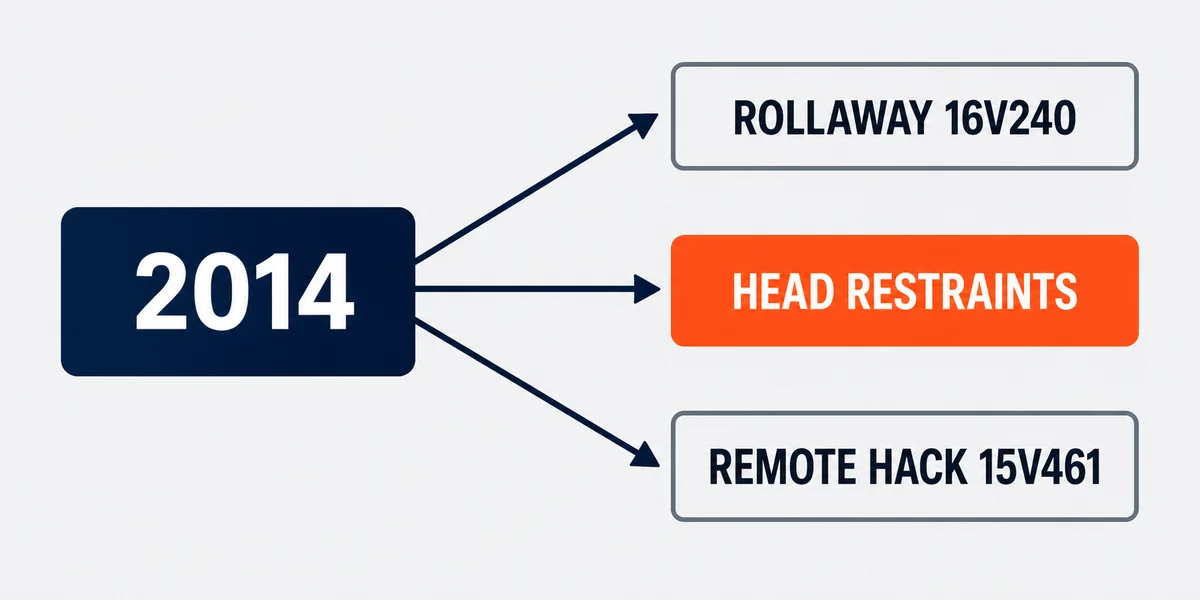
Campaign 16V240 covers it. Jeep states that drivers who believe the vehicle is in park may be struck by it, which is a risk to whoever is standing beside the car rather than sitting in it.
Owners were writing about the campaign itself, not only the behaviour. Thirty-six of the 2014 filings name 16V240 by number and 46 of the 2015 ones do.
The campaign is not confined to this nameplate. It also reaches 2012 to 2014 Dodge Charger and Chrysler 300 models, which is the signature of a shared gear selector.
The second campaign has nothing to do with the first. Campaign 15V461 covers a software vulnerability that allowed unauthorised remote modification and control of the vehicle.
Its model list is larger still. The same entry reaches Ram pickups, the Chrysler 200 and 300, the Dodge Charger, Challenger and Durango, and the Cherokee.
- 16V240gear selector, drivers struck by their own vehicle
- 15V461infotainment software, remote control of vehicle systems
- Head restraints271 of the 2014 car's 284 seat filings, with no campaign at the time
Nothing about that list is a Grand Cherokee design story on its own. Two of the three are parts shared across the group, and the third had no campaign behind it for a decade.
The 2015 car repeats the pattern. It holds 311 such filings out of 1,354, a higher proportion than 2014 even though the total is lower.
Then it stops. The 2016 car holds 61 park or rolling filings out of 308, and its whole seats category falls to eight.
Eight seat filings against 284 two years earlier is the sharpest boundary in this record. Whatever changed for 2016 changed all three of these at once.
The head restraints fire without a crash
The third problem on those cars is filed under a category name that hides it completely.
The seats category holds 284 filings on the 2014 car. Read them and 271 of those 284 name the head restraint.
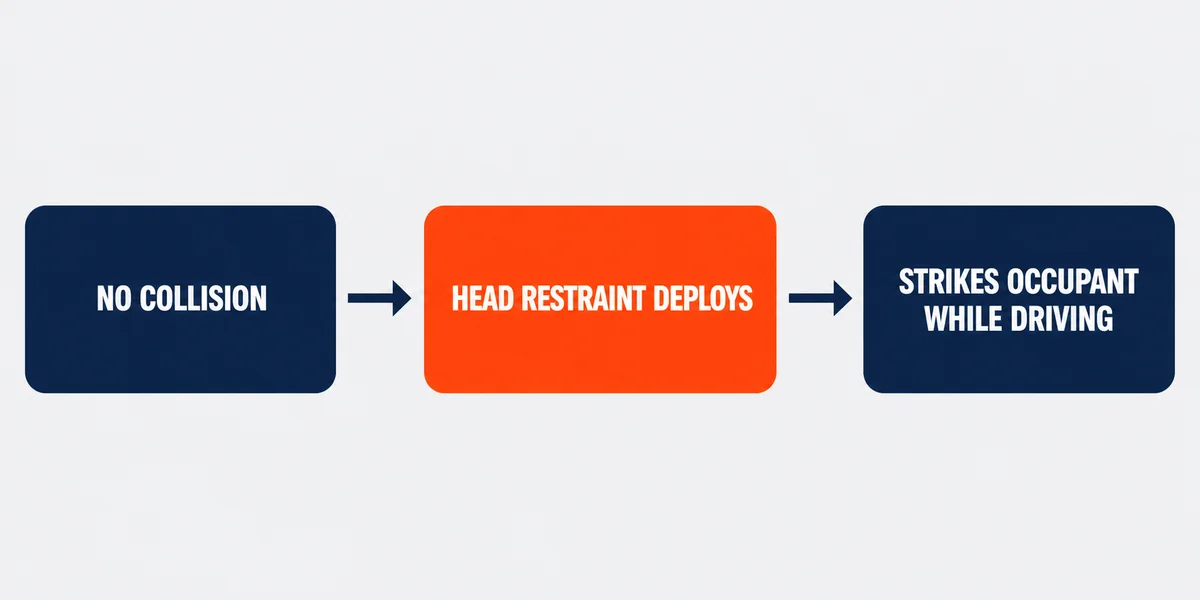
What owners describe is the active head restraint deploying with no impact at all. One filing has the front passenger restraint firing while the vehicle was moving at 40 mph.
| Model year | Seat filings | Naming the head restraint |
|---|---|---|
| 2014 | 284 | 271 |
| 2015 | 254 | 252 |
A ranking that reads category labels rather than filings will report this as a seat problem, which tells a buyer nothing useful. The specific question is whether the restraints have been replaced.
Then it comes back. Campaign 25V472 covers head restraints again on 2023 and 2024 Grand Cherokee models, a decade after the filings above.
The newest cars are quieter but not finished
The recent years look like a different vehicle on volume, and mostly they are.
The 2020 car holds 231 filings and the 2024 car 239. The 2021 car is the busiest of the recent run at 401.
Electrical still leads the 2022 to 2024 records, but at counts in the fifties rather than the hundreds.
One recent year does not fit that pattern. The 2018 car holds 848 filings with 338 of them electrical, which is closer to the old era than to the years either side of it.
Owners of that year describe warnings that the vehicle is about to shut down, with batteries and alternators replaced without the fault clearing. It is the one modern year worth treating as part of the electrical story.
Repeated parts replacement is a running-cost problem as much as a safety one. Weigh a cheap 2018 car against what the Jeep Grand Cherokee reliability record says it costs to keep, because the filings describe owners paying twice without fixing anything.
What still reaches a recent car
- 2021
- 401 filings, the busiest recent year, with exterior lighting and steering near the top
- 2022 to 2024
- Electrical still leading, at roughly a tenth of the old era's counts
- 2023 and 2024
- Campaign 25V472 for head restraints, the same component as a decade earlier
- 2025
- 66 filings so far, on a car with very little time on the road
So a low total is not the same as a finished vehicle here, and the component that defined the worst year is on the newest campaign list.
The plug-in hybrid is a third vehicle under the badge
From 2022 the name splits once more. This time the split is mechanical, not a matter of body length.
The Grand Cherokee 4xe is filed separately throughout. It holds 96 filings for 2023 and 23 for 2024, against 379 and 239 on the petrol car.
Those totals are small because sales were. What sits behind them is not small at all.
Ask for that by number. A service record showing 24V720 closed is a record of the superseded repair, not the current one.
The engine campaign is newer still. Campaign 25V766 covers 2023 to 2025 cars where debris inside the engine may cause engine failure, a loss of drive power or an engine compartment fire.
Its remedy is not a software patch. Dealers install an update and replace the block or engine as necessary, which tells you what was found.
Neither campaign stops at this nameplate. Both name the Jeep Wrangler 4xe as well, the usual sign of a shared component rather than a fault belonging to one vehicle.
A low complaint total on the 4xe reflects how few were sold, not how little went wrong. Read its campaign list instead of its filing count.
Which Grand Cherokee to look for
The useful window is a genuine gap rather than a quiet patch, because the campaigns on either side of it do not reach those years.
The 2016 car holds 308 filings and the 2017 car 364. The electrical era has ended and the rollaway campaign covers 2014 and 2015 only.
The head restraint campaign does not reach them either, since it covers 2023 and 2024. That leaves a Jeep Grand Cherokee from those two years outside every cluster named on this page.
The lesson from the 2014 car is that one model year can carry several unrelated safety campaigns at once. Check the year rather than the nameplate, and check every campaign that reaches it rather than the one you read about.