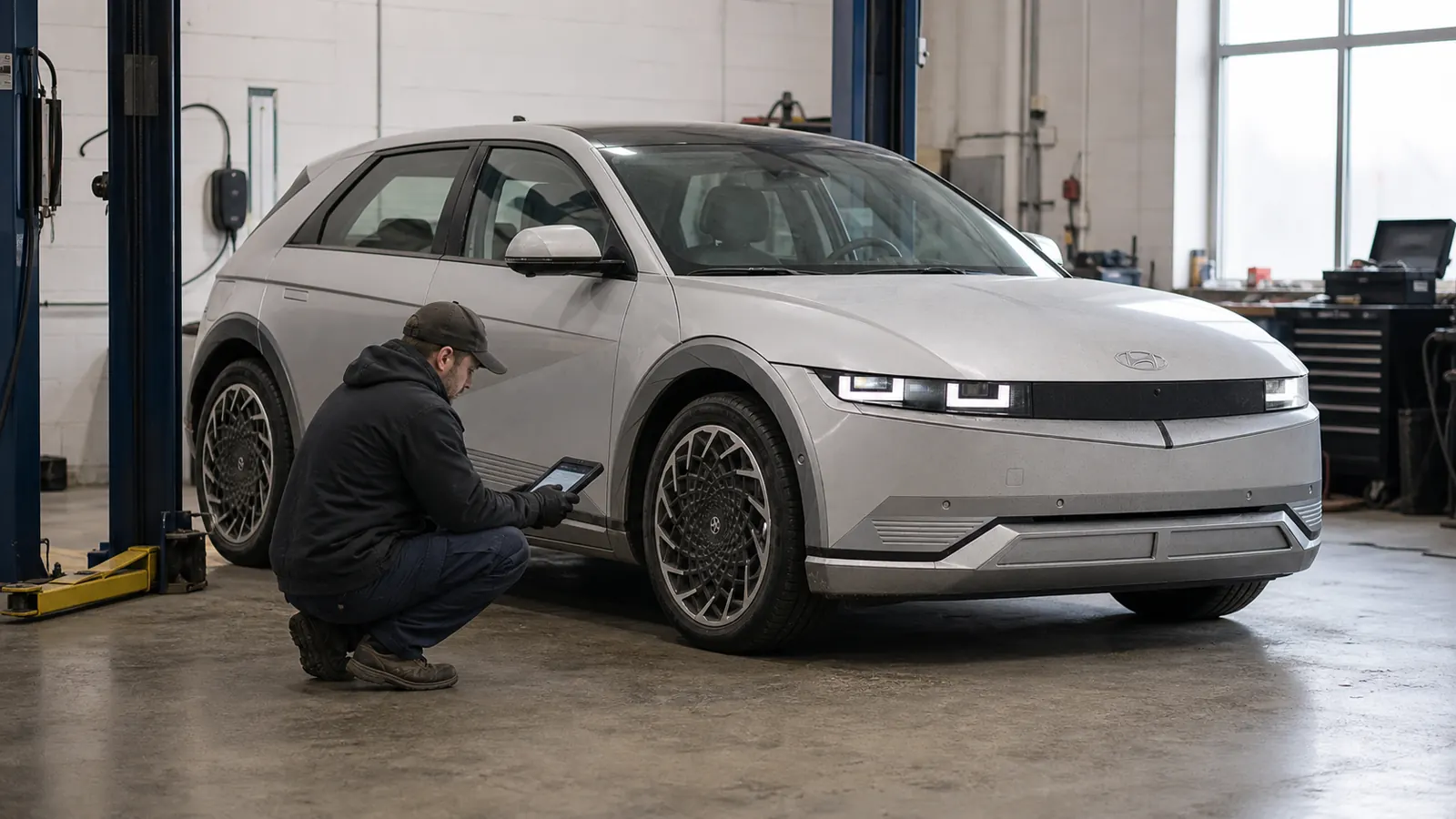
Two model years need the most caution
The 2022 Ioniq 5 is the first year to filter out. NHTSA currently returns 399 submitted complaints and three recalls for that model year.
The complaints include many electrical and power-loss reports, while the recall list includes two separate ICCU campaigns and a first-year parking mechanism update.
The 2025 Ioniq 5 creates a different concern. NHTSA currently returns 271 complaints and nine recalls for 2025.
That count includes Ioniq 5 N campaigns that do not apply to the regular model, along with small production groups that may cover only a few vehicles.
A buyer still needs a VIN check because the remaining campaigns touch the high-voltage battery, wiring, seat belts, and rear suspension.
| Model year | Starting verdict | NHTSA record as checked July 2026 | Required proof |
|---|---|---|---|
| 2022 | Avoid without complete work | 399 complaints, 3 recalls | Recall 272, recall 228, ICCU history, 12-volt test, and full-power Level 2 charge |
| 2023 | Inspect closely | 379 complaints, 4 recalls | Recall 272, driveshaft applicability, traction-battery recall, and charging test |
| 2024 | Best used target with records | 215 complaints, 3 recalls | Recall 272, traction-battery recall, and charging performance |
| 2025 | Avoid unresolved campaign cars | 271 complaints, 9 recalls | Exact VIN campaign list, battery records, wiring, seat-belt, brake, and suspension completion |
| 2026 | Too new for a long record | Complaint history is still developing | Current recalls, build date, charging test, and full inspection |
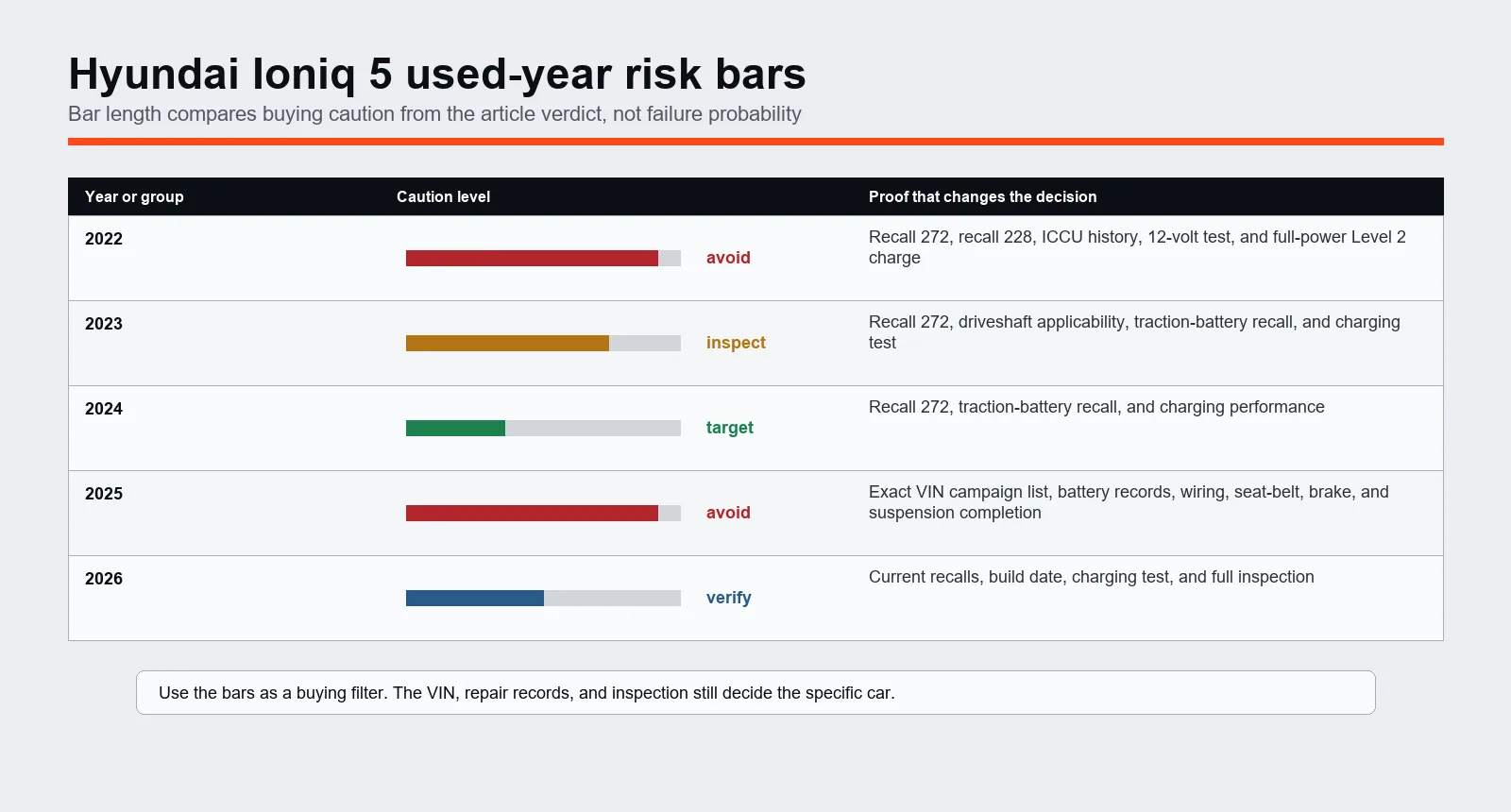
These are submitted reports and campaign counts, not failure rates.
Older cars have had more time to collect complaints.
One complaint can also name several vehicle components.
Use the totals to set inspection priority, then let the VIN and repair orders decide the individual car.
The figures come from the live NHTSA complaints API and NHTSA recall API. The research method explains why a campaign document carries more weight than a broad reputation score.
The 2022 launch year carries the longest ICCU record
The 2022 combines first-year production with the widest exposure to early electrical complaints.
Its central issue is the Integrated Charging Control Unit, or ICCU. This unit converts high-voltage battery power for the 12-volt system and handles AC charging functions.
When it fails, the auxiliary battery may stop charging and the vehicle can enter reduced-power mode or lose drive power.
Hyundai first addressed the condition under recall 257. The company then issued recall 272, NHTSA 24V868 because the earlier remedy did not close the risk for every affected vehicle.
Recall 272 covers certain 2022 through 2024 Ioniq 5 vehicles. The repair calls for an ICCU inspection, fuse replacement when needed, and updated software.
A repair order for recall 257 alone is not enough.
The 2022 also has NHTSA campaign 22V324. A software error could let the parking mechanism disengage and allow a parked vehicle to roll.
The remedy updates the shifter control unit. This campaign is separate from the ICCU work, so both need their own completion entry.
- May 2022Hyundai identifies a parking-pawl software condition and opens recall 228, NHTSA 22V324
- June 2023Hyundai adds battery preconditioning to certain 2022 AWD cars through service campaign T9Q
- March 2024Recall 257 begins for ICCU inspection, software, and possible parts replacement
- November 2024Recall 272 supersedes the earlier ICCU campaign with another required dealer visit
- July 2026Used buyers still need both campaign history and a physical charging test
A certain 2022 AWD car may also qualify for Hyundai's battery-conditioning campaign.
That update improves cold DC charging preparation. It does not repair an ICCU, and it does not apply to every drivetrain.
Keep the campaign numbers separate when reading the service printout.
A 2023 or 2024 still needs recall proof
Moving one year newer does not remove the ICCU check. Both 2023 and 2024 vehicles can fall under recalls 257 and 272.
Ask the dealer to show the date and mileage for the latest campaign, then compare those details with any ICCU or 12-volt battery replacement invoice.
A limited group of 2023 vehicles also falls under NHTSA recall 24V065. An improperly heat-treated rear inner driveshaft could break and remove drive power.
NHTSA lists 1,165 affected vehicles across the Ioniq 5, Ioniq 6, and Genesis GV60. The small population is why a model-year label cannot answer the question by itself.
NHTSA added campaign 26V432 for certain 2023 and 2024 Ioniq 5 vehicles in 2026. The agency says misaligned electrodes in high-voltage battery cells can lead to a fire while parked or driving.
Check the current 2023 recall results because a car advertised as recall-free in 2025 may have gained a campaign later.
Among used examples, a 2024 with recall 272 and 26V432 shown complete is the strongest starting point.
It avoids the 2022 parking-pawl campaign and the limited 2023 driveshaft campaign. Its long-term history is still short, so a clean campaign list does not replace battery, charging, tire, and collision checks.
Use the electric-car field to compare other EVs with similar age. The Ioniq 5 and Model 3 comparison helps with the broader choice, but only the Hyundai VIN lookup can settle Hyundai campaign eligibility.
The 2025 update has a separate production story
The 2025 model brought a larger battery, a native NACS charge port on many U.S. versions, and Georgia production.
It did not simply continue the 2022 through 2024 campaign list. NHTSA currently lists nine recalls, and the scope varies sharply between regular Ioniq 5 models, Ioniq 5 N cars, and small build groups.
Two high-voltage battery campaigns deserve immediate attention. NHTSA recall 25V482 covers certain 2025 cars with an improperly tightened battery bus bar that can short circuit.
Hyundai told owners in that group to park outside and away from structures until the inspection was completed.
A later campaign, 26V068, covers another production group with a similar bus-bar condition.
Hyundai also published TSB 26-EV-002H for some 2025 vehicles that may not fully charge because battery-cell voltage differs beyond the allowed range.
The bulletin names codes P1AA700 and P1AD300 and directs dealers to replace the battery system assembly when an active qualifying code is confirmed.
A cleared warning light does not prove that this diagnosis was completed.
The 2025 can become a reasonable choice after every applicable battery, wiring, seat-belt, headlight, brake, and suspension campaign shows complete. Until that paper trail is clear, do not pay a newer-model premium for a car with unresolved high-voltage or chassis work.
ICCU evidence matters more than a new 12-volt battery
A fresh auxiliary battery can hide the symptom for a short time.
It does not prove that the ICCU is charging correctly. Hyundai's recall 272 repair bulletin tells technicians to check for code P1A9096, update software, and replace the ICCU and fuse when the inspection requires it.
Ask for a dealer history that names recall 272 or campaign number 272.
Look for part numbers and labor lines if the ICCU was replaced.
A generic entry such as electrical diagnosis gives too little detail. The repair date should come after the superseding campaign opened, or the record should show a later revisit.
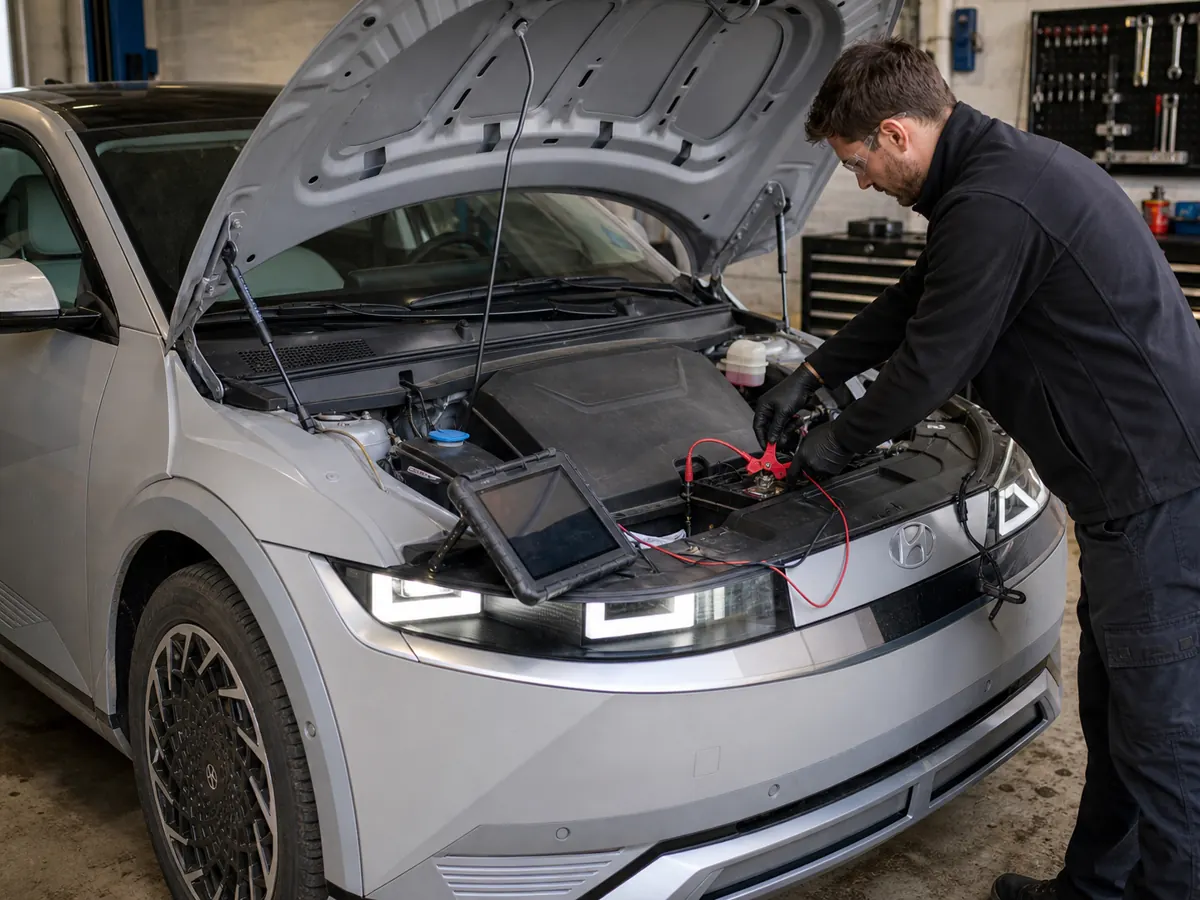
Have an EV-qualified shop perform these checks:
- Load-test the 12-volt battery after the car has rested
- Scan every module for current, pending, permanent, and history codes
- Confirm the ICCU software event and recall 272 completion
- Match any ICCU and fuse replacement to the VIN and mileage
- Check for repeated jump-starts, roadside calls, or auxiliary-battery replacements
A healthy test result today does not erase repeated failures in the records. Repeated 12-volt replacements after the latest ICCU work justify a deeper diagnosis.
The repair history should explain why each battery failed and what stopped the pattern.
Compare that evidence with the Hyundai model range rather than assuming every Hyundai EV uses the same charging hardware. The Mustang Mach-E profile shows another EV with its own low-voltage and campaign history.
Test Level 2 charging long enough to expose heat behavior
A short plug-in test can miss an inlet-temperature problem. Certain 2022 through 2024 cars may interrupt a 240-volt AC session or reduce charging power after the inlet heats up.
Hyundai's service campaign 9B5 bulletin updates the Vehicle Charging Management System logic for affected vehicles.
Ask the seller to start with a battery state of charge low enough to accept steady power. Use a known-good 40-amp or 48-amp Level 2 station when the equipment and circuit support it.
Record the starting power, then watch the session for at least 30 minutes. A rate that drops sharply needs an explanation, especially when the charger works normally with another vehicle.
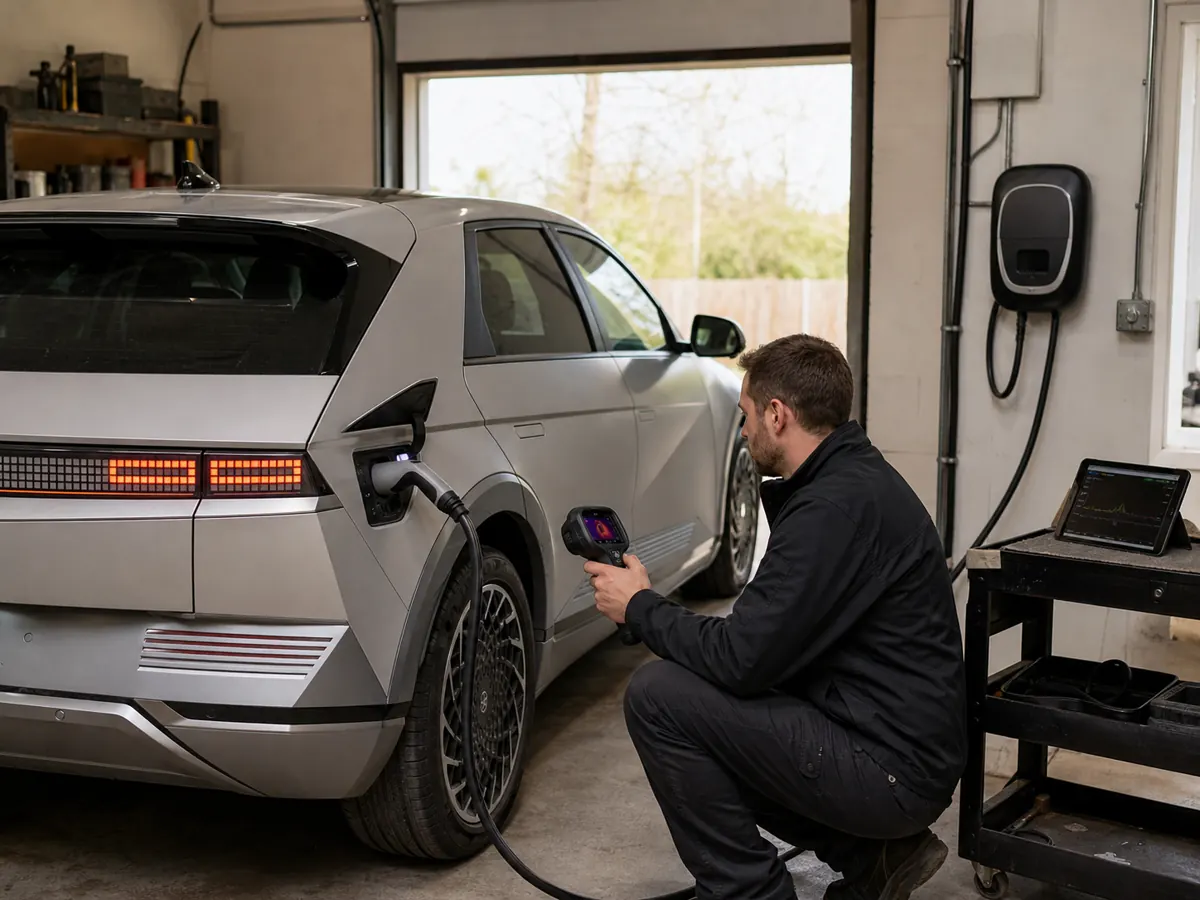
Complete the charging inspection in this order:
- Inspect the port for heat damage, discoloration, looseness, moisture, and bent contacts
- Run a sustained Level 2 session and save the power graph
- Test DC fast charging long enough to confirm stable communication
- Review the dashboard and app for interrupted-session messages
- Check the high-voltage battery state of health with Hyundai-capable equipment
- Inspect the battery case and underbody for impact damage
Level 2 and DC charging use different hardware paths, so one successful session cannot clear both.
Walk away when the seller refuses a charging test or when repeated interruptions have no documented diagnosis.
The used-car paperwork checks also apply to title, collision, and warranty history.
Tires and accident repairs can outweigh the year label
The Ioniq 5 is heavy and delivers torque immediately. Uneven or mismatched tires can expose alignment damage, aggressive use, or a suspension repair that did not restore the factory geometry.
Measure all four tread depths and confirm the load rating. The tire-pressure procedure helps establish a clean baseline before the road test.
Pay close attention to the battery enclosure and rocker areas. A repaired side or underbody impact needs documented high-voltage inspection, not only clean paint.
Check the charge-port corner, cooling lines, suspension mounting points, and battery shield from below.
During the drive:
- Listen for rear suspension clunks and hatch noise on broken pavement
- Check straight tracking under acceleration and regenerative braking
- Confirm smooth transition between regenerative and friction brakes
- Test heat, air conditioning, cameras, sensors, and both key fobs
- Recheck warning messages after the charging session and road test
The Tesla Model 3 profile offers a useful efficiency comparison, while the ownership archive keeps model-specific repair histories separate. Choose the individual car whose records, charging behavior, and physical condition agree.
Which Ioniq 5 year should you buy?
Start with a 2024 if you want the strongest used-year candidate. Require recall 272 and campaign 26V432 completion when the VIN is included.
Then run the same 12-volt, Level 2, DC charging, tire, and underbody checks used on every year.
A 2023 can work when the price is lower and the VIN clears the driveshaft and battery campaigns. A 2022 needs a larger discount because it adds first-year exposure, the parking-pawl update, and the longest ICCU history.
A 2025 needs a complete, current campaign printout before its newer hardware deserves a premium.
Check the VIN in both the Hyundai campaign lookup and NHTSA on the day you make the offer.
Campaign lists can change after a listing is written. Hyundai states a 10-year or 100,000-mile hybrid and EV battery warranty for qualifying U.S. vehicles, but coverage terms and remaining time must be confirmed for the exact car.
The year narrows the search. The VIN and the inspection settle it.