Which Honda Civic Hatchback years should you avoid?
The year is 2022. You would get the same answer for the sedan, the Si or anything else wearing the badge.
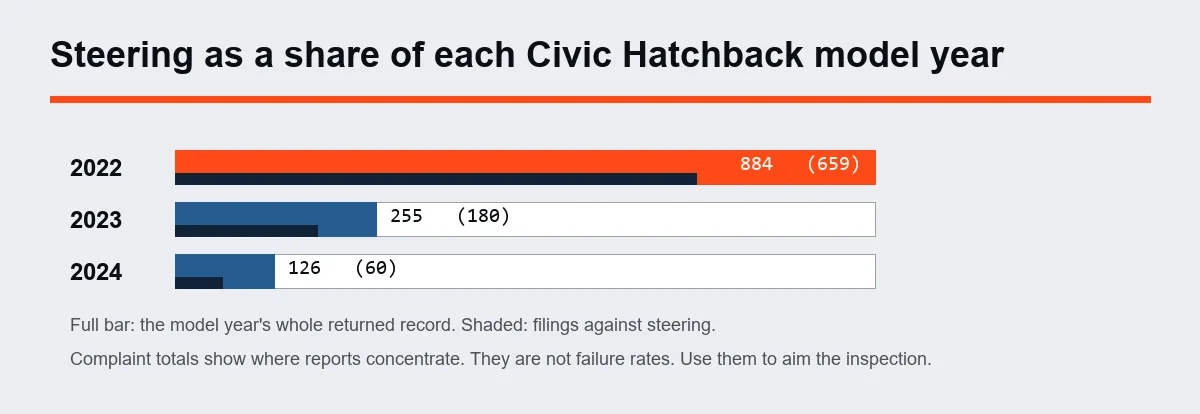
Those left-hand numbers are the ones every year list is built on. The right-hand numbers are what is actually attributable to the five-door.
For scale, the current Civic has generated about 1,502 filings across all its labels since 2022. The 2022 model year alone accounts for well over half of them.
The 2022 car does carry a real problem: steering. That story belongs to the sibling analysis of Honda Civic years to avoid, which covers the defect, its year-by-year concentration and the road test that finds it.
What is left for this article is the question you came with.
Does choosing the hatchback change the risk? The honest answer is that the data cannot show that it does.
The hatchback has no record of its own
Complaint totals are easy to compare and easy to misread. Every filing carries a record number, so two model labels can be checked against each other directly rather than by size.
Doing that for the current Civic gives the same result three years running.
| Model year | Sedan label | Hatchback label | Shared | Sedan only |
|---|---|---|---|---|
| 2022 | 881 | 884 | 881 | 0 |
| 2023 | 251 | 255 | 251 | 0 |
| 2024 | 117 | 126 | 117 | 0 |
The decisive column is the last one. In three consecutive model years, not one filing appears under the sedan label without also appearing under the hatchback label.
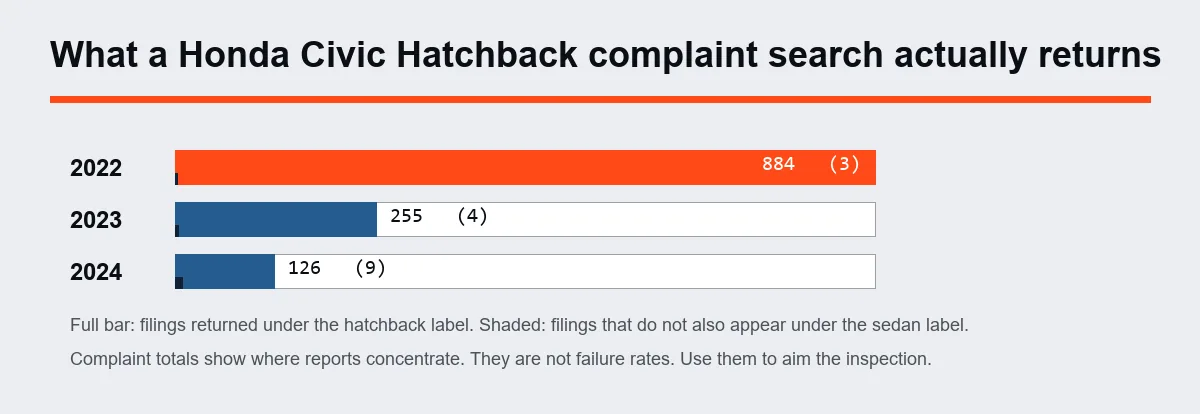
Two vehicles with genuinely separate records would not behave like that. They would each hold filings the other does not, in both directions, roughly in proportion to how many were sold.
One set completely containing the other is what a labelling artefact looks like.
The database's model field is not reliably separating the bodies. Almost every filing comes back under both.
There is a clean way to test that, supplied by the same database.
The Type R is also a five-door Civic. It is filed under a label of its own.
Compare the Type R against the sedan and every one of its filings is unique.
Eleven of eleven for 2023. Nine of nine for 2024.
So the separation is not simply beyond the database. It draws a clean line around the Type R and draws no line at all between the sedan and the standard hatchback.
That is the difference between two vehicles with distinct records and one vehicle wearing two labels.
No publisher here is acting in bad faith. Anyone querying by model name and reporting the total gets a hatchback-shaped number that is not a hatchback number, and nothing in the interface warns them.
Why 2017 to 2021 hatchback rankings are guesswork
The previous generation is worse, failing in the opposite direction.
Under the hatchback label those five model years hold two filings for 2017, none for 2018, none for 2019, two for 2020 and none for 2021. Four filings in total.
Over the same five years the Civic nameplate holds 584, 598, 348, 221 and 139.
Four filings against 1,890 cannot separate one model year from another, let alone rank five of them. Any article confidently telling you the 2019 hatchback is safer than the 2018 is reading sedan data and relabelling it.
That does not make those cars a bad buy. It moves the decision to where it always belonged on a car this age, which is condition, service history and how the specific example drives.
Judge a tenth-generation hatchback on its own paperwork rather than on a year score that has nothing behind it.
The recall you might not be able to close
Campaign 24V744 covers the steering gearbox assembly on 2022 to 2025 Civic and Civic Hatchback cars, along with several other Honda and Acura models.
The remedy is modest on paper.
Dealers replace the worm gear spring and redistribute or add grease. Owner notification letters went out on 18 November 2024.
Sixty filings across the 2022 to 2025 record name that campaign by number. What they say about it is the finding.
Forty-six of those sixty report that the parts to carry out the repair were not yet available. Owners describe being notified, booking the work, and being turned away or left waiting.
The agency's own classification confirms it rather than leaving it to interpretation. Forty-one of the forty-six carry NHTSA's tag for a parts distribution disconnect.
So the question to ask changes. Instead of asking whether the recall is closed, ask whether the part is in stock and how long the dealer's current wait is.
That single question separates a car you can put right next week from one that stays open for months.
If the answer is that parts are still out, that is not automatically a walk-away. Treat it as a price conversation, plus a reason to get the dealer's estimate of the wait before you commit.
What it should never be is invisible. A car sold with 24V744 open and no parts date is carrying an unresolved steering campaign, and the buyer inherits both the wait and the fault behind it.
What the hatchback-only filings actually say
The sixteen filings that a hatchback search returns and a sedan search does not are worth reading rather than counting.
Fifteen of the sixteen name steering. One 2024 filing names air bags and another pairs steering with suspension, and that is the entire remainder.
Most are the availability complaint again, in owners' own words.
The contact received notification of NHTSA Campaign Number: 24V744000 (Steering); however, the part to do the recall repair was not yet available. The contact stated that the manufacturer had exceeded a reasonable amount of time for the recall repair.
Read that back against the question this article opened with. The one slice of the record that the hatchback label uniquely produces is not about the hatchback at all.
That is the strongest evidence in the whole exercise. When even the exclusive data is not body-specific, there is nothing left for a hatchback year ranking to stand on.
What genuinely changes with the body style
The body-style question is real. It just cannot be answered with complaint volume, so it has to be answered somewhere else.
Two places, in fact.
One is the campaign list. The other is the car itself.
On campaigns, 2023 and 2024 hatchbacks pick up 24V859, which covers driver seat cushion frame fasteners that may not have been tightened. It reaches the sedan too, but it is a second lookup that a 2022 car does not need.
Both of the campaigns on this car have model lists that run well past the Civic. 24V859 also names the Accord and the Pilot, and 24V744 names the CR-V and the Honda HR-V alongside the Integra.
That is useful context rather than trivia. A defect appearing across five nameplates is a supplier or assembly problem, which is why it does not track the body style at all.
The Type R is a genuinely separate matter. It is filed under its own label and holds 11 filings for 2023, 9 for 2024 and 3 for 2025, which is a different vehicle with a different record and not a trim of the car described here.
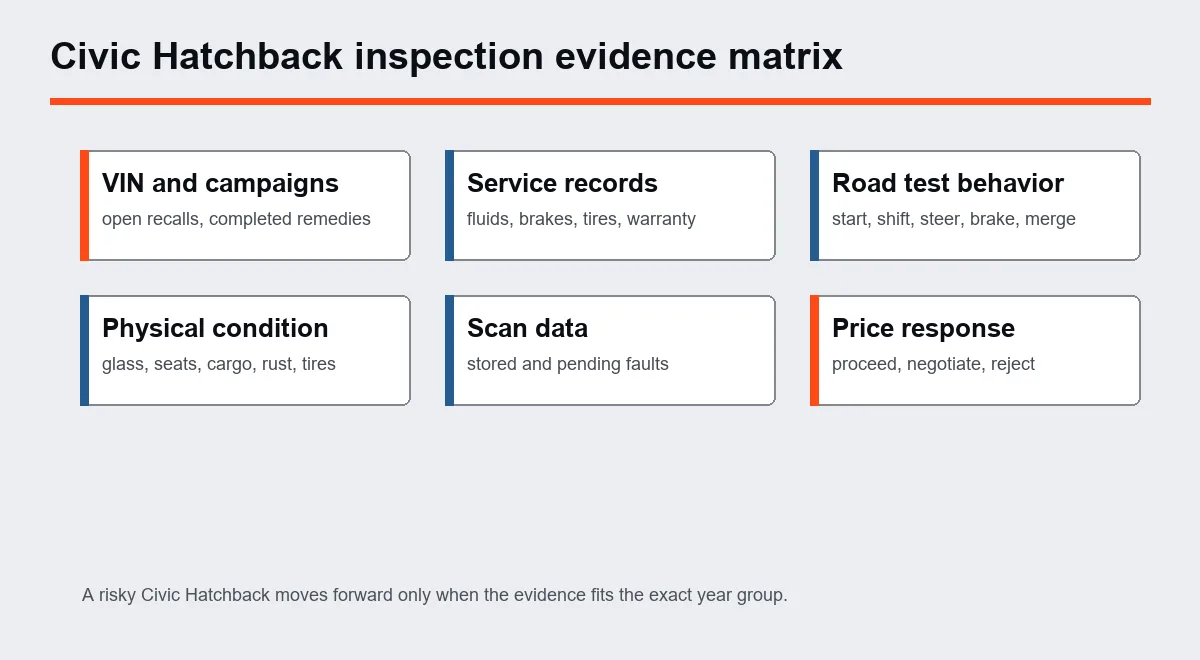
At the car, the tailgate is what the sedan does not have. Open it, feel around the seal for damp or a musty smell in the load area, and run the rear wiper through a full cycle including the washer.
Servicing does not change with the body. Every interval and parts price in the Honda Civic reliability record applies here unchanged, because nothing behind the front doors was re-engineered.
Pros
- A tailgate and folding rear seats that the sedan cannot match for awkward loads
- The same mechanical package, so nothing about the body adds a drivetrain risk
- A second campaign lookup on 2023 and 2024 cars that takes about a minute
Cons
- A tailgate seal, rear wiper and load-area drainage that the sedan never has to be checked for
- More road noise from an open load bay, which is a road-test judgement rather than a fault
Not one of those is a reason to choose the sedan, nor does any of it appear in a year ranking. It is simply the part of the decision the body style genuinely owns.
Which Civic Hatchback to buy
On volume the 2024 car is the clear pick.
It returns 126 filings against 884 for the 2022. That gap is far too large to be explained by age alone.
But no model year escapes the steering campaign. 24V744 reaches every car from 2022 through 2025, so a newer year narrows the odds without removing the check.
A 2022 car is still a good buy on the right terms. Those terms are the campaign closed in writing, with a repair order naming the work rather than a status line, plus a drive long enough for the steering to warm through.
The 2023 car sits between the two and is easy to overlook. It returns 255 filings, much closer to the 2024 than to the 2022, and it carries the same two campaigns the 2024 does.
On price that often makes it the better value of the pair. The condition is the same either way, which is repair orders rather than status lines.
That is the whole decision. The year narrows the search, the campaign paperwork settles the car, and the body style only ever changed what you check at the tailgate.
Sources
- NHTSA 2016 Civic Hatchback complaints
- NHTSA 2017 Civic Hatchback complaints
- NHTSA 2018 Civic Hatchback complaints
- NHTSA 2019 Civic Hatchback complaints
- NHTSA 2020 Civic Hatchback complaints
- NHTSA 2021 Civic Hatchback complaints
- NHTSA 2022 Civic Hatchback complaints
- NHTSA 2016 Civic Hatchback recalls
- NHTSA 2017 Civic Hatchback recalls
- NHTSA 2018 Civic Hatchback recalls
- NHTSA 2019 Civic Hatchback recalls
- NHTSA Civic sticky-steering investigation EA23-003