Which Honda HR-V years should you avoid?
One year, clearly.
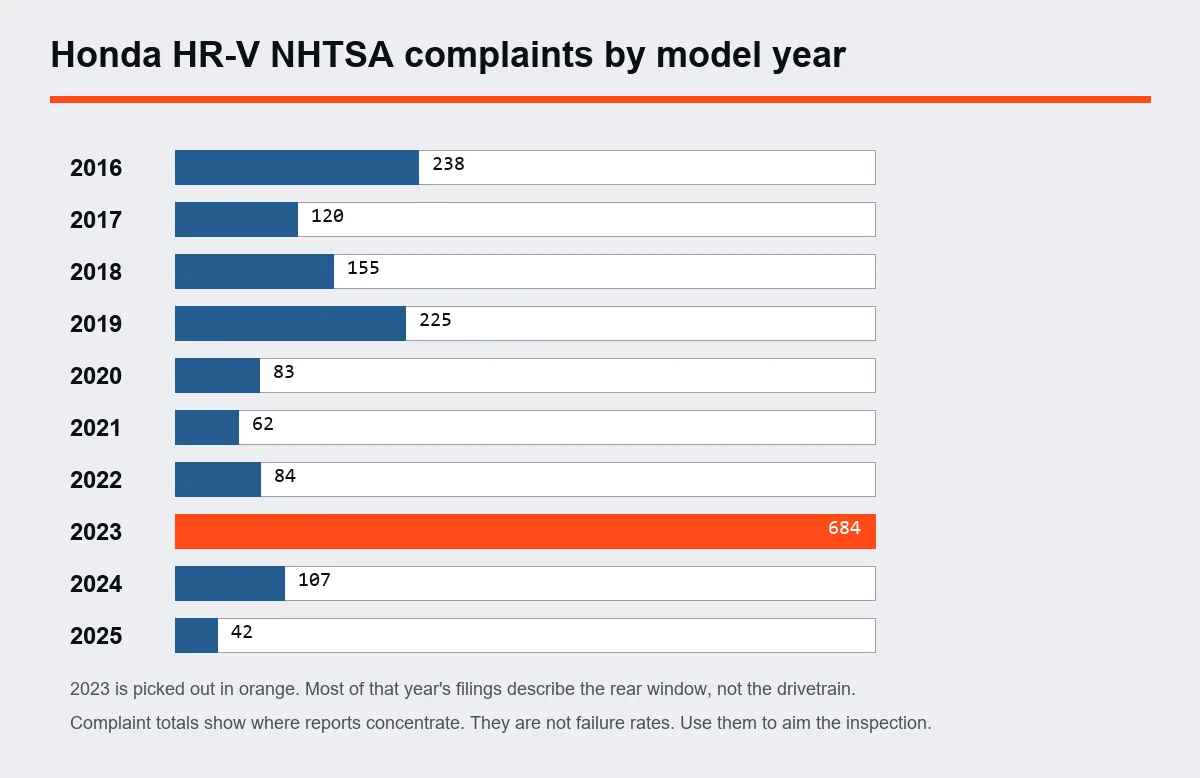
The 2023 Honda HR-V holds 684 complaints in the federal database. Nothing else in the model's record comes near it.
The next-highest is the 2016 car at 238, which is the first year of the previous generation. Every remaining model year sits between 42 and 225.
For a buyer, a single year standing roughly three times above the next is good news rather than bad. It means the answer is a specific defect on a specific car rather than a vague weak period.
Rule out one model year and the HR-V becomes a straightforward small crossover to shop. The rest of this explains what that year's problem is and why it needs checking differently.
One model year stands alone in the HR-V record
Laid out across ten model years, the record is flat until it is not. The 2022 car holds 84 filings and the 2023 car holds 684.
That is an eightfold jump between consecutive model years of a car that was not fundamentally redesigned between them.
Read the filings themselves rather than their categories and it gets specific. 549 of the 684 name the rear window, hatch or tailgate glass, which is roughly four filings in every five.
Categories alone understate it. The filings are scattered across visibility, wiper and general headings depending on how each owner described the failure, so any single category count misses a large share of them.
That rules out the things buyers normally worry about on this car. Power train leads the 2016 record and does not appear near the top for 2023, so the continuously variable transmission is not what those owners are filing about.
The year after settles back down. The 2024 car holds 107 filings, which is an ordinary number for this model.
The 2023 rear windows are breaking, and no recall covers it
The filings describe the rear window breaking on its own.
Owners report hearing it go while the car sat parked. Some describe the same failure while driving, with no impact involved.
Reporting on the issue attributes it to assembly, with the urethane sealer that bonds the rear glass to the body making contact with the heating element embedded in the glass for the rear defroster.
That explanation fits what owners describe, because it makes the defroster the trigger and puts the failures in cold weather when the defroster gets used.
Here is the part that matters for a used purchase.
Thirteen NHTSA campaigns cover the HR-V. Not one of them concerns glass.
Honda addressed it in 2024 through a service campaign rather than a safety recall.
A service campaign is an instruction to dealers. It does not appear in the public recall lookup that buying guides tell people to run.
The gap that creates is visible in the filings. One owner describes being told at a dealership that there was a recall on the back windshield, while never having received any notification about it.
That is what a service campaign looks like from the owner's side. Because no notification letter is required in the way a recall requires one, the dealer network knows while the owner frequently does not.
Consumer Reports has argued the campaign should be converted into a full recall, on the grounds that a recall reaches more owners. Until that happens the burden sits with the buyer to ask the right question.
The practical check is simple once you know to make it. Look closely at the rear glass for a replacement date sticker or fresh sealer, and ask whether the glass has already been changed under the campaign.
Original Honda glass carries a maker's mark and a date code in one corner.
A replacement pane often carries a different mark. Fresh sealer also sits slightly proud of the trim compared with a factory bond.
The 2023 car has a second issue that is unrelated and does show up normally. Campaign 24V744 covers 2023 to 2025 HR-V cars for difficulty steering, so this model year needs both a service-campaign search and an ordinary recall check.
That one is not trivial either. Seventy-seven of the 2023 filings name steering, which on its own would be a respectable total for an ordinary HR-V model year.
That combination is the real reason to be careful with a 2023 car rather than the glass alone.
One problem is invisible to the standard check while the other is not. A buyer who runs only one search therefore sees half of it.
The obvious follow-up is whether a car that has already had the glass replaced is now settled. On the reported cause it should be, because the campaign replaces the pane and the bond that created the problem.
Treat that as a reason to prefer a car with the work documented rather than one with no history either way. A 2023 HR-V with a dated glass replacement on file is a more known quantity than one that has simply not failed yet.
The first-generation cars have an older, separate problem
Everything above applies to the current car.
The 2016 to 2022 HR-V is a different vehicle with a different record. Most of the popular year lists are still written about that car.
Its concentration is mechanical rather than structural. The 2016 car holds 238 filings led by power train at 62, which is the continuously variable transmission that dominates the older reviews.
Those filings are consistent about the symptom. Owners describe the car dropping into limp mode with warning lights across the dash, and several quote a stored transmission code when the car is scanned.
A milder version shows up as hesitation pulling away from a stop, where the car creeps and then does not respond cleanly to the accelerator. That one is worth provoking deliberately on a test drive.
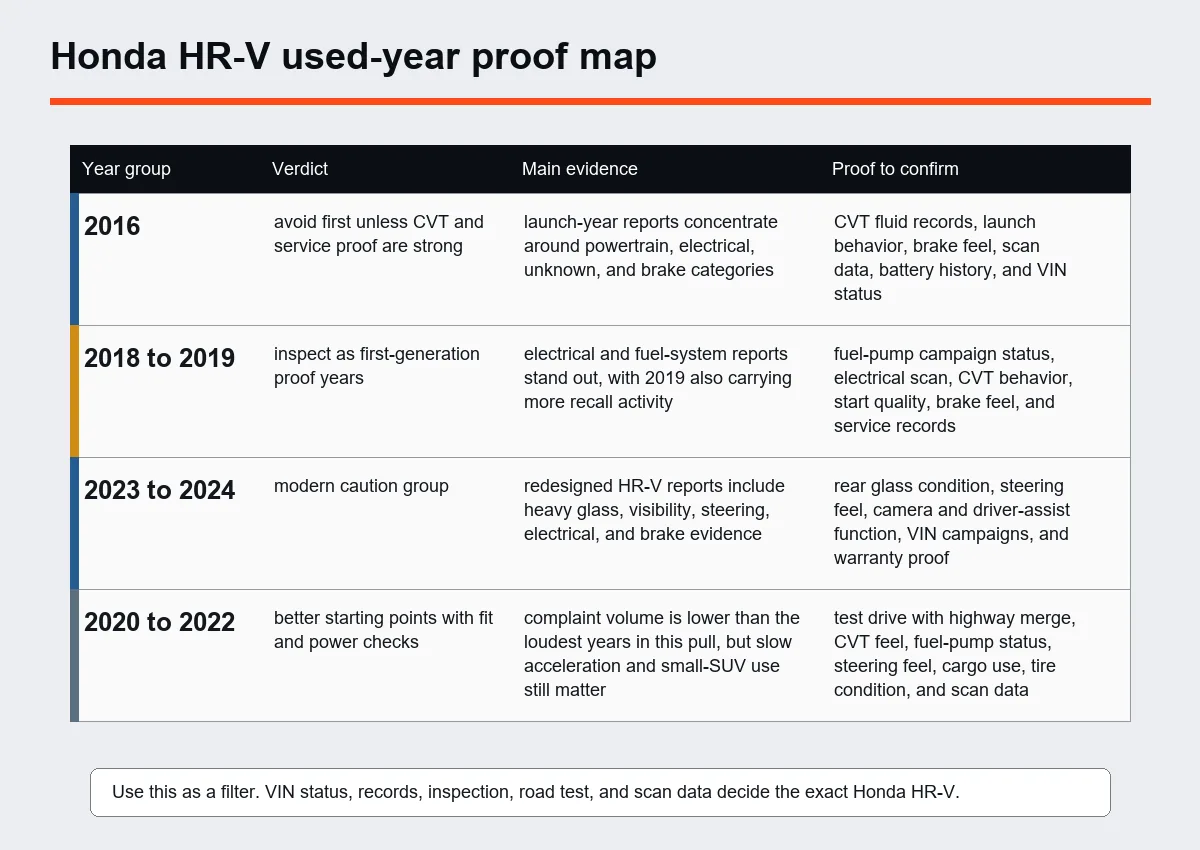
By 2018 and 2019 the leading categories move to electrical and fuel delivery, at 31 and 26 filings on the 2018 car and 36 and 30 on the 2019.
| Model year | Complaints | Leading category | Campaign to check |
|---|---|---|---|
| 2016 | 238 | Power train at 62 | 18V777, rear brake caliper pistons |
| 2017 | 120 | Power train at 19 | 18V777, rear brake caliper pistons |
| 2018 | 155 | Electrical at 31 | 20V314 and 23V858, low-pressure fuel pump |
| 2019 | 225 | Electrical at 36 | 20V314, 21V215 and 23V858, low-pressure fuel pump |
The 2019 car deserves a note of its own, because at 225 filings it is the second-busiest year in the whole record.
Its leading category is electrical. Those filings largely describe the instrument cluster.
Owners report the fuel gauge, temperature and mileage display going blank or working intermittently, sometimes from startup. On a car where the fuel gauge is the only way to know the range, that is more than a convenience fault.
Three separate campaigns covering the same fuel pump across overlapping years is worth reading as one supplier problem being chased rather than as three faults.
On any first-generation car, drive it long enough for the transmission to warm through and confirm the fuel pump work is closed on the VIN.
The 2024 car carries two campaigns for one component
The current car looks ordinary in the complaint record, at 107 filings with steering leading at 40. Its campaign list is more interesting than its complaint list.
Campaign 24V744 covers 2023 to 2025 HR-V cars for difficulty steering, alongside several other Honda and Acura models sharing the same system.
Then there are two campaigns for the seats. Campaign 24V859 covers 2024 cars for seat critical fasteners, and campaign 26V054 covers 2024 cars for seat critical fasteners again.
A second campaign on the same component and the same model year means the first one did not close the matter, which changes what a completed record proves.
What to ask for on a 2024 car
- 24V744, steering
- Confirm the campaign status and drive the car warm, assessing weight and centring
- 24V859, seat fasteners
- Confirm the repair order rather than the status line
- 26V054, seat fasteners
- Check separately, because it covers the same year a second time
The 2024 car remains a sound buy on this evidence. It makes it a car where one closed line in a history report is not the same as a clear VIN.
What to check on any used HR-V
The checks that matter change completely with the generation, which is why a single used-crossover checklist is close to useless on this model.
On a current car the work is documentary. Two separate searches, one for recalls and one for service campaigns, plus a warm drive to assess the steering the 24V744 campaign covers.
On a first-generation car the work is mechanical. The transmission needs to be driven from cold through to fully warm, with a deliberate pull away from a standstill to provoke the hesitation owners describe.
Checks weighted to the generation in front of you
- 2023 to 2025: ask a dealer to search service campaigns and product updates by VIN, not only recalls
- 2023 cars specifically: inspect the rear glass for a replacement date code and fresh sealer at the trim edge
- 2023 to 2025: drive warm and assess steering weight and return to centre, then check campaign 24V744
- 2024 cars: check both seat fastener campaigns separately, because the second covers the same year as the first
- 2018 and 2019: confirm the low-pressure fuel pump campaign is closed on the VIN
- 2019 cars: start the car several times and confirm the fuel gauge and mileage display come up every time
- 2016 and 2017: drive from cold to fully warm, pull away deliberately from a stop, and scan for stored transmission codes
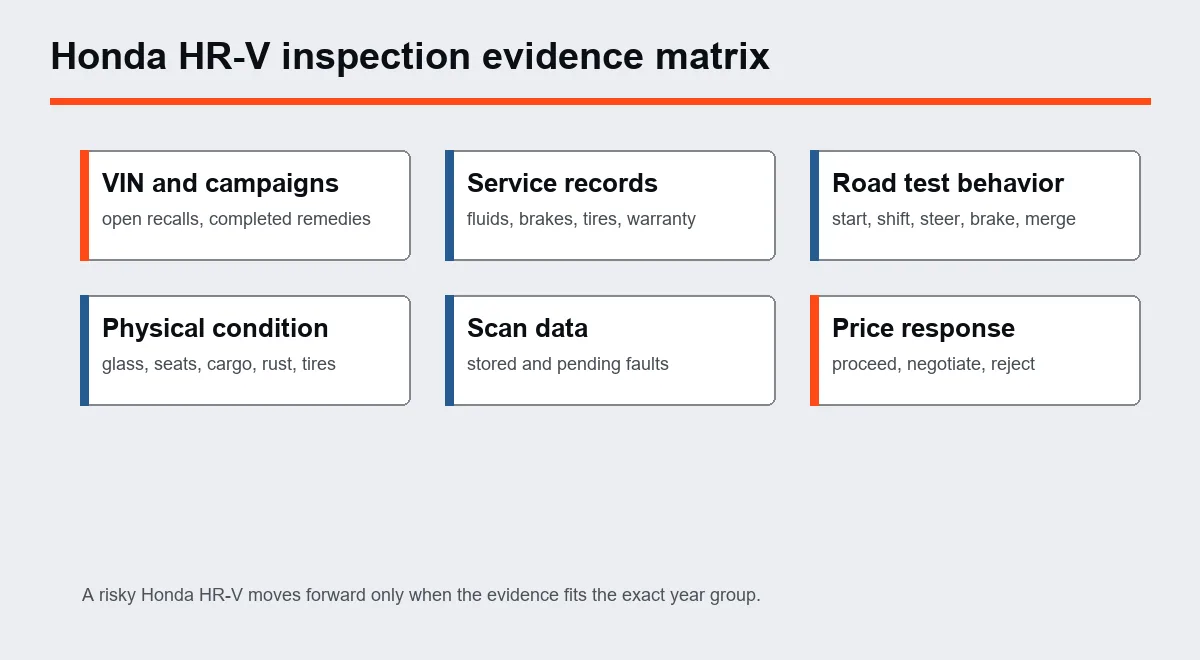
Run the VIN yourself on the day rather than accepting a printout, because campaign status changes as manufacturers file and a report from last month is not the same as one from this morning.
Unusually for a used crossover, not one of these checks needs a lift. On this model the decisive evidence is a phone call to a dealer and a drive long enough to reach operating temperature.
Which HR-V years are worth shortlisting
The quiet window is unusually well defined on this model, because something bounds it on each side.
The 2020, 2021 and 2022 cars hold 83, 62 and 84 filings, the three lowest totals for any HR-V with real time on the road.
The fuel pump campaign period ends just before that window.
The rear glass problem begins just after it. Those two boundaries are what make it a window rather than a coincidence.
The 2025 car holds 42 filings, which looks better still and means less. It has had barely a year in which anyone could file anything.
That is the whole decision on this model.
One year needs a question nobody thinks to ask. The three before it need very little.
Two campaigns the HR-V shares with the rest of the range
The rear window is specific to this model. Two other entries on the current car are not, and both are easy to miss because they are usually written up as Civic stories.
Campaign 24V744 covers a steering gearbox assembly that may have been manufactured incorrectly. It reaches 2023 to 2025 HR-V models alongside the Civic, the Civic Hatchback, the CR-V and the Acura Integra.
Campaign 24V859 covers driver seat cushion frame fasteners that may not have been tightened. On the HR-V it applies to 2024 cars, in the same entry as the Civic Sedan, Civic Hatchback and Pilot.
Two shared campaigns to check by VIN
- 24V744, steering gearbox
- 2023 to 2025 HR-V. Honda gives difficulty steering as the risk
- 24V859, seat fasteners
- 2024 HR-V only, and separate from the 26V054 entry on the same year
- Where to see it in full
- The gearbox defect dominates one sibling's record rather than this one's
- What it means here
- A quiet HR-V record does not mean the campaign has been done on your car
The scale difference between the models is the interesting part. On the 2022 Honda Civic that same gearbox accounts for roughly seven in ten complaint filings, while the HR-V record barely registers it.
That does not make the HR-V exempt. It means the fault is being reported far less often on this model, which is a reason to check the campaign rather than a reason to skip it.
The Civic Hatchback analysis covers what owners actually describe when the gearbox misbehaves, and the same description applies here.