Which Honda Civic years should you actually avoid?
Three groups of Honda Civic carry elevated risk.
They fail for three unrelated reasons. The 2006 to 2008 cars, the 2016 car, and the 2022 car.
Read raw volume with one correction in mind. A 2006 car has had twenty years in which owners could file and a 2024 car has had two, so older years look worse partly because they have been around longer.
That correction makes the third group more striking rather than less.
The 2022 Civic reached 957 filings in about four years. Most popular lists still do not rank it.
Steering owns the modern Civic complaint record
Pull the leading reported component for every Civic model year and one word repeats until it stops looking like a coincidence.
Steering leads 2016, 2017, 2018, 2019, 2020, 2021, 2022, 2023, 2024 and 2025. That is a ten-year run spanning two complete redesigns of the car.
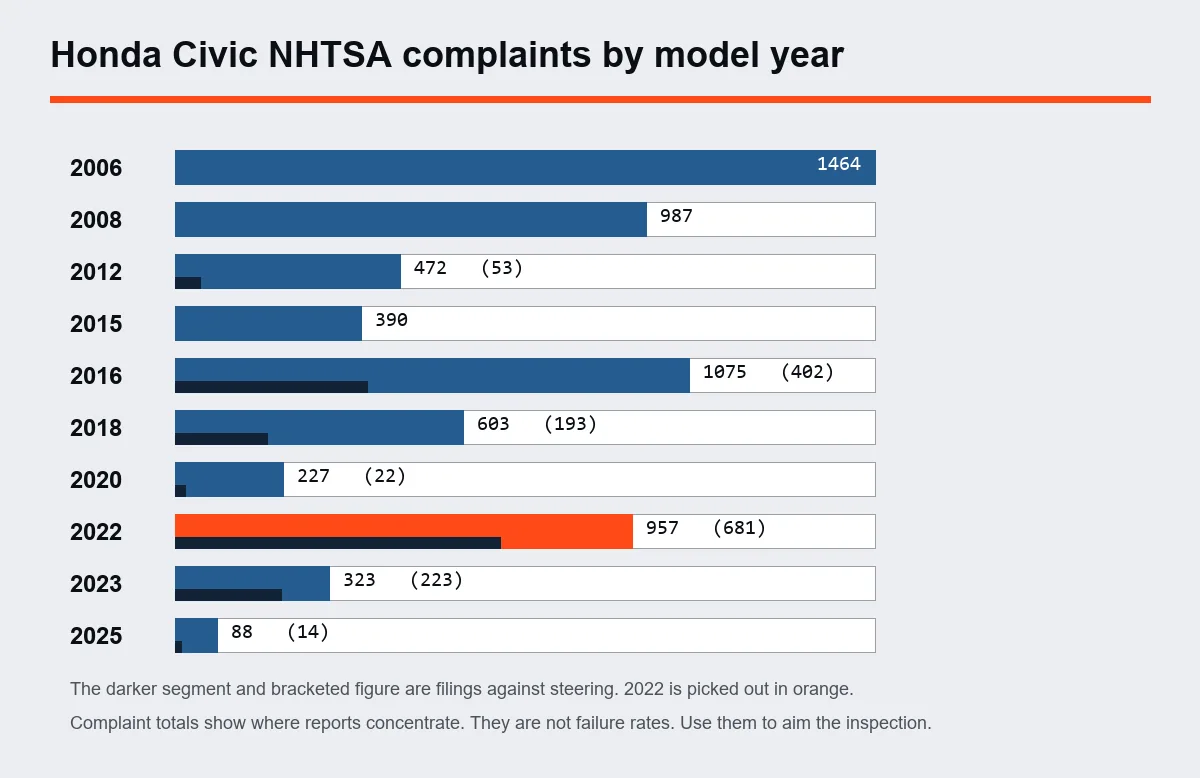
The scale moves a great deal inside that run. The 2016 car carries 402 steering filings, the 2018 car 193, the 2021 car 53, and then the 2022 car 681.
A component that leads across two redesigns is telling you something different from a component that spikes once. One is a bad batch and the other is a design lineage.
The recent years need the same age discount as the old ones. The 2025 car shows 12 steering filings, which is what a car with barely a year on the road looks like rather than what a fixed car looks like.
On any Civic from 2016 onward, the steering is the thing to test rather than one item on a list. Drive it at parking speed, at town speed and at a genuine road speed, and pay attention to weight, centring and any notchiness returning to straight.
What went wrong with the 2022 Civic
The 2022 car holds 957 complaints. Of those, 681 name steering, which is roughly seven in every ten.
Nothing else in the Civic's record comes close to that concentration. Even the 2016 car, with more total filings across a longer period, puts only about four in ten against steering.
Honda has two campaigns covering it.
Take the straightforward one first. Campaign 24V744 covers 2022 to 2025 Civic and Civic Hatchback cars for difficulty steering, and its model list is worth reading rather than skimming.
It also names the CR-V, the Acura Integra and the 2023 to 2025 Honda HR-V. So the gearbox defect is a range-wide manufacturing problem that happens to show up most violently in the Civic's record.
The second one is stranger and matters more to a used buyer. Campaign 23V704 covers 2022 to 2024 Civic four-door and five-door cars that received a replacement power steering rack as part of a service repair.
The filings themselves are unusually consistent about what it feels like. Owners describe the wheel going sticky around the straight-ahead position, needing extra effort to move off centre, and not returning to centre cleanly after a turn.
Several go further and name the mechanism. They report the electric power steering gearbox failing with the worm wheel swelling once it is hot, which is consistent with a condition that is absent on a cold car and present twenty minutes later.
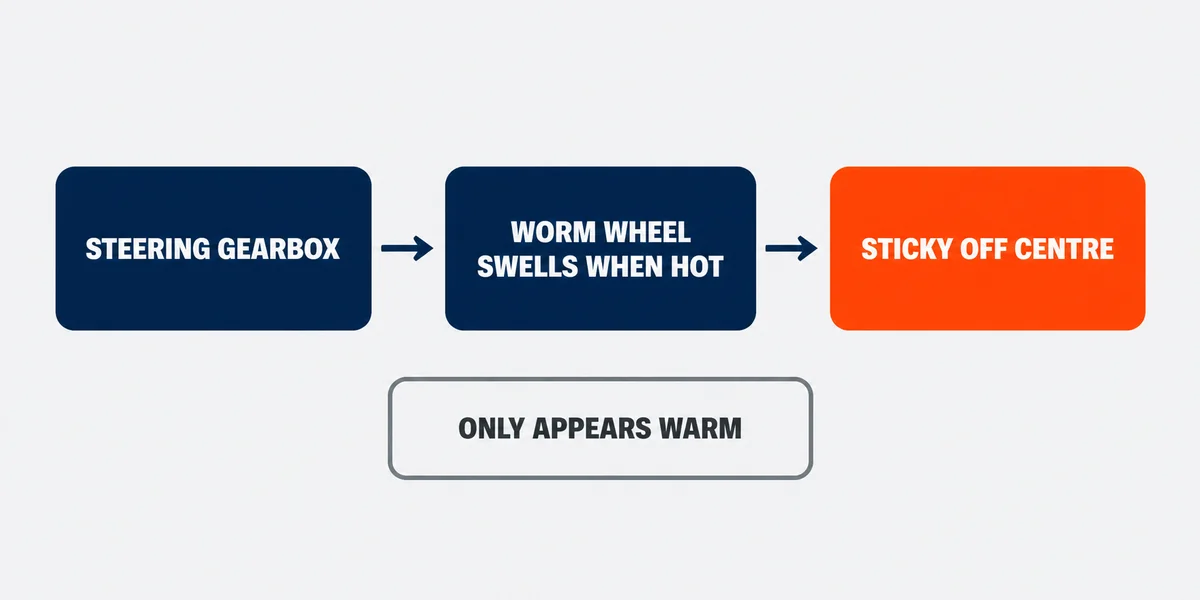
That detail is the single most useful thing in this article for anyone viewing a 2022 car. A short test drive from a cold start is close to worthless here, because the symptom owners describe needs heat to appear.
Some filings also report the campaign repair not resolving it, with owners being quoted for a further steering rack afterwards. That is one more reason to treat prior steering work as a question rather than an answer.
The following year improves without resolving. The 2023 car holds 323 complaints with 223 still filed against steering, so the proportion barely moves even as the volume falls by two thirds.
A 2022 Civic remains buyable on this evidence. It makes it a car you drive properly before agreeing a price, with both campaign entries resolved in writing.
The 2006 to 2008 cars are a different problem entirely
These three model years hold the highest totals in the record. Almost none of that volume is the steering story.
The 2006 car is led by engine at 196 filings, the 2007 car by suspension at 162, and the 2008 car by airbags at 165. Three consecutive years, three different leading categories.
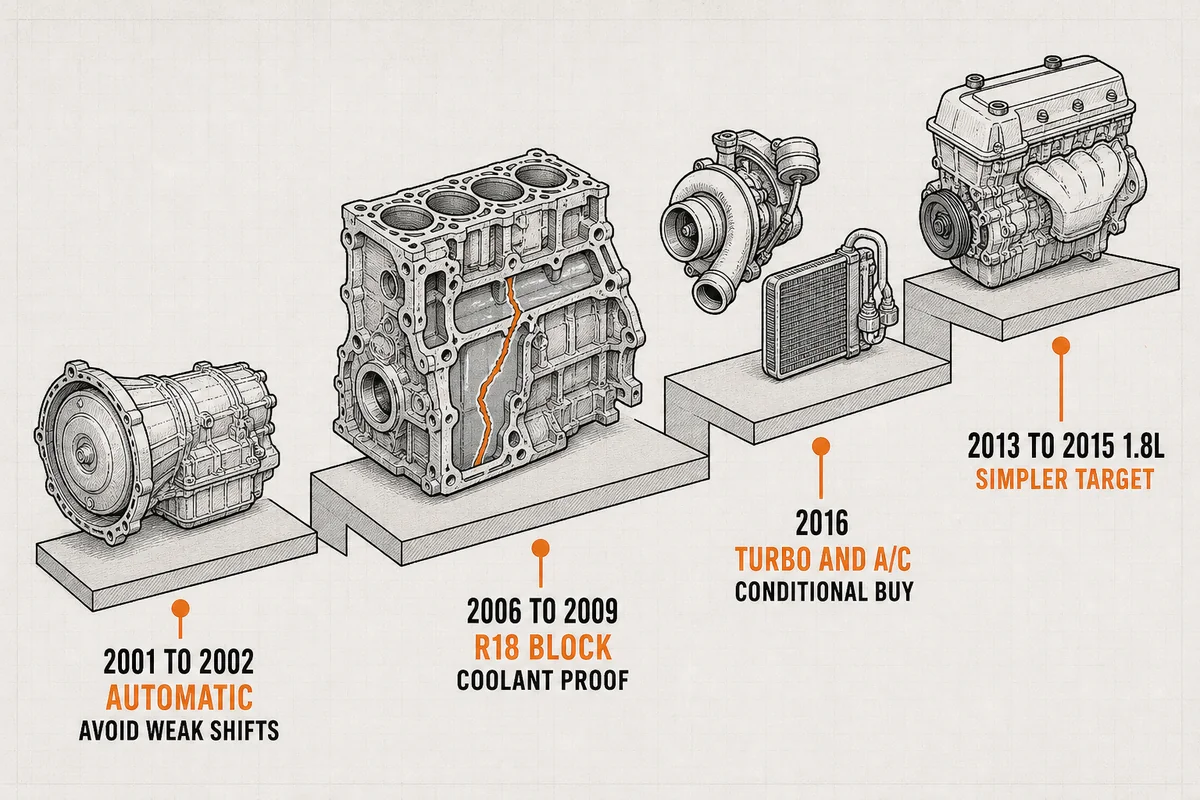
The engine group is specific enough to name. One hundred and forty three of those 196 filings describe a cracked engine block or a crack in the engine, and 104 mention coolant loss, overheating or a head gasket.
It runs across all three years rather than one. The 2007 car carries 111 of 155 and the 2008 car 89 of 132 in the same group.
Owners describe the sequence the same way each time. The car overheats, a water pump or radiator is suspected, and the diagnosis comes back as a crack in the block.
The mileage owners quote is the part that matters for a used buyer. Filings repeatedly place the failure past 100,000 miles, which every surviving car of this age has now passed.
Honda extended the warranty on it, and 45 of the 2006 filings name that extension directly. Owners describe being told the car fell outside it once the extension expired.
That extension is long gone. On a car of this age the repair is entirely the owner's cost, which is why cooling system history matters more here than the model year does.
The airbag numbers deserve separating out. An airbag concentration on cars of this age generally reflects the industry-wide inflator replacement programme, which swept up millions of vehicles across many manufacturers.
Treating an industry-wide programme as a Civic design fault is how these years end up looking worse than they are.
What actually leads each old model year
- 2006
- Engine at 196 filings, with visibility at 195 and airbags at 158
- 2007
- Suspension at 162, with visibility at 156 and engine at 155
- 2008
- Airbags at 165, largely the industry-wide inflator programme
At close to twenty years old these cars are bought on condition rather than on model year. Corrosion, cooling system history and whether the inflator work was completed matter more than which of the three you are looking at.
Where the popular year lists get it wrong
The results holding this search converge on 2001, 2002, 2006, 2007, 2012 and 2016, with 2022 appearing occasionally and rarely near the top.
Against the record, roughly half of that survives.
| Model year | What the popular lists say | What the record shows |
|---|---|---|
| 2006 to 2007 | Cracked engine blocks and overheating | Supported. The two highest totals in the record, led by engine and suspension |
| 2012 | A weak redesign year to avoid | Overstated. 472 filings, and the largest group is airbags at 108, mostly the industry-wide programme |
| 2016 | Bluetooth and air conditioning faults | Mischaracterised. 1,075 filings led by steering at 402, not infotainment |
| 2022 | Rarely ranked, or listed last | Understated. 957 filings with 681 against steering, the largest concentration in the record |
The pattern behind those errors is worth naming. A list like this gets updated by consulting other lists rather than by re-reading the source, so a characterisation written in 2017 survives into 2026 while new model years accumulate unexamined.
That is also why the oldest years dominate every version of the list.
Each was correct when first written. Nothing has removed them since.
The Civic years that are genuinely quiet
Four years stand out at the low end. Two of them need discounting.
The 2024 and 2025 cars hold 134 and 88 filings, which looks excellent until you remember they have had one and two years respectively for anyone to file anything.
Civic years worth searching for
2021
152 filings with several years on the road, the strongest combination in the record
2020
227 filings, the last year before the current redesign and its steering spike
2024
134 filings, genuinely low but with only two years of exposure behind it
2015
390 filings led by power train at 146, a fair budget option if the transmission checks out
The 2015 car is worth a separate note, because its 390 filings are led by power train at 146 rather than by anything in the steering story. That era used a continuously variable transmission, which asks for a different test drive.
On that car the drive is about how the transmission behaves under steady load and on a climb, and whether the fluid has ever been changed. It is a cheaper way into a Civic and it swaps one question for another.
The 2020 and 2021 cars are the defensible answer. They carry low volume and enough time on the road that the low volume means something, and they sit either side of the redesign boundary rather than on it.
Both still fall inside the steering run, which is the point of that section rather than a contradiction of this one.
Low volume narrows the odds. The drive still settles the individual car.
What to check before you pay
This is one of the few used purchases where the test drive outranks the inspection, because the dominant category is one you can feel from the driver's seat.
Drive the car cold and keep driving it. Steering complaints on these cars describe weight changing, the wheel sticking slightly off centre, or a notchy return to straight, and none of that is reliably present in the first two minutes.
Checks weighted to the car in front of you
- Any 2016-onward car: drive at parking, town and road speed and assess steering weight, centring and return
- 2022 to 2024 cars: check campaign 24V744 and also 23V704, which covers cars given a replacement steering rack in service
- 2017 and 2018 cars: check campaign 18V663, covering an electric power steering torque sensor magnet
- 2016 cars with the 2.0-litre engine: check campaign 16V074, covering a piston wrist pin circlip
- Any 2013 to 2023 car: confirm the low-pressure fuel pump campaign has been completed
- 2006 to 2008 cars: confirm the airbag inflator work is done, then judge on corrosion and cooling history
Run the VIN yourself on the day rather than accepting a printout from the seller's folder, because campaign status changes as manufacturers file and a report from last month is not the same as one from this morning.
Get the steering answered on the road and the campaigns answered on paper, and the Civic becomes a straightforward purchase in almost every model year.
One thing the drive cannot price is the gearbox. A car from the continuously variable era costs a different amount to keep than a 2022 one does, and the Honda Civic reliability record is where those two are set against each other.