Four eras, four unrelated faults
Laid out by model year, the record does not describe a truck getting better or worse. It describes four different problems taking turns.
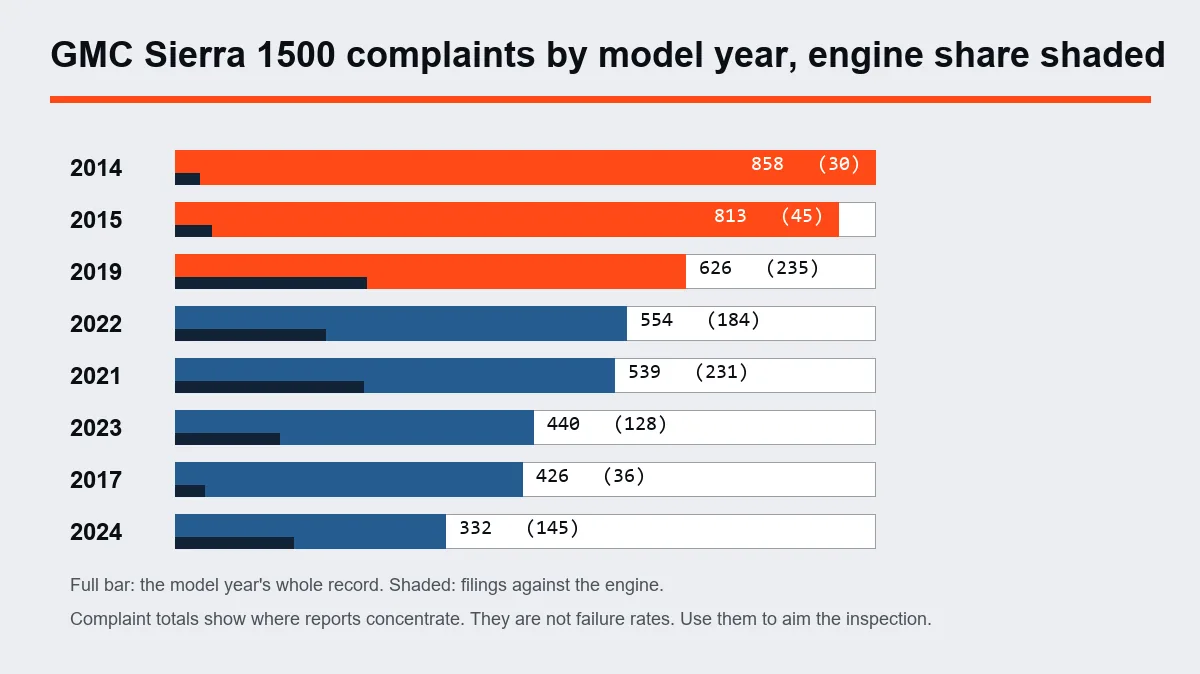
The 2014 and 2015 trucks hold 858 and 813 filings, the two largest totals in the run. The engine accounts for just 30 of the 2014 record, which is almost nothing.
Then look at 2019. That truck holds 626 filings and 204 of them are against the engine, a share that did not exist five years earlier.
So the tall bars and the shaded bars are not the same problem. The oldest trucks are busy for reasons that have nothing to do with what makes the newer ones busy.
The 2018 truck holds 296 filings, less than half the 2019 total, and looks like the quiet year as a result. Its composition says otherwise, which the transmission section deals with.
The 2014 and 2015 trucks are a lights and brakes problem
The first era has two categories and both describe something degrading rather than breaking.
Exterior lighting leads the 2014 record at 181 filings. Owners describe headlights dim enough to reduce what they can see, with dealers often finding nothing wrong.
The wording sharpens when you read them. Sixty-seven of the 181 describe lights flickering, dimming, going out or being inoperative, rather than a bulb that simply failed.
The 2015 truck carries the same thing at a smaller scale, with 113 lighting filings and 39 in that group. Two consecutive years of the same complaint is what separates a design choice from a bad batch.
Service brakes lead the 2015 record at 192. Those filings describe a pulsing pedal and a truck that will not stop properly when reversing, which owners attribute to failing vacuum assist.
GM issued campaign 19V645 covering exactly that. On 2014 to 2018 trucks the vacuum pump output can decline over time, reducing brake assist and lengthening the stopping distance.
What to test on a first-era truck
- Headlights
- View it after dark on an unlit road, not on a forecourt under floodlights
- Brakes reversing
- Back up on a slope and brake firmly, feeling for a pulsing or long pedal
- 19V645, vacuum pump
- Confirm by VIN, then read the next section before treating it as settled
- Steering
- 70 filings on the 2014 truck, worth a slow-speed check for play
Both faults are testable in fifteen minutes, which is unusual on a truck this age.
Neither shows itself on a forecourt in daylight. That is the whole reason these two years keep being described as quiet.
GM recalled the fix for the brake recall
Here is where a completed recall stops being reassurance on this vehicle.
The remedy for 19V645 was software. Dealers reprogrammed the electronic brake control module rather than replacing the pump.
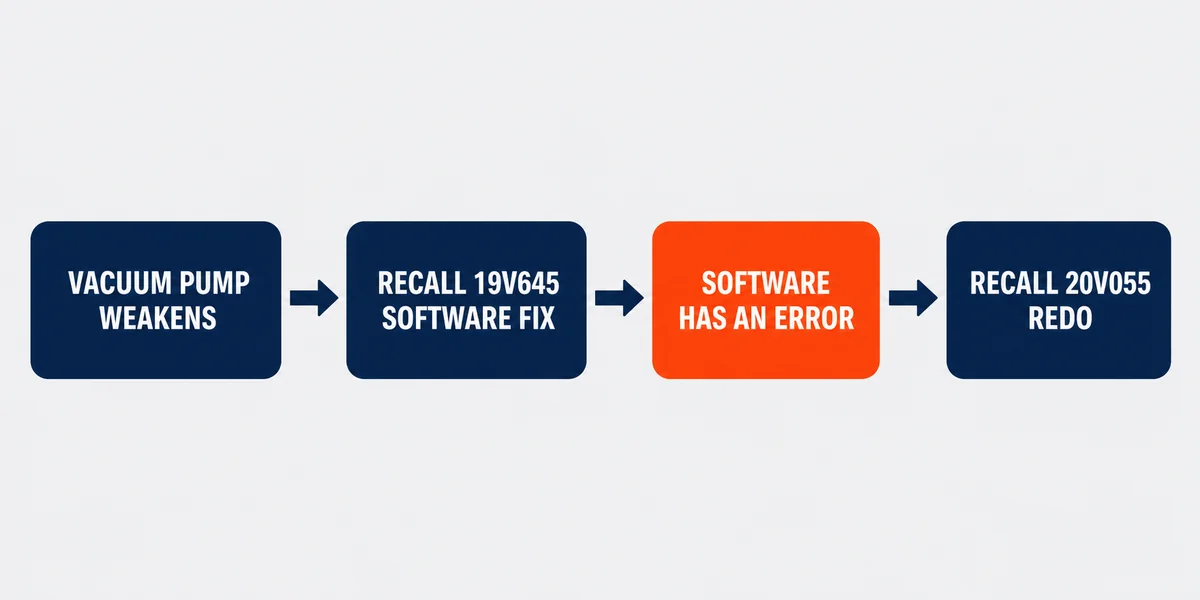
Then campaign 20V055 arrived, covering 2019 Sierra 1500 and Silverado 1500 trucks. Its stated population is vehicles that received that updated software.
GM's own wording is that the software has an error, and the result is a loss of electronic brake assist. The remedy is to reprogram the module again.
That is a narrow population and an easily fixed one. It matters because it changes what a buyer should ask, from whether the recall is closed to which version of the fix the truck is running.
The 2017 and 2018 trucks are a transmission era
There is a third era between the other two, and it is the one most likely to catch a buyer out, because those years look quiet on volume alone.
The 2017 truck holds 426 filings and the 2018 truck 296, modest totals next to 858 or 626. The composition is where the problem sits.
Power train accounts for 108 of the 2017 record and 85 of the 2018 one. On the 2018 truck that is 29 percent of everything filed against it.
Read the free text and 65 of the 2017 power train filings and 56 of the 2018 ones describe shuddering, rough or hard shifting, slipping, or the transmission failing outright.
Owners describe a shudder present from new that worsened with mileage, in one case with the gearbox failing at 75,000 miles. Others report the truck jerking, refusing to accelerate and stalling at speed.
That changes the shape of this whole record. There is no quiet window on this truck, only a choice about which fault you would rather inherit.
The useful thing about this one is that it shows itself. A transmission that shudders under light throttle between 40 and 60 mph will do it on a test drive, where an engine bearing or a grille attachment will not.
The engine takes over from 2019
From the 2019 truck onward the leading category changes and never changes back.
The engine leads every model year from 2019 through 2025. It peaks at 204 filings on the 2019 truck and 177 on the 2021.
Of the 2019 engine filings, 70 name lifters, cylinder deactivation or misfires. One owner describes the truck displaying a total loss of oil pressure at 65 mph on the highway.
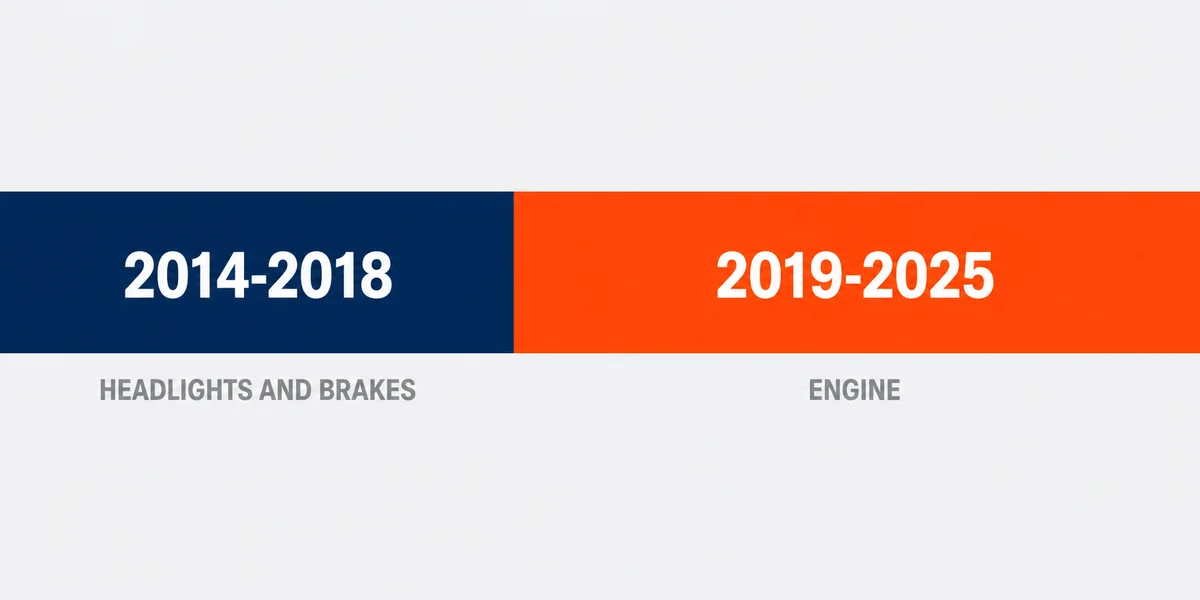
The current campaign is more serious than a component entry. Campaign 25V274 covers 2021 to 2024 trucks fitted with the 6.2 litre V8, for connecting rod and crankshaft failures, and the remedy is to inspect and where necessary replace the engine.
The first question on any modern Sierra is therefore which engine it has. The campaign reaches the 6.2 litre trucks specifically, not the whole model year.
An engine replacement also resets what the truck costs from that point on. Weigh a 6.2 litre car against the GMC Sierra 1500 reliability figures knowing the campaign may have put a new engine in it.
The grille lets go at highway speed
The newest trucks have a fault that sounds trivial until you read what happens.
Across 2022 to 2024, 158 filings name the grille, its trim or the front deflector. The structure category holds 78 of them on the 2022 truck, 62 on the 2023 and 19 on the 2024.
| Model year | Structural filings | Naming the grille or deflector |
|---|---|---|
| 2022 | 78 | 67 |
| 2023 | 62 | 48 |
| 2024 | 19 | 13 |
What owners describe is the part leaving the truck. Thirty-nine of the 158 record the deflector detaching while the vehicle was moving, most of them at highway speed.
One filing has the chrome deflector flying off at 70 mph, tearing paint from the hood and cracking a windscreen behind. Another owner stopped 270 miles into a road trip after finding several mounting points cracked.
Campaign 25V060 covers it on 2022 trucks, where the attachments holding the deflector may fracture. GM gives a detached deflector as a road hazard to other traffic.
The campaign is narrower than the complaint pattern. It reaches 2022 trucks fitted with chrome front grille deflectors, and only eight of the 158 filings name it by number.
One owner records exactly that gap. The dealer told them the recall covered the chrome 2022 deflector for the same issue, but not the part fitted to their truck.
Seventy-four of the 158 mention a recall at all. Twenty-four of those describe the part working loose again afterwards, which is a minority of the record and still a real pattern.
So on a 2022 or 2023 truck the check is physical rather than documentary. Take hold of the grille surround and feel for movement at the attachment points, whatever the campaign status says.
The Silverado record is this truck's record too
Every year list treats these as two trucks. The campaign lists mostly disagree.
Where the two lists appear to diverge, the campaign text usually closes the gap. Campaign 14V007 is indexed under the 2014 Sierra alone.
Its own summary says otherwise. The campaign recalls certain 2014 Chevrolet Silverado 1500 and GMC Sierra 1500 vehicles.
Complaint counts are a different matter entirely. The 2014 Chevrolet Silverado holds 1,558 filings to the Sierra's 858.
The 2019 trucks split the same way, 1,059 to 626. Every later year narrows until the 2024 trucks land at 332 and 287.
That gap is sales volume, not build quality. A truck sold in larger numbers generates more reports of the same fault, which is why any ranking sorted by complaint total places the Silverado worse.
Two recent campaigns do belong to one truck only. Campaign 25V060 covers chrome grille deflectors on the 2022 Sierra, and 22V873 covers 2022 Silverados whose sensing diagnostic module was left in manufacturing mode.
Heavy duty trucks are a third record again. Campaign 18V267 is indexed against the 2014 Sierra while its text covers Sierra HD and van models, so an HD result in a search says nothing about a 1500.
Which Sierra to look for
There is no year on this truck where the record goes quiet. Every model year from 2014 onward has a category leading it, so the honest question is which fault you can verify before paying.
On that measure the 2017 and 2018 trucks come out ahead, despite their transmission share. A shudder under light throttle appears on a test drive, so you can rule it out yourself in twenty minutes.
The engine years are the opposite. A worn bearing gives no warning you can provoke, which is why the 2021 to 2024 trucks depend entirely on knowing which engine is fitted and whether 25V274 applies.
Every campaign named here except the grille also covers the Chevrolet Silverado in the same entry.
A cross-shopper therefore carries almost the same checklist between the two badges. Campaign 25V060 is the one that is yours alone, and it happens to be the one you can settle by hand.
Buyers looking wider should repeat the exercise on the Ram 1500, which NHTSA files separately again.