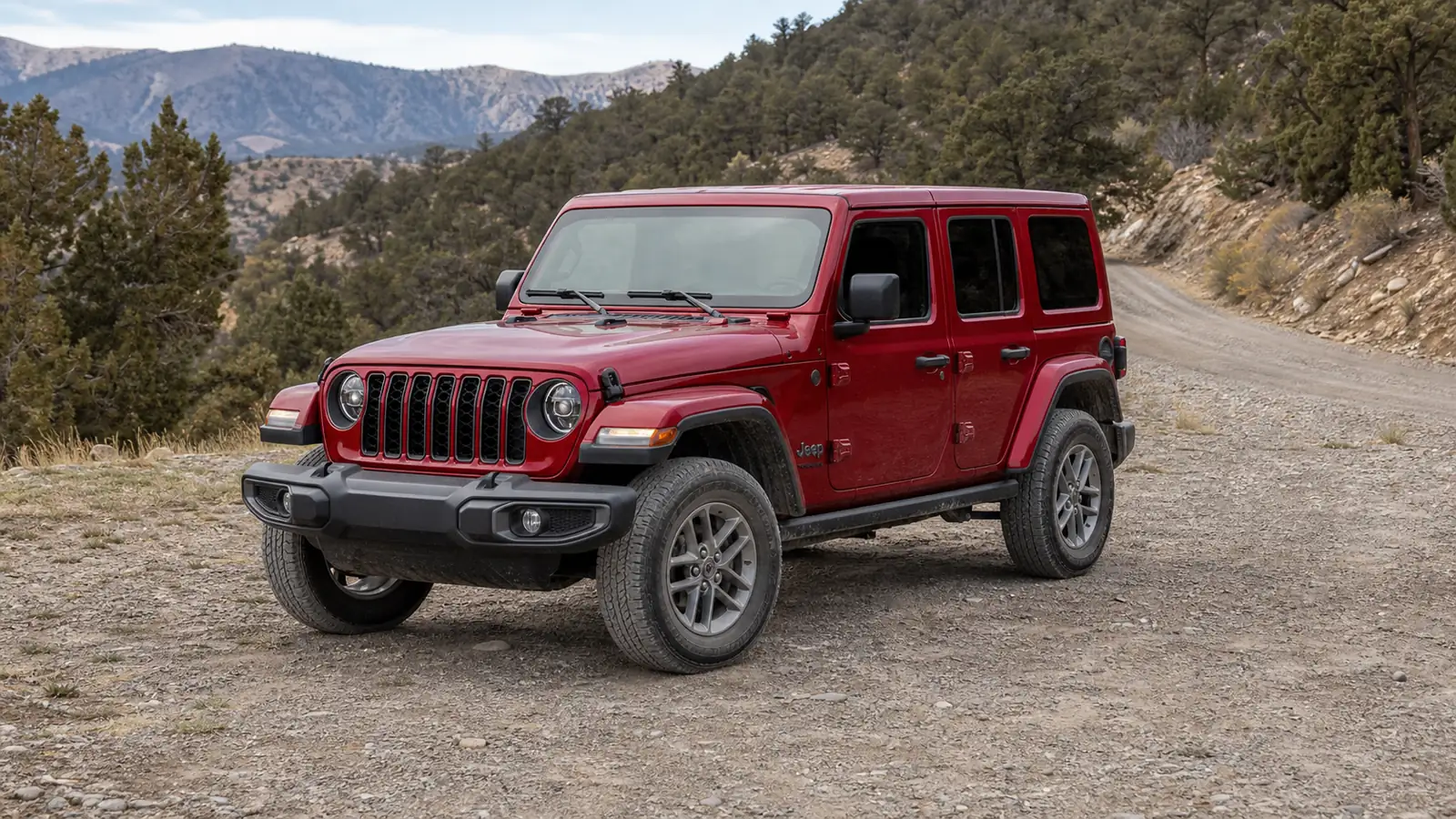
Is the Jeep Wrangler reliable?
Yes, a carefully chosen Jeep Wrangler can provide dependable long-term service. The honest verdict is average rather than exceptional because the vehicle combines durable basic hardware with steering, sealing, powertrain, and modification risks that vary sharply from one example to another.
RepairPal's invoice-based analysis rates the Wrangler 3.5 out of 5. It reports $694 in average annual repair and maintenance cost, 0.3 unscheduled shop visits per year, and a 16 percent chance that a repair is severe under its methodology.
Those numbers are useful context, but they combine multiple generations and configurations.
They cannot tell you whether one JK has frame corrosion, one JL has loose steering hardware, or one 4xe has completed the newest battery remedy.
The Wrangler's simple version remains the easiest to evaluate. A stock or conservatively modified gas model with factory-like steering geometry, matching tires, dry floors, stable fluids, a clean module scan, and complete safety campaigns presents fewer unknowns than a diesel, plug-in hybrid, or heavily altered trail build.
There is also a current safety exception that should precede a general reliability discussion. NHTSA's June 2026 alert says certain 2021 to 2025 Wranglers may have an electrical connection problem in the electrohydraulic power-steering pump wiring that can overheat and cause a fire while the vehicle is parked.
That active safety alert makes a current VIN check essential before any purchase or ownership decision.
What is normal Wrangler behavior, and what signals a fault?
A Wrangler does not feel like a car-based compact SUV, and Jeep's owner's manual explicitly says it handles and maneuvers differently from many passenger vehicles. The live axles keep both wheels tied to one rigid housing, while the upright body and removable panels trade quietness and aerodynamic stability for visibility, articulation, and open-air use.
Light steering corrections in crosswinds, more impact feedback over broken pavement, tire hum, and wind noise around the roof can be expected. The two-door model also responds more quickly to surface changes because its wheelbase is shorter.
Those traits have limits.
A steering wheel that continues shaking after one bump, measurable free play, a steady pull on level pavement, clunks that change with steering input, water reaching carpet, warning lights, or interrupted drive power require diagnosis.
| What you notice | It may be normal when | It needs inspection when | First check |
|---|---|---|---|
| Steering correction | Wind, crowned road, or aggressive tires create a small predictable input | The vehicle wanders on level pavement or needs constant correction | Tire pressure, wear, alignment, joints, and modification geometry |
| Impact feedback | One axle reacts to a pothole or pavement edge | The steering keeps oscillating after the impact | Track bar, tie rod, drag link, ball joints, bearings, tires, and damper |
| Roof or door noise | Removable panels are installed correctly but transmit more wind | Noise changes with water entry, a lifted seal, or a loose latch | Panel seating, seal condition, door surround, and header contact |
| Driveline sensation | Four-wheel drive is engaged on a suitable loose surface | Binding occurs on dry pavement or the transfer case will not shift correctly | Operating mode, tire match, linkage, fluid, and driveline condition |
A useful road test begins cold and covers more than a smooth dealership loop. Drive rough and smooth pavement, reach highway speed where safe, brake firmly without panic, make tight low-speed turns, and operate the transfer case on an appropriate surface.
Repeat the steering test after the tires warm because pressure and construction can change the feel.
Expected character stays predictable, while a defect repeats, escalates, or leaves physical and electronic evidence.
Why does a Jeep Wrangler develop steering shake?
A sharp kick at the steering wheel is not automatically the sustained oscillation commonly called death wobble. The serious pattern begins after a bump and continues as the front wheels and steering linkage feed movement back and forth until the driver slows substantially.
FCA's V41 steering-damper campaign covered about 192,000 included 2018 and 2019 JL Wranglers. FCA said the damper might not effectively control oscillation, particularly above 55 mph after a bumpy surface and in temperatures below 40 degrees Fahrenheit.
That campaign does not prove that every later shake needs only a damper.
NHTSA's PE19-012 closing resume separates damper-related shimmy, steering calibration, and a safety recall involving the front track-bar bracket weld.
The track bar locates the front axle from side to side. Movement at its axle or frame mount can let the housing shift under the vehicle, while looseness in ball joints, tie-rod ends, the drag link, wheel bearings, or control-arm bushings can add another path for oscillation.
Tires and geometry complete the system.
An out-of-round tire, poor balance, uneven wear, too little caster, incorrect toe, a large change in wheel offset, or a lift installed without geometry correction can trigger or amplify movement even when no single joint has separated.
The inspection should begin with tire size, pressure, condition, and balance, then proceed through wheel bearings, ball joints, tie rod, drag link, track-bar joints and mounts, control arms, fastener torque, toe, and caster. The shop should compare measured play and alignment values with the vehicle's actual suspension height and wheel setup.
Certain 2018 and 2019 JL vehicles also need proof that NHTSA campaign 18V675 was completed correctly. That action addressed a front track-bar bracket weld that could separate, and some vehicles required reinspection because of an earlier inspection-procedure issue.
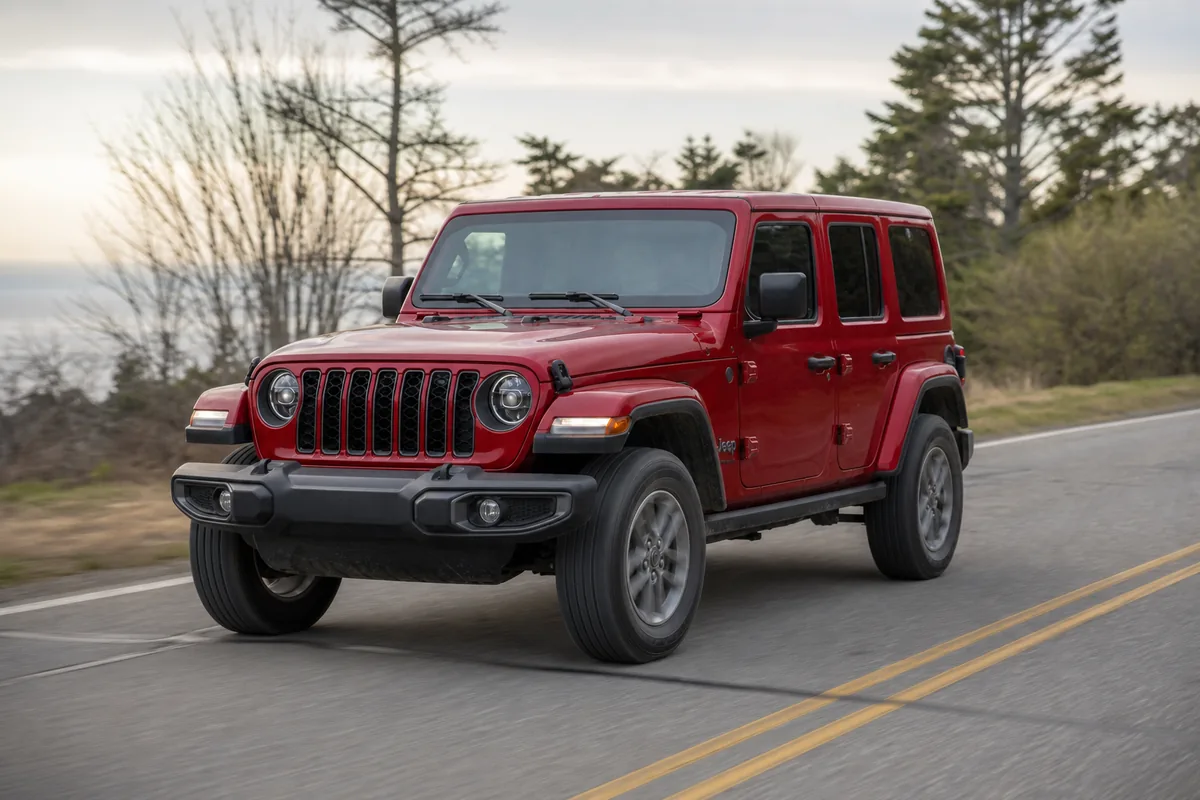
If the steering oscillates on the test drive, slow safely and end the evaluation.
Buy only after the source is found, the repair is documented, and a second road test confirms stable steering on the same kind of surface.
Where does water enter a Wrangler?
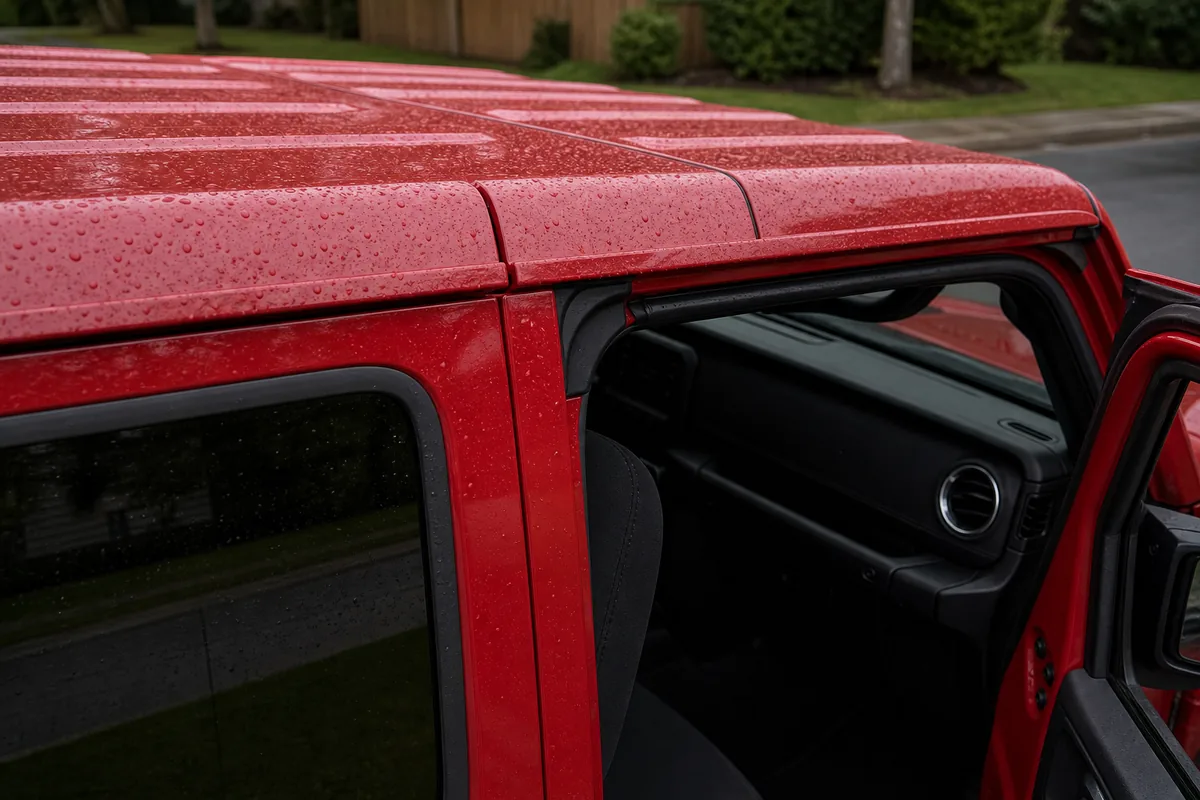
Water can enter around removable roof panels, door surrounds, header seals, the B-pillar area, or the cowl, but the stain does not identify the path by itself. Airflow and gravity can move water away from the opening before it appears on trim or carpet.
FCA bulletin 23-060-24 applies to defined 2021 to 2025 JL Wranglers with three-piece hardtops. It describes water at the top of the B-pillar when the vehicle is parked on a downward incline, with moisture reaching the door trim or carpet because specified foam pads were missing.
Older JK vehicles have a different documented path. FCA bulletin 23-034-14 Rev A addresses front-footwell water accumulation on certain 2007 to 2014 Wranglers associated with cowl trim panel fasteners.
Other leaks can follow a twisted, dirty, pinched, or poorly seated removable-panel seal. A panel installed out of sequence may latch while leaving uneven compression at the header or center joint.
The consequence extends beyond a wet surface.
Carpet padding can hold water after the top fibers feel dry, allowing odor, fastener corrosion, mold, or connector problems to develop out of sight.
Inspect after rain if possible, or use a controlled low-pressure water test while a second person watches inside. Begin below the suspected area and work upward slowly so the first water path is not hidden by runoff from above.
Remove and reinstall the roof panels according to the manual, then inspect the full contact surface for folds, debris, cuts, hardened rubber, uneven latch tension, and evidence of sealant spread over the area. Lift an accessible carpet edge and check the padding rather than relying on a dry floor mat.
A proper repair record should identify the source and the parts or adjustment used. A fresh fragrance, newly shampooed carpet, or a bead of general-purpose sealant does not prove the underlying path was corrected.
Treat recurring water entry as an electrical and corrosion risk, not merely an open-air vehicle inconvenience.
A dry cabin after a controlled retest is the evidence that matters.
Which powertrain changes the reliability picture?
The naturally aspirated 3.6-liter V6 paired with the eight-speed automatic is the lower-complexity mainstream JL choice. It still needs stable oil and coolant levels, a clean cold start, smooth shifting, and documented service, but it avoids the diesel emissions system and the 4xe high-voltage system.
The 2.0-liter turbo four uses forced induction and its own cooling hardware. It can be a sensible gas choice when its service history is continuous, the cooling system is dry, the turbo delivers power smoothly, and no stored boost, misfire, or cooling codes appear.
The six-speed manual changes the risk more than its simplicity suggests. Recall 23V116 covers certain 2018 to 2023 JL Wranglers because an overheated clutch pressure plate can fracture, open the transmission case, and expel heated debris that may cause a fire.
FCA's remedy instructions identify clutch replacement plus instrument-cluster and powertrain software work for applicable vehicles. Clutch odor, slipping under load, a changing engagement point, or campaign records that do not name the completed remedy should stop the test until the VIN is checked.
The discontinued 3.0-liter EcoDiesel adds selective catalytic reduction, a diesel particulate filter, exhaust-gas recirculation, and high-pressure fuel equipment. Highway use can suit that system better than repeated short trips, but a buyer still needs complete emissions, cooling, fuel-system, and campaign records.
The Wrangler 4xe combines a turbo gas engine with motors, power electronics, charging hardware, and a high-voltage battery. Its electric driving ability is valuable only after the current battery action is resolved and every propulsion mode operates without active, pending, or stored faults.
Evidence required by Wrangler powertrain
- 3.6-liter V6 automatic
- Cold-start sound, oil and coolant stability, smooth shifts, scan, and routine-service history
- 2.0-liter turbo automatic
- Cooling pressure test, dry turbo plumbing, stable boost, clean scan, and correct oil history
- 3.6-liter V6 manual
- 23V116 status, clutch replacement proof when applicable, pedal feel, odor check, and loaded acceleration
- 3.0-liter EcoDiesel
- Emissions readiness, fuel and EGR campaign proof, coolant stability, and evidence of suitable duty cycle
- 4xe plug-in hybrid
- 25V741 status, high-voltage inspection, charging history, full scan, and operation in electric and hybrid modes
No powertrain choice cancels the need to inspect the rest of the vehicle.
The better long-term choice is the configuration whose added systems match your use and whose records prove they have been maintained and updated.
How do off-road use and modifications change what fails?
Trail use does not automatically ruin a Wrangler, but it changes which evidence matters. Low-speed rock work, water, mud, dust, repeated tire slip, and underbody contact load parts that highway mileage barely touches.
Larger tires add rotating mass and leverage.
Steering joints, wheel bearings, brakes, axle shafts, driveshafts, and gears all work harder, especially when the tire is much heavier than stock or the axle ratio was never corrected.
Wheel offset changes scrub radius and the leverage applied to bearings and steering parts. A lift can reduce caster, change control-arm and driveshaft angles, and leave brake hoses or wiring with insufficient travel when the suspension extends.
The parts therefore need to be judged as a system. A quality lift with matched springs, dampers, control arms, track bars, bump stops, driveshaft provision, alignment data, and torque records is different from a collection of parts installed without measurements.
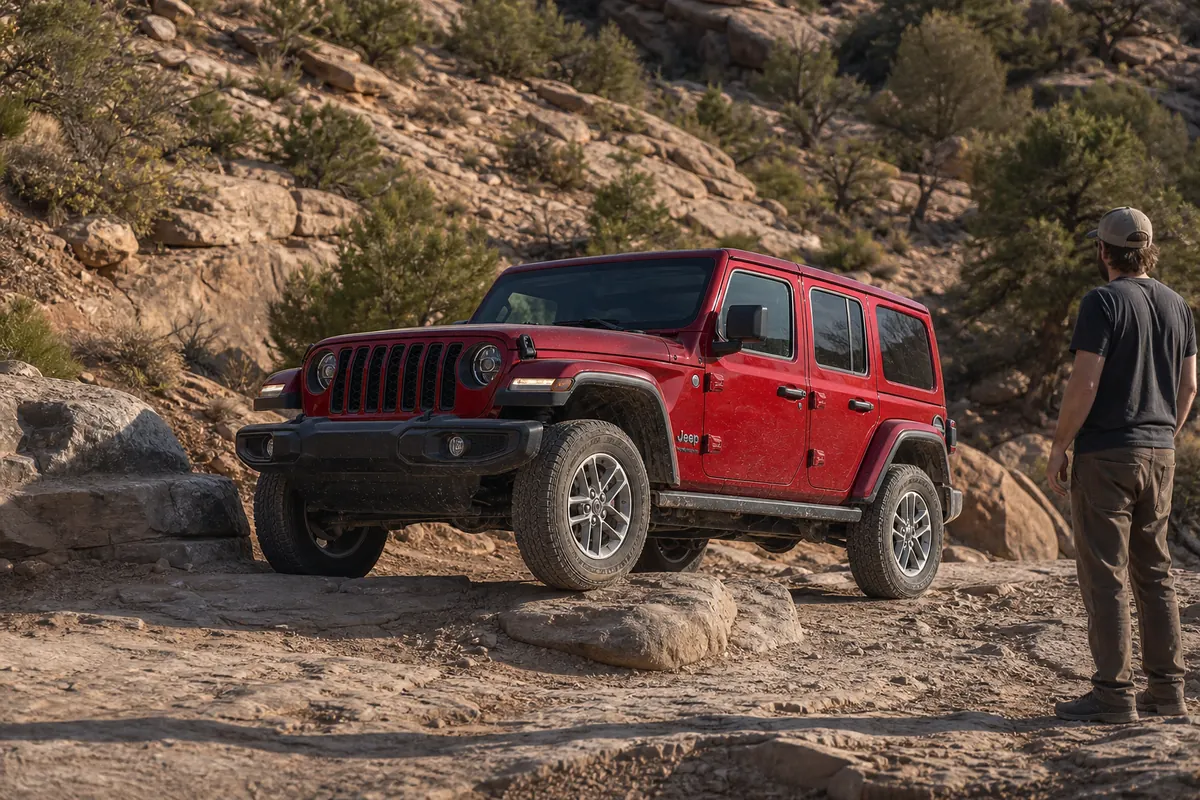
Water crossings add another layer.
Axle, transmission, and transfer-case breathers, wheel bearings, brake components, starter and alternator connections, and body connectors can be exposed even when the cabin stays dry.
Mud can also hide leaks, trap moisture against the frame, and unbalance a wheel. Rock contact may bend a bracket or skid plate without leaving obvious body damage above it.
- Before the trailEstablish fluid levels, tire condition and pressure, steering feel, brake response, and underbody condition
- During the trailNote impacts, deep water, overheating, warning lights, steering changes, and repeated wheelspin
- After the trailWash without forcing water into connectors, inspect steering and underbody hardware, check brakes and fluid contamination, and retorque specified parts
- After symptoms appearStop using the vehicle as normal until noise, vibration, pull, heat, leak, or warning is diagnosed
A used buyer should ask for lift and alignment invoices, axle ratio, tire age and load rating, programmer status, torque checks, and photographs or records from post-trail service. Inspect frame and suspension brackets, skids, control arms, differentials, driveshafts, hoses, wiring, exhaust, wheel openings, and recovery points from below.
Look for mismatched new parts around one corner because they can reveal a localized impact. Fresh undercoating over dirt, scale, welds, or bent metal deserves closer inspection rather than credit for cosmetic improvement.
Pay for modifications only when their engineering and maintenance are documented.
Unknown parts and altered geometry should reduce the price because the next owner inherits both their wear and their diagnostic complexity.
Which Wrangler safety actions matter right now?
The current priority for many gas and hybrid Wranglers is the June 2026 power-steering-pump wiring action. NHTSA says the issue affects more than 1,076,000 combined 2021 to 2025 Wrangler and Gladiator vehicles and may cause a fire even while the vehicle is turned off.
At the time of its June 9 alert, NHTSA said it was aware of 51 likely related fires and one injury. Owners of affected, unrepaired vehicles were told to park outside and away from other vehicles and buildings until repair.
The 4xe has a separate high-voltage battery action. Campaign 25V741 covers certain 2020 to 2025 Wrangler 4xe vehicles because internal battery failure can cause a fire while parked or driving.
NHTSA tells owners of included, unrepaired 4xe vehicles to park outside away from structures and other vehicles and not to charge until the new remedy is completed. The warning still matters when an older battery software action was performed because NHTSA found that the previous remedy did not detect every relevant abnormality.
Older Wranglers can carry an even more urgent instruction. NHTSA's February 2026 Takata alert includes 2007 to 2016 Wranglers with open, unrepaired inflator recalls and says they should not be driven until repaired.
| Vehicle or configuration | Action | Risk | What to do |
|---|---|---|---|
| Certain 2021-2025 Wranglers | 2026 steering-pump wiring action | Overheated connection and fire while parked or driving | Check the VIN and follow the park-outside instruction until repaired |
| Certain 2020-2025 Wrangler 4xe models | 25V741 | Internal high-voltage battery failure and fire | Park outside, do not charge, and complete the new remedy when included |
| Certain 2018-2023 JL manuals | 23V116 | Overheated clutch pressure plate can fracture and expel hot debris | Confirm inclusion and completed clutch and software remedy |
| Certain 2018-2019 JL models | 18V675 | Front track-bar bracket weld can separate | Confirm correct inspection or reinspection and repair |
| Certain 2007-2016 JK models | Open Takata inflator actions | Inflator rupture can cause serious injury or death | Do not drive an affected unrepaired vehicle and arrange the free repair |
Broad model-year ranges are not proof that a particular vehicle is included. Use the NHTSA VIN or license-plate lookup, then confirm completion through a Jeep dealer and retain the invoice.
A dashboard with no warning lights cannot establish recall status.
Current VIN evidence controls today's parking, charging, and driving decision.
Can a Jeep Wrangler reach 200,000 miles?
A Wrangler can reach 200,000 miles, but no credible source can promise that result for one vehicle. Mileage survival depends on corrosion exposure, operating temperature, lubrication, trail impacts, water crossings, towing, modifications, repair quality, and whether early symptoms were corrected before they damaged other parts.
Survival also differs from inexpensive ownership. A Wrangler may remain roadworthy after an axle rebuild, clutch, steering overhaul, cooling repair, roof-seal work, or electrical diagnosis that another owner would consider too costly.
Start with the engine and transmission, but do not end there. Verify cold and hot oil pressure where appropriate, oil consumption, coolant stability, shift quality, clutch behavior, transfer-case operation, axle noise, driveshaft vibration, and leaks at operating temperature.
Then inspect the structure and control systems. Frame corrosion, cracked or distorted brackets, loose steering joints, uneven tires, wet carpet, corroded connectors, altered wiring, and unresolved campaign work can shorten useful life even when the engine starts cleanly.
A high-mileage stock Wrangler with continuous records can be easier to trust than a lower-mileage lifted vehicle with unknown gearing and no alignment history. The odometer counts distance, while it says nothing about the force of impacts or the quality of modifications.
Ask whether the service pattern matches the use. A trail-driven vehicle should have evidence of post-use inspection, fluid checks after deep water, brake and steering attention, and prompt repairs after impacts or new vibration.
A road-only vehicle should still show routine drivetrain-fluid, cooling, brake, tire, and steering care. Long periods of inactivity can create their own seal, battery, brake, and tire issues.
Two hundred thousand miles is plausible when the condition and records support it, but it is never a substitute for inspection.
Price the remaining work on the exact vehicle rather than paying for a reputation attached to the badge.
The best Wrangler is the one whose history still adds up
Start by recording the VIN, generation, engine, transmission, axle ratio if known, tire size, wheel offset, suspension height, roof type, and major accessories. Those details determine which campaigns, wear paths, and tests apply.
Every candidate deserves a cold start, full-module scan, highway steering test, braking test, transfer-case operation on a suitable surface, fluid and leak inspection, roof and carpet check, tire measurement, and underbody view. A modified vehicle also needs alignment data and evidence that gearing, driveshaft angles, hoses, wiring, and fastener torque were addressed.
A small roof rattle, ordinary tire noise, or cosmetic trail mark can be an acceptable Wrangler tradeoff when the vehicle remains dry, straight, stable, and mechanically documented.
These items can be priced rather than feared.
Persistent steering movement, active safety instructions, water below the carpet, structural rust, overheating evidence, or missing modification records carry a different consequence. They can connect several systems and turn an attractive accessory list into a long diagnostic bill.
The lower-risk choice is usually a stock or carefully modified gas Wrangler with complete campaigns and records that match its use. A diesel, manual, or 4xe can still be a sound purchase, but only when the extra hardware and current safety work are proven rather than promised.