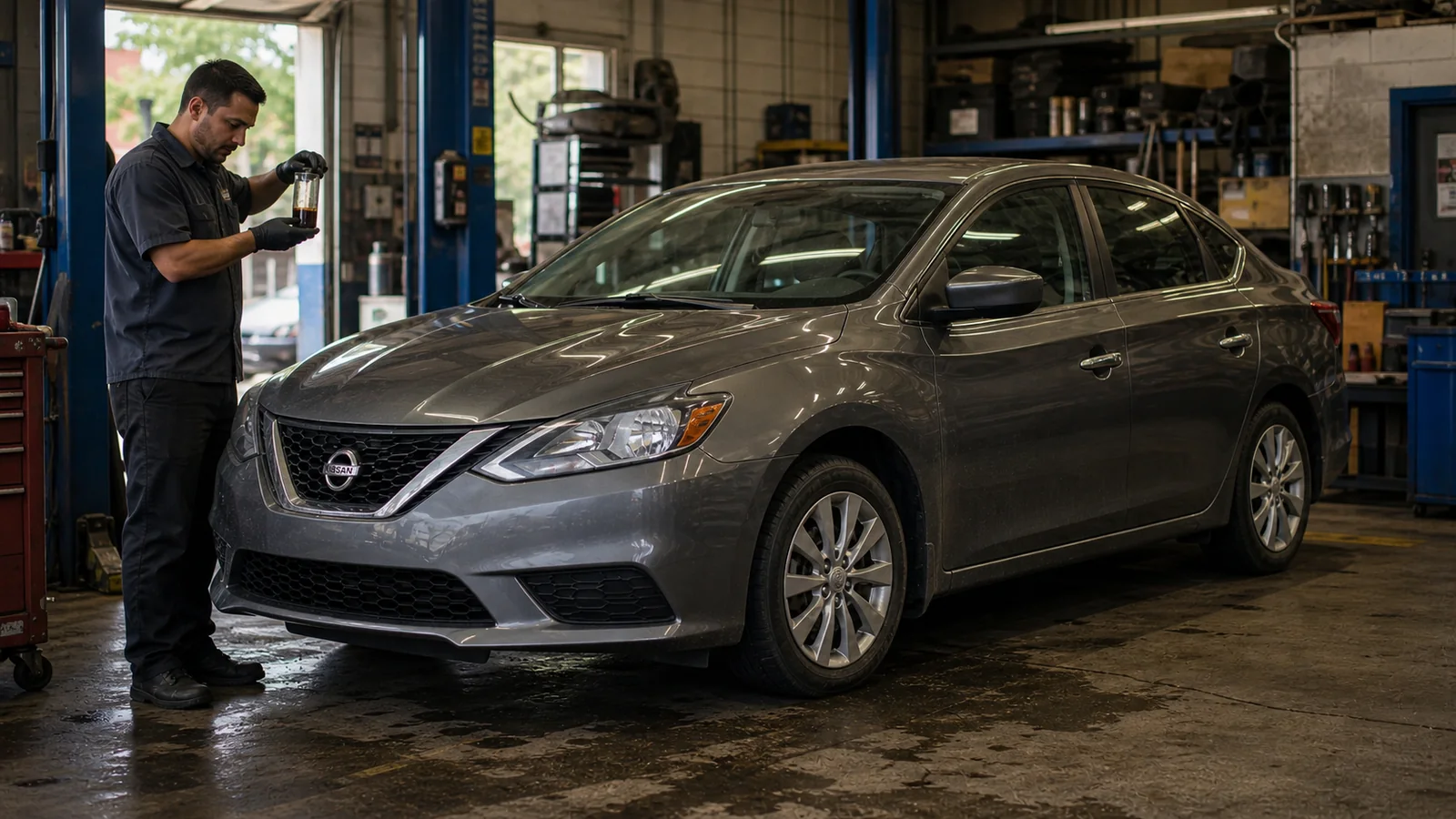
B17 CVT failures dominate Sentra risk
On paper the Sentra scores mid-pack. RepairPal rates it around average for a compact car and puts yearly running costs on the low side, which is what pulls budget buyers in.
The problem is that the average hides a transmission that fails on specific years. CarComplaints lists transmission as the worst problem category across the model's life, and its two loudest complaints are 2015 and 2014 CVT failures.
That gap between the reputation and the reality is where used buyers get burned.
A CVT has no fixed gears, so when it starts to slip there is no clean shift to mask the wear.
On the bad Sentra years the belt and pulleys inside the unit glaze and lose grip, and the car reacts by shuddering, holding revs, then hesitating before it finally moves.
Once that starts, a rebuild rarely fixes it for long, and a full replacement often costs more than a high-mileage Sentra is worth.
That is the math that turns a cheap listing from a bad year into a car you cannot resell.
The trouble is not spread evenly. It clusters in one generation, and the fault is almost always the same:
- 2005Older 1.8L can blow a head gasket, around $1,300 to fix near 76,000 miles
- 2013Redesigned Sentra draws the most complaints of any year, most aimed at the CVT
- 2013-2015Peak CVT trouble: juddering, power loss, and outright failure well before 100,000 miles
- 2016-2017Same CVT family, fewer complaints but the identical failure pattern
- 2020+Eighth-generation redesign, a stiffer car with a reworked transmission
The 2013-2015 cars need replacement proof
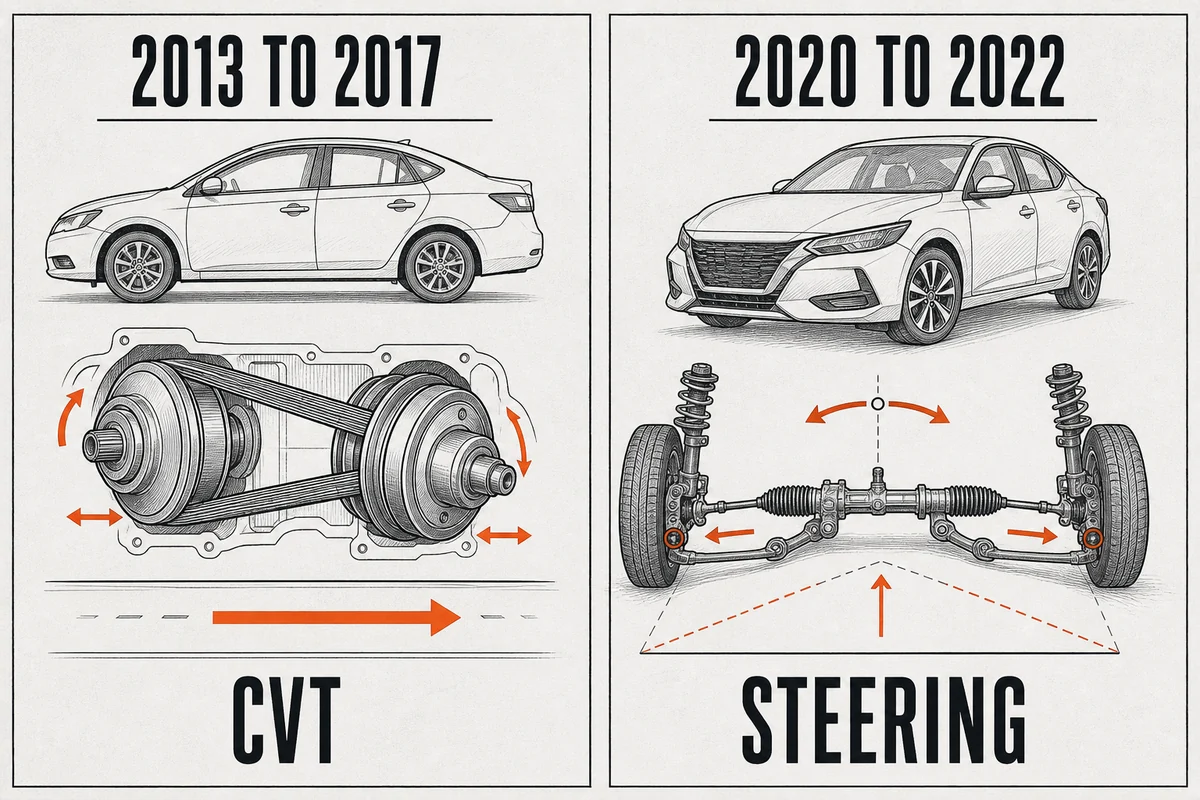
The 2013-2015 cars are the ones to fear most. These launched the seventh-generation Sentra with Nissan's Jatco continuously variable transmission, and it is the single worst part of any Sentra.
Owners report shudder on light throttle, a lag then a lurch when accelerating, and complete loss of drive.
Walk away from any of these years that shudders or hesitates on the test drive.
| Year or group | Starting verdict | Evidence | Required check |
|---|---|---|---|
| 2005 | Inspect the engine | Head-gasket reports belong to the older 1.8L generation | Cooling pressure, coolant condition, and exhaust |
| 2013 | Avoid without proof | Seventh-generation launch and peak CVT complaints | Cold engagement, judder, and replacement invoice |
| 2014-2015 | Avoid weak CVTs | Similar failure pattern and high repair burden | Full CVT scan and long road test |
| 2016-2017 | Inspect carefully | Same CVT family with lower complaint concentration | Fluid history, heat behavior, and codes |
| 2018-2019 | Consider cautiously | Late B17 years received warranty attention | VIN and transmission record |
| 2020-2022 | Consider by VIN | New platform, plus a tie-rod safety recall | Steering recall and CVT condition |
| 2023+ | Consider | Newer age reduces wear but does not prove CVT health | Warranty and maintenance status |
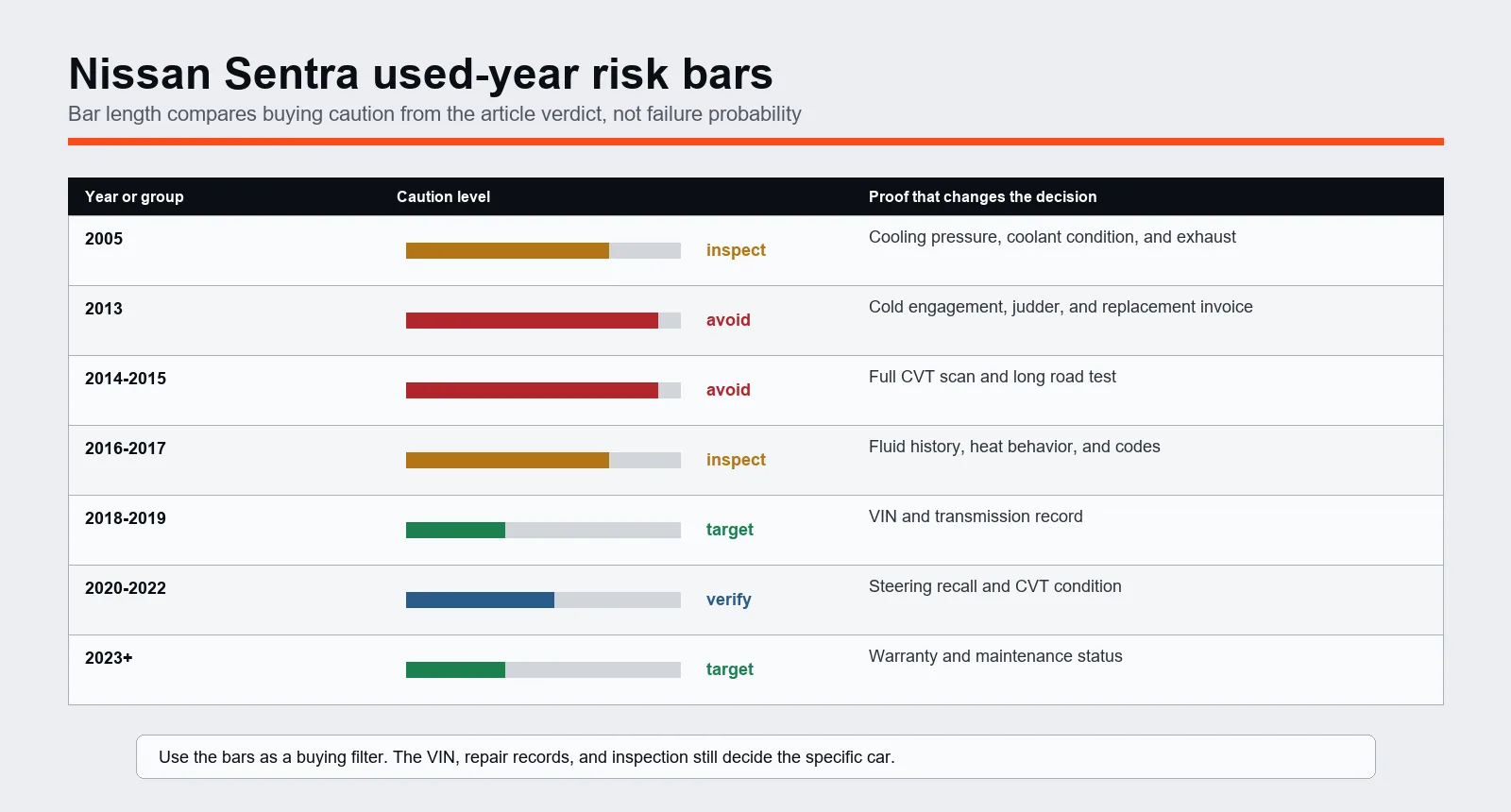
Use the Sentra table to separate engine, CVT, and steering checks. The rows do not imply that every car fails the same way.
Move a vehicle forward only when its VIN, repair history, and physical condition support the row.
A 2005 head gasket is a separate problem
The 2016 and 2017 cars are a softer warning. They use the same CVT family and show the same failure behavior, just in smaller numbers as the design aged.
A 2016 or 2017 with a clean transmission service record and no shudder is a usable car, but it carries the same risk if the CVT was never touched.
There is no version of these years where you can skip the transmission inspection.
The 2005 car sits in a different era with a different problem. It came before the CVT, so the fault there is a blown head gasket on the 1.8L engine, a repair CarComplaints pegs near $1,300.
That is a cheaper failure than a dead transmission, but on a car this old it usually signals a life of thin maintenance, so it is a warning about the specific car in front of you as much as the year.
The 2020 redesign adds a steering check
Sentra value depends on transmission behavior and recall completion more than a broad score.
Pros
- Buy a 2020 or later car with a clear steering recall and smooth CVT
- Consider a documented replacement CVT when the price reflects the history
Cons
- Skip any B17 car that hesitates, judders, or loses power under steady throttle
Apply the filter after the CVT reaches operating temperature.
The case for waiting on a newer Sentra is strong. The 2020 redesign moved the car onto a stiffer platform, gave it a far better interior, and paired it with a reworked CVT that has drawn a fraction of the complaints the 2013-2017 cars did.
It is not flawless, some 2020-2023 owners still report occasional CVT shudder and there is no settlement backing those years, so a test drive and a fluid-history check still matter.
But as a used buy it is a different class of car from the years that earned the bad name.
If you want an even calmer transmission record, cross-shop the Toyota Corolla or a Honda Civic, and if this is a first car, the best first cars list weighs running cost against these risks.
Warm the CVT before making the call
Drive the Sentra long enough to warm the transmission. A CVT may behave normally for the first few miles, then judder or reduce power when heat builds.
Nissan's CVT owner notice lists settlement coverage for 2013-2017 Sentras. Newer 2020-2022 cars need a separate VIN check for the tie-rod recall, so one clear record does not clear the other.
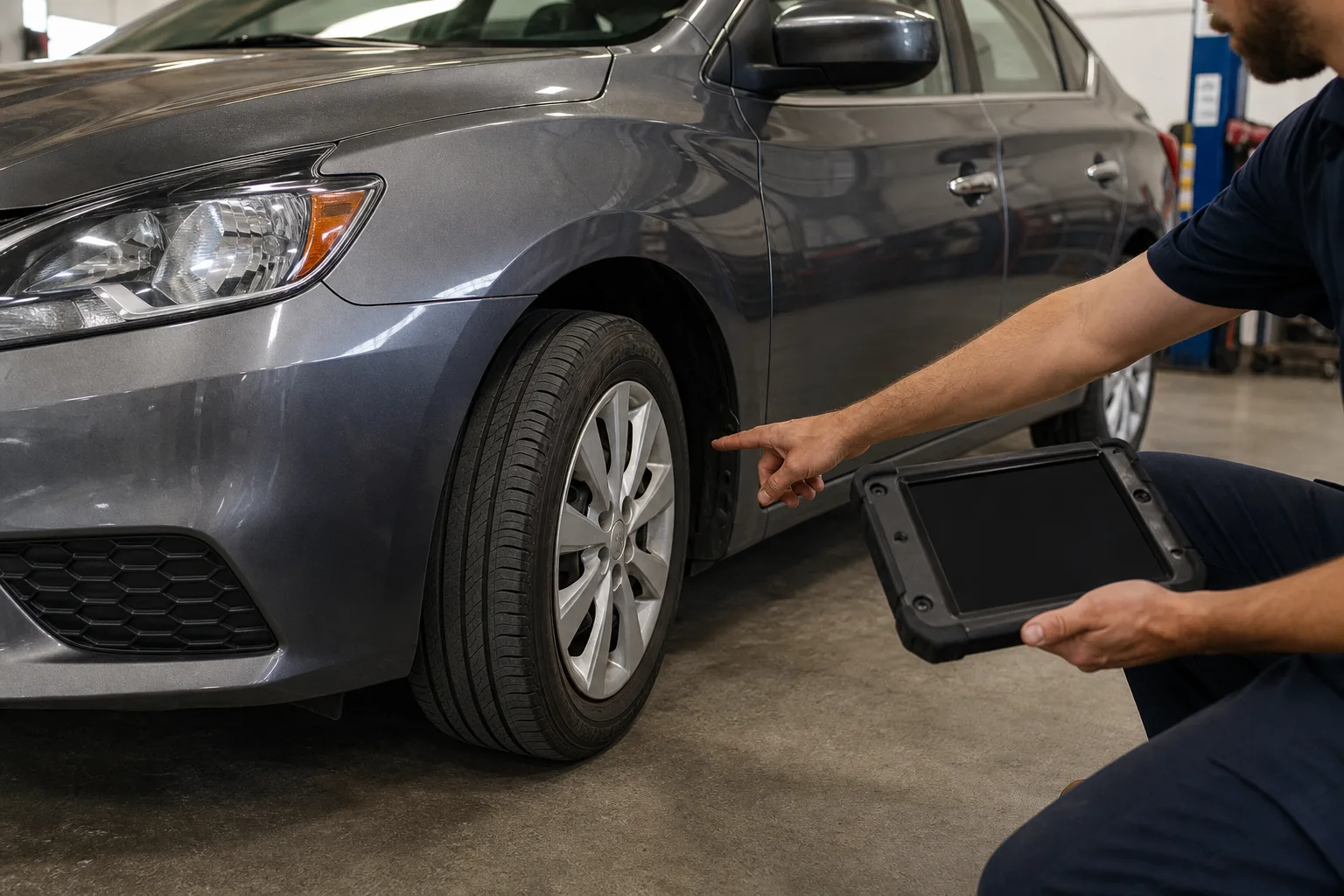
The Sentra profile separates the older head-gasket concern from the later CVT years. On a B17 car, repeat a gentle uphill pull after the fluid warms and watch for rpm flare, vibration, or reduced power.
On a 2020-2022 car, inspect steering response and confirm the tie-rod recall status before treating the newer platform as cleared.
Repeat these checks before and after warmup:
- Test cold Drive and Reverse engagement
- Repeat steady-throttle acceleration after the CVT warms
- Scan for stored transmission and steering codes
- Check coolant condition on older 1.8L cars
- Use the Nissan model range and compact sedan field to judge the asking price
Missing paperwork does not prove that a repair was unnecessary. Walk away when hot CVT behavior or steering records conflict with the advertised condition.
Replacement proof changes the B17 Sentra verdict
A B17 Sentra with a replacement CVT may be worth considering when the record identifies the unit, install mileage, fluid, and warranty.
Ask whether it was new, remanufactured, or used. A vague receipt for "transmission service" does not answer that question.
Nissan's bulletin cited above describes CVT diagnosis and repair context. Match it to the symptoms and VIN instead of treating publication of a bulletin as proof of repair.
Start the drive cold, but do not finish there. Include repeated low-speed pulls, a highway segment, a moderate grade, and hot Reverse engagement.
Watch for rpm flare, judder, delayed movement, whining, or reduced-power behavior.
A quiet idle says almost nothing about CVT condition. Scan for stored ratio, pressure, temperature, ABS, airbag, and steering faults before accepting a clean dashboard.
Evidence by Sentra concern
- B17 CVT
- Unit history, correct fluid, hot drive, and clean scan
- 2005 cooling issue
- Cold level, pressure test, and overheating history
- 2020 steering
- Straight tracking, return-to-center, and VIN campaigns
- All years
- Collision repair, tire condition, and complete module scan
Steering and chassis checks protect the newer-car choice
The 2020 redesign changes the primary concern, so the inspection must change with it. Drive on a flat road and note whether the wheel returns naturally after a gentle turn.
Check for wandering, binding, uneven tire wear, or a steering warning.
Confirm current recalls by VIN. Do not carry the old B17 CVT verdict into a newer car without testing the systems it actually uses.
Inspect brakes, suspension, A/C, wheel bearings, and underbody damage as separate costs. A recommended year with bald tires and deferred brakes still needs immediate money.
A higher-mile car with complete CVT proof may be safer than a low-mile example that only made short trips and has no records.
Choose the Sentra whose inspection matches its generation and whose major repair history can be verified.
Use a generation-specific inspection sheet:
- B17 cars need a fully warm CVT drive and unit-history review
- A 2005 candidate needs cooling pressure, coolant condition, and overheating history
- A 2020-or-newer car needs steering return, tracking, and campaign checks
- Every Sentra needs a complete scan, brake test, tire measurement, and collision inspection
If a B17 hesitates after heat, obtain a CVT diagnosis before discussing price. If a newer car wanders, confirm tire alignment and steering faults instead of assuming one cause.
The cheapest visible repair should not distract from the system that carries the largest downside.
A useful inspection ranks faults by safety and cost, then the offer follows that order.
On a newer Sentra with steering concerns, an alignment printout can add useful evidence when paired with tire inspection and a road test.
Alignment alone does not clear binding, poor return, or an electronic steering fault. On a B17 CVT car, the equivalent supporting document is a scan and hot-drive report.
Each generation needs its own proof. That distinction keeps the inspection focused and avoids replacing unrelated parts while the main symptom remains unexplained.
A cheap Sentra needs a larger evidence margin
Low purchase price can make buyers accept a shorter drive or incomplete records. That is risky on a B17 car because the cost of an uncertain CVT can dominate the value of the vehicle.
The inspection standard should become stricter as the repair exposure grows relative to the car's price.
Start by separating immediate visible costs from the major unknown.
Tires, brakes, battery, and worn suspension can be measured.
A delayed, hot CVT symptom needs diagnosis. On a newer Sentra, apply the same logic to steering faults that remain after tire pressure and alignment are checked.
Do not proceed when:
- The seller refuses a fully warm drive
- Transmission codes were recently cleared without an invoice
- Replacement history cannot identify the installed unit
- Steering binding or poor return remains unexplained
- Cooling loss on an older car has no located source
A discount is useful only if the buyer knows what it covers. Unknown major-system risk cannot be priced as accurately as a set of tires.
Compare the rejected car with the cost of a documented candidate, including inspection and immediate maintenance.
The stronger evidence margin often makes the apparently expensive Sentra the cheaper ownership choice.