The 2021 launch year has the heaviest record
NHTSA currently returns 153 complaints and six recalls for the 2021 K5.
The 2022 follows with 120 complaints and five recalls. The 2023 has 97 complaints and four recalls, while 2024 drops to 26 complaints and two recalls.
CarComplaints' K5 overview labels 2022 its worst year within a much smaller owner-submitted dataset.
Its most-reported individual complaint is a sulfur smell in the cabin. NHTSA's larger report set points to 2021 as the main investigation year.
Together they support a cautious 2021-2022 filter rather than a claim that every early K5 is defective.
| Year | Starting verdict | Powertrain-specific exposure | Required proof |
|---|---|---|---|
| 2021 | Avoid incomplete campaign cars | Six recalls, including 2.5T fuel line, steering, DCT pump, airbag, and fuel tank | Full VIN history and powertrain-matched inspection |
| 2022 | Inspect closely | Five recalls and the same major GT and 1.6T campaign groups | Fuel-tank record, GT DCT record, steering, and airbags |
| 2023 | Consider with records | DCT pump, curtain airbag, trim, and fuel-tank campaigns | Engine code, recall completion, and hot road test |
| 2024 | Best used target | Fuel-tank recall reaches certain 1.6T cars | Recall 25V794, tank inspection, and normal wear |
| 2025 | Consider by build and trim | Updated standard engine and two current recalls | VIN lookup, roof trim, electronics, and service history |
| 2026 | Too new for a mature record | One current recall and short exposure | Current campaigns and full inspection |
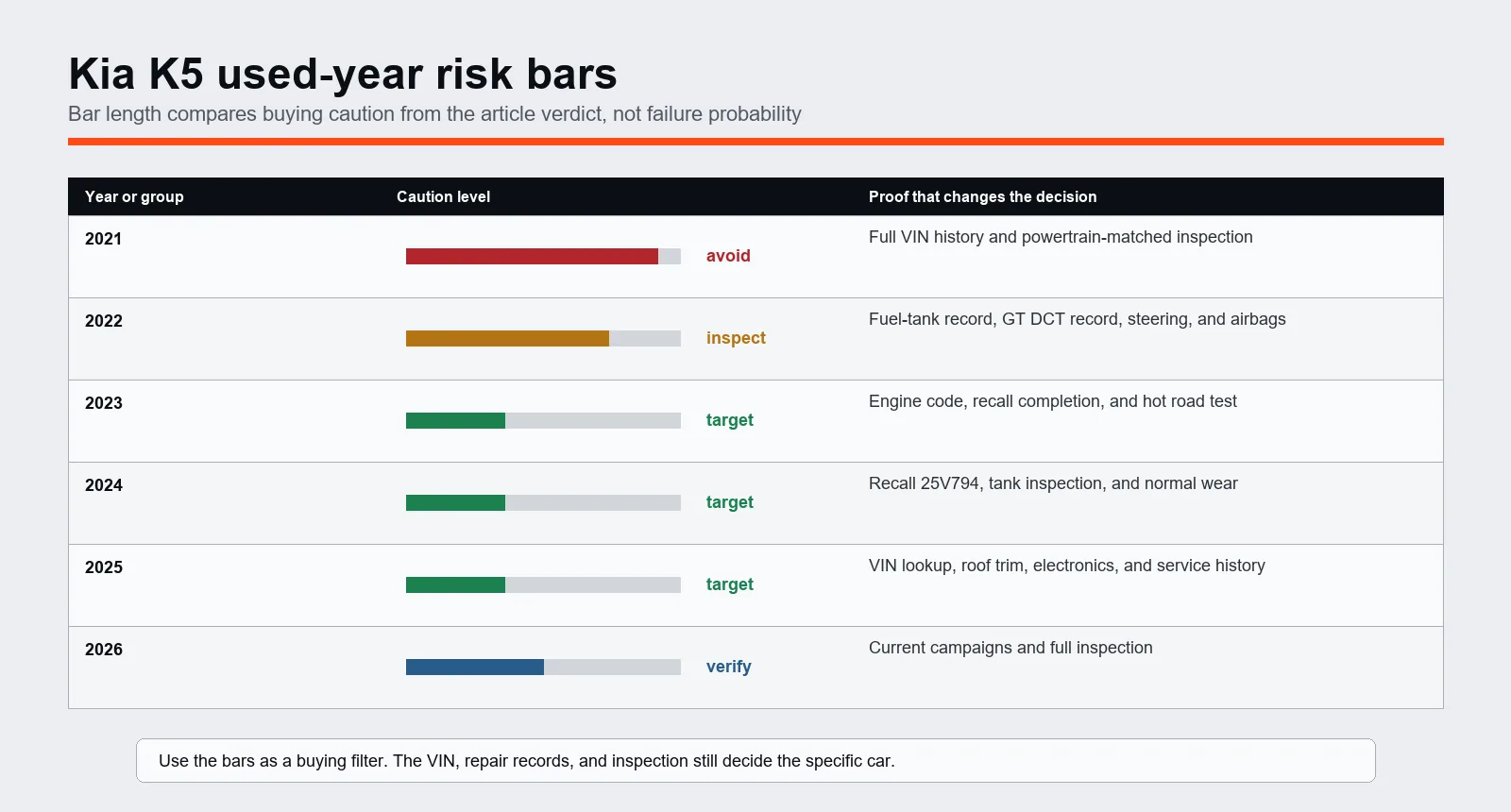
The counts come from the live 2021 NHTSA complaint results and K5 recall results. New campaigns can appear after a used listing is written, so run the VIN again on the day of purchase.
The 1.6T fuel tank recall reaches four model years
NHTSA recall 25V794 covers certain 2021 through 2024 K5 vehicles. A damaged purge-control check valve can let air enter the fuel tank.
The tank may expand and contact hot exhaust components, which can melt the tank and create a fuel leak.
The campaign applies to the 1.6L turbo powertrain, not every K5 built in those years. Confirm the engine on the underhood label and build sheet before carrying this concern onto a GT or a later 2.5L non-turbo car.
Kia's remedy can include an ECM update, inspection, and replacement of the fuel tank or purge-control valve when needed.
A seller may show an older campaign entry from Kia's earlier service action.
Ask whether the final safety recall 25V794 was completed after it opened. Match the repair date, campaign number, tank or valve part lines, and VIN.
An ECM update alone may not prove that a deformed tank was replaced.
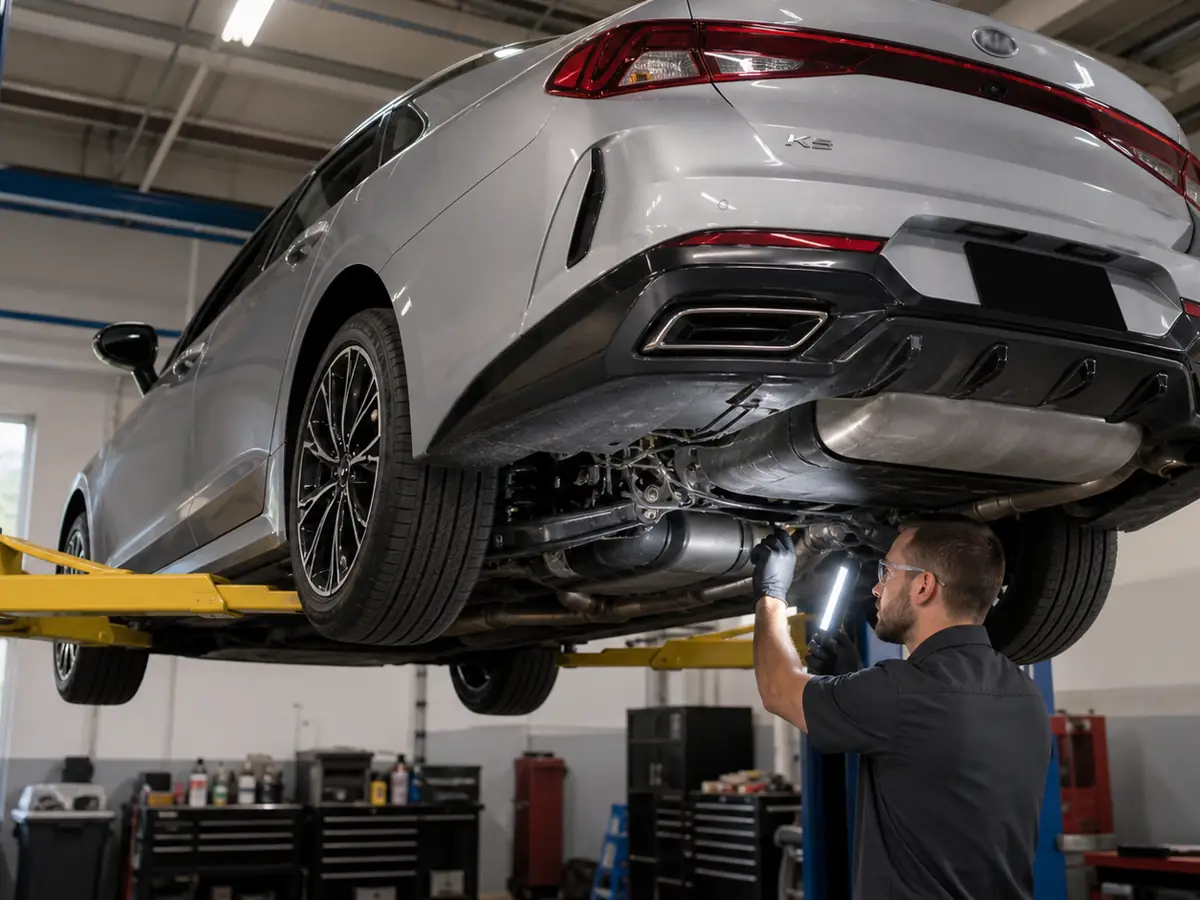
Inspect the tank and exhaust clearance from below. Look for fresh straps, distorted plastic, heat marks, fuel staining, or an evaporative-system repair that lacks a recall number.
Reject a car when fuel odor or tank condition conflicts with the paperwork.
The Kia model range gives alternatives when the seller cannot resolve that conflict.
Recall 25V794 does more than add another line to a VIN report. The service procedure may require inspection of the fuel tank and replacement when damage is present, followed by the purge-valve remedy.
Ask for the final repair order, not only an appointment confirmation. The invoice should show what the technician found and whether the tank itself needed work.
Inspect the tank area after the campaign because a completed valve repair cannot reverse old heat damage or an earlier deformation unless the affected parts were also addressed.
Check tank mounting, heat shielding, fuel lines, exhaust clearance, and any fresh fasteners. A fuel smell after refueling or during a hot soak needs diagnosis before another road test.
K5 GT buyers must clear the DCT oil-pump campaign
The K5 GT uses a 2.5L turbo engine and an eight-speed dual-clutch transmission. NHTSA recall 22V760 covers certain 2021 through 2023 K5 vehicles because a transmission oil-pump malfunction can impair the limited-mobility fail-safe mode and cause a complete loss of drive power.
This campaign should not be applied to a normal 1.6T K5 with the conventional eight-speed automatic.
Confirm the trim, transmission, and VIN first. A GT listing with cosmetic GT-Line parts or an incorrect advertisement can send the inspection toward the wrong hardware.
- 2021K5 launches in the U.S. with separate 1.6T and 2.5T GT powertrains
- July 2021Fuel-pipe recall 21V519 covers certain 2.5T cars
- October 2022DCT oil-pump recall 22V760 covers certain 2021-2023 GTs
- March 2023Curtain-airbag recall 23V149 adds another early-year check
- November 2025Fuel-tank recall 25V794 covers certain 2021-2024 1.6T cars
Test a GT from cold through full transmission temperature. Include parking-lot creep, repeated low-speed starts, a steady cruise, and a highway merge.
Dual-clutch behavior can feel more direct than a torque-converter automatic, but harsh bucking, delayed engagement, warning messages, or loss of drive are not acceptable traits.
Scan the transmission after the drive and ask for the recall repair order. A software update with no current fault can be appropriate under the campaign.
A car that already lost drive may have needed more diagnosis.
Buy a GT only when the campaign record and hot transmission behavior agree.
A GT repair record should identify the transmission, campaign number, mileage, and corrective work. Ask whether the car lost drive power before the remedy and whether the transmission or related components were replaced.
A software update alone should not be described as a new transmission.
Match the invoice language with the current scan and road behavior.
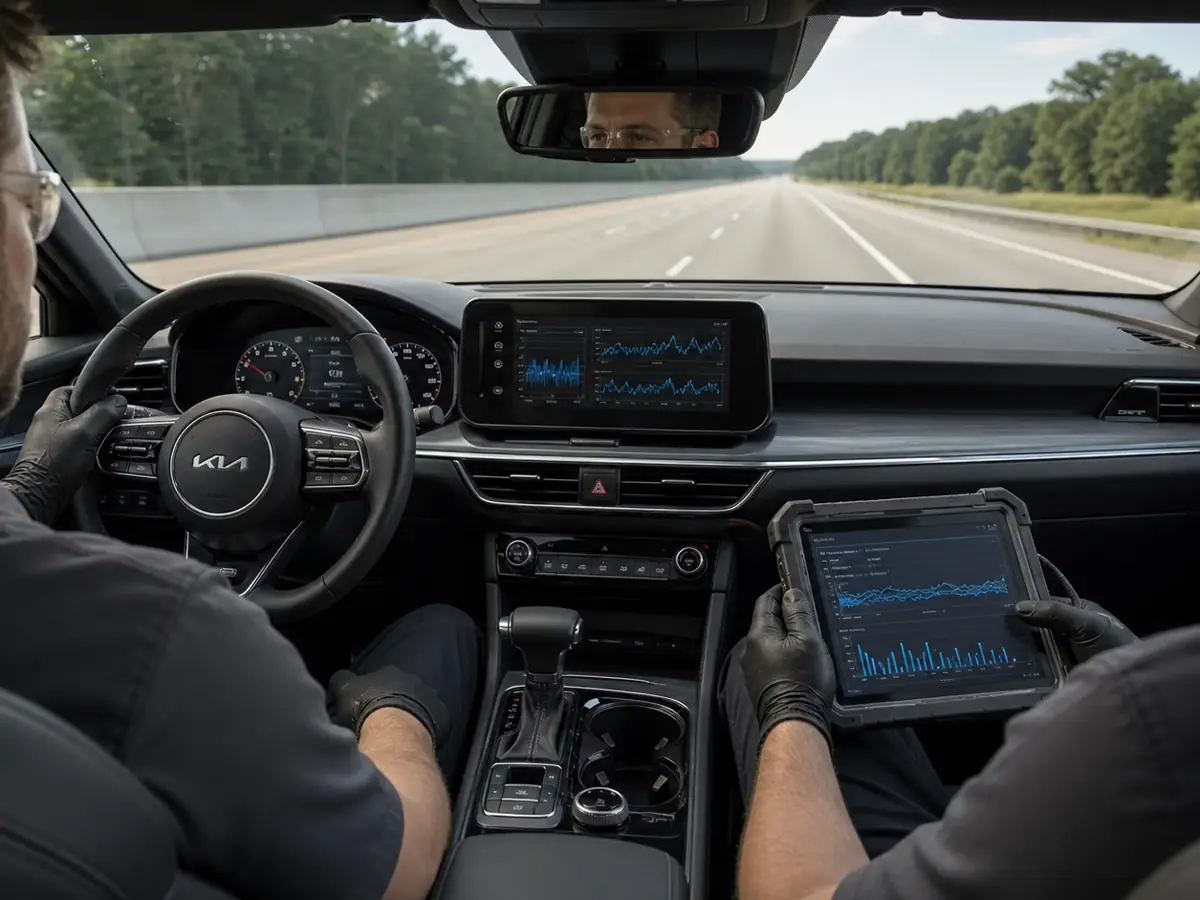
The dual-clutch unit should be tested from a cold start through normal operating temperature. Include creeping traffic, a hill start, Reverse engagement, a moderate merge, and a hot restart.
Some clutch feel at parking speed can be normal. Repeated shudder, a flashing gear display, delayed engagement, limp mode, or a transmission warning is not a trait to accept because another GT drove the same way.
The 2021 and 2022 add fuel-line and steering checks
Certain 2021 and 2022 K5 GTs also fall under NHTSA recall 21V519. Fuel can leak at the connection between the high-pressure fuel pump and rail.
Inspect the engine bay for fuel odor, staining, disturbed fittings, and a repair order that names the campaign.
The same two model years have a steering campaign for certain 2.5T cars. The rack-mounted electric power-steering system could fail to adjust assistance correctly when a communication fault occurs with Lane Following Assist engaged in a curve.
The remedy and applicability are VIN-specific.
Early K5s also have occupant-detection or curtain-airbag campaigns depending on year. A dashboard with no airbag light cannot prove that the curtain module was installed correctly.
Check the dealer record and the NHTSA status.
These systems make 2021 the busiest paperwork year. The car can still pass, but the seller must provide more proof than a 2024 owner.
A new versus used comparison helps decide whether an early K5 discount covers that extra uncertainty.
Why 2024 is the strongest used target
The 2024 sits after the launch-year steering and GT fuel-line campaigns and has far fewer submitted NHTSA complaints than 2021 through 2023. It still belongs to the 1.6T fuel-tank group when the VIN is included, so it is a target only after recall 25V794 is complete.
A 2024 GT does not escape performance-car inspection. Check DCT behavior, launch history, tires, brakes, modifications, and insurance.
The absence of the earlier oil-pump recall on a specific VIN does not prove that a modified or abused transmission is healthy.
The 2025 changes the standard engine from the earlier 1.6T to a naturally aspirated 2.5L on many trims.
That removes the 2021-2024 fuel-tank campaign from the basic comparison, but 2025 has a shorter ownership record and current trim-related recalls.
Do not call it proven because it is newer.
Compare the K5 with the Toyota Camry when long-term resale matters, and with the Hyundai Sonata when similar powertrain logic and warranty value matter. The K5 wins only when its price, coverage, and individual condition remain stronger after those comparisons.
Road-test the transmission that is actually installed
A normal K5 uses a conventional automatic, while the GT uses a dual-clutch unit.
The road test must match the transmission. Start both cold and verify prompt Reverse and Drive engagement.
For the conventional automatic, use light throttle, a steady climb, and a highway downshift.
Watch for flare, harsh shifts, warning lights, and vibration. For the GT, add extended slow traffic because heat and clutch control are most obvious at low speed.
Complete these checks on every used K5:
- Confirm the engine, transmission, trim, and build date
- Run the VIN through NHTSA and Kia for every campaign
- Inspect for fuel odor, tank deformation, and exhaust contact
- Test the correct transmission from cold through operating temperature
- Scan powertrain, steering, ABS, airbag, and body modules
- Measure all four tires and inspect brakes, wheels, and alignment
AWD GT-Line cars need matching tires with similar tread depth. The tire-pressure routine protects tire life after purchase, but a mismatched set during inspection can reveal neglected rotation, road damage, or an incomplete accident repair.
The standard 1.6T automatic needs a different test. It should engage Drive and Reverse promptly, shift consistently at light throttle, and respond without flare during a passing maneuver.
Check the engine for oil or coolant residue around turbo plumbing, then scan for boost, misfire, fuel-pressure, and emissions faults after the drive.
A 2024 can still be a poor purchase after collision repair or rental use. Measure paint where panels look mismatched, inspect the lower front structure and cooling stack, and verify alignment with even tire wear.
Compare the in-service date with remaining factory coverage. A newer model year has value only when the warranty, condition, and repair record support the higher price.
Warranty and trim can change the value
Kia's long original warranty is a selling point, but used coverage may differ for later owners.
Confirm what transfers by VIN and whether the car qualifies as Kia Certified Pre-Owned.
A salesperson's claim that the car has ten years of coverage is not enough.
Get an insurance quote for the exact trim. The 290 hp GT can cost more to insure and consumes expensive tires and brakes faster when driven hard.
A GT-Line appearance package does not have the same engine or transmission, so its running costs should not be estimated from GT data.
RepairPal does not yet publish a model-specific annual K5 cost because it lacks enough data.
That limitation is useful. The K5 is too new for a broad lifetime-cost average to replace service records, current campaigns, and a pre-purchase inspection.
Use the K5 specifications above to confirm the equipment. The Honda Accord offers a useful midsize benchmark when you want a longer model history.
Compare the Hyundai Sonata when similar styling and powertrain choices matter more than a longer history.
Ask the shop to record the exact engine oil level, coolant condition, battery test, tire depths, brake measurements, and module codes.
Written measurements make two similar listings easier to compare and prevent a clean exterior from carrying the decision.
Price open maintenance and near-term wear before choosing the newer year.
Which K5 year should you buy?
Start with a 2024 after recall 25V794 is complete when applicable. It has the lowest mature complaint total among the 2021 through 2024 cars and avoids several early campaign groups.
A 2025 can be considered when its updated standard engine and shorter record fit the price.
A 2023 is a conditional value buy. It still needs the DCT, curtain-airbag, roof-trim, and fuel-tank campaigns checked depending on trim and VIN.
A 2021 or 2022 should cost less and provide a complete campaign trail.
The K5's styling is shared across the range. Its mechanical risk is not.