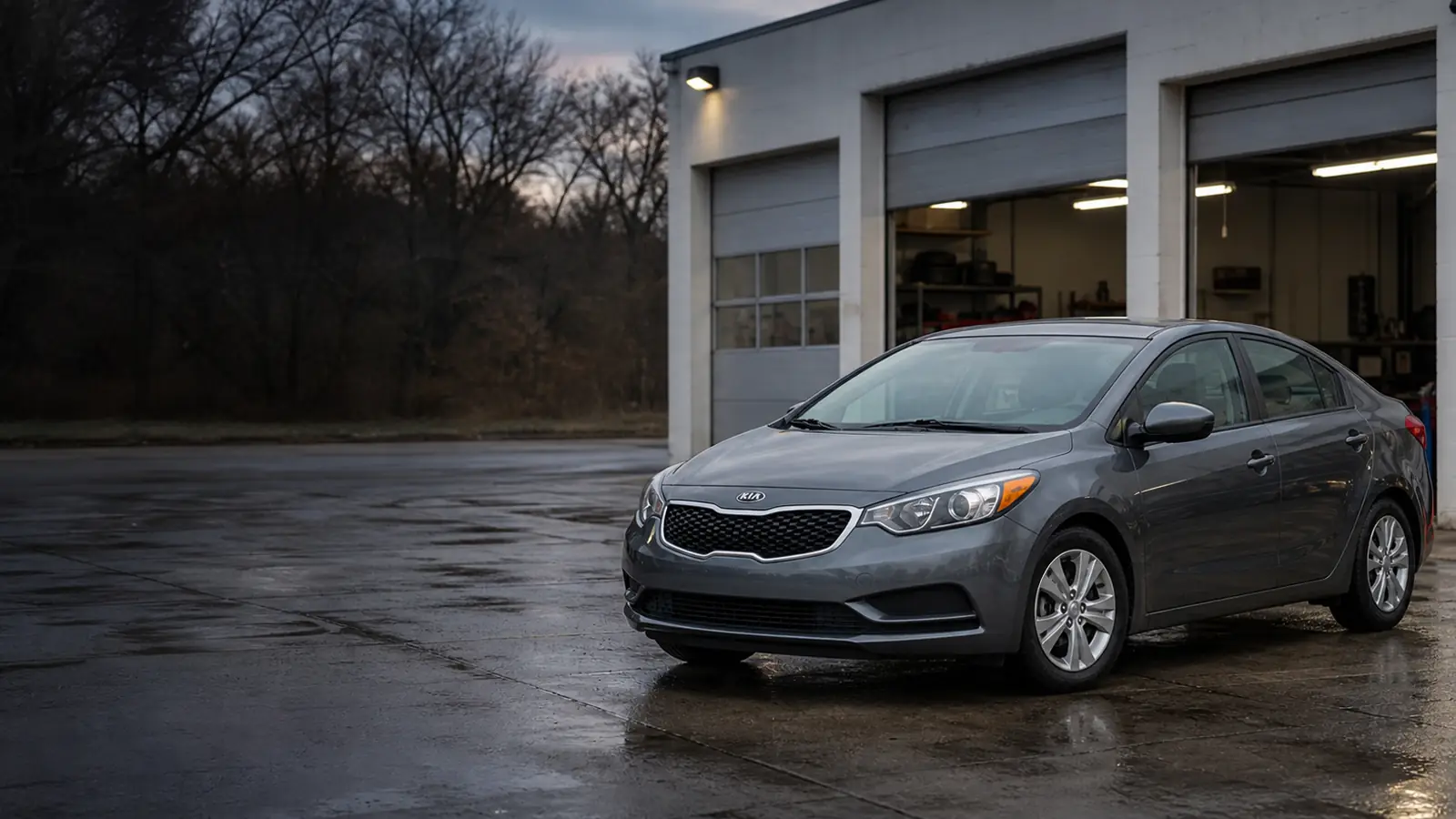
The complaint data points first to 2014
NHTSA currently returns 437 submitted complaints and three recalls for the 2014 Forte. That is the highest complaint total in the model years from 2010 through 2024.
The 2017 follows with 300 complaints and three recalls, while 2012 has 289 complaints and four recalls.
CarComplaints model-year data also puts the engine at the center of the older Forte record. It lists 2010 as its worst year after considering repair cost and mileage, while 2017 has the most owner-submitted complaints on that site.
The two sources measure different report sets, so the useful conclusion is the overlap: early engine noise and later oil-pump history deserve more weight than the badge's broad reputation.
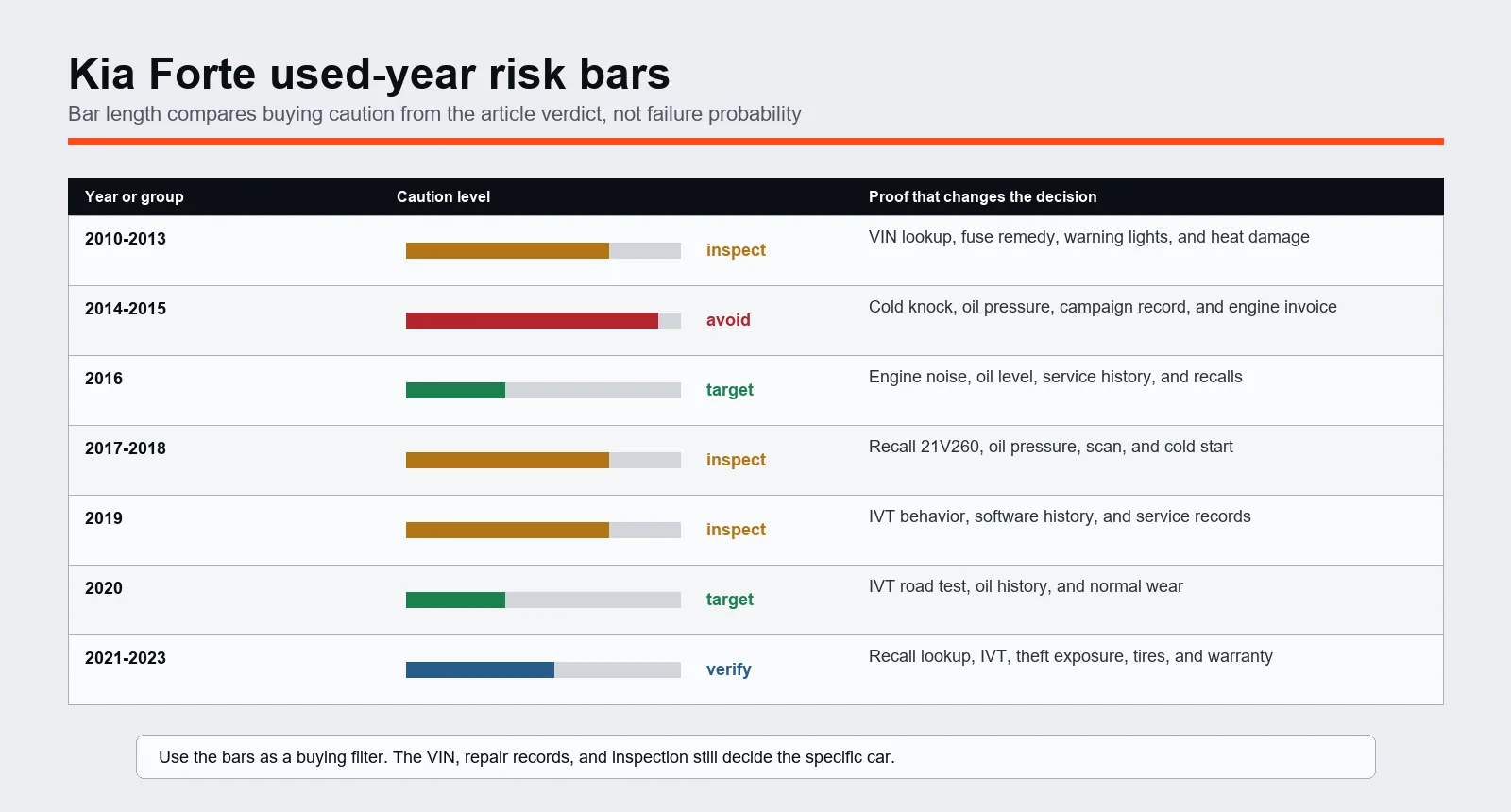
| Model year or group | Starting verdict | Evidence that changes the choice | Required check |
|---|---|---|---|
| 2010-2013 | Inspect recall status first | HECU electrical-short fire campaign | VIN lookup, fuse remedy, warning lights, and heat damage |
| 2014-2015 | Avoid without engine proof | Recall 20V750 and concentrated engine reports | Cold knock, oil pressure, campaign record, and engine invoice |
| 2016 | Consider with full records | Outside the 2014-2015 engine-fire group | Engine noise, oil level, service history, and recalls |
| 2017-2018 | Inspect closely | 2.0L MPI oil-pump recall plus airbag and latch campaigns | Recall 21V260, oil pressure, scan, and cold start |
| 2019 | Inspect the first third-generation year | New body and IVT, 145 NHTSA complaints | IVT behavior, software history, and service records |
| 2020 | Target for value | 71 NHTSA complaints and no current recalls | IVT road test, oil history, and normal wear |
| 2021-2023 | Consider by VIN | Lower complaint totals, but year-specific campaigns remain | Recall lookup, IVT, theft exposure, tires, and warranty |
| 2024 | Target when price is right | 22 NHTSA complaints and no current recalls | Service history, remaining coverage, and full inspection |
These counts can change as owners submit reports and agencies add campaigns. The live 2014 NHTSA results and 2017 recall results are better references than an old listing.
The research method explains why a recall document and repair invoice outrank a seller's description.
The 2014 and 2015 engine recall is the hard stop
NHTSA recall 20V750 covers certain 2012 through 2015 Forte and Forte Koup vehicles along with other Kia models. For the Forte, the central used-car concern is engine damage that can release oil, create smoke, or lead to an engine-compartment fire.
Dealers inspect the engine area and perform the prescribed remedy for an included VIN.
A completed recall entry does not prove that an engine ran for years with correct oil level.
Ask whether the engine was inspected, repaired, or replaced. A useful invoice names the VIN, mileage, campaign number, test result, and installed parts.
A generic line that says recall completed gives too little information when the car now knocks or consumes oil.
CarComplaints' 2014 engine section records owner reports of clicking, knocking, failure, stalling, and oil use. Those reports do not show the probability that one Forte will fail.
They show why 2014 deserves the most demanding engine check.
A replaced engine can move a car back into consideration when the invoice matches the VIN and the replacement has its own maintenance trail.
Walk away when the seller cannot explain a replacement engine, repeated oil top-ups, or a recent warning-light reset.
The Kia model range offers newer alternatives when the paperwork stays unclear.
A car with an engine replacement needs two histories, one for the chassis and one for the replacement assembly.
Match the repair invoice to the VIN, installation mileage, engine part number, and installing dealer or shop.
Then calculate how many miles the replacement has actually covered. A recent replacement with no follow-up oil service is not automatically better than an original engine with consistent records.
Ask the inspecting shop to remove and open the oil filter when noise, warning history, or oil loss creates doubt.
Metal in the filter, low measured oil pressure, or stored timing and misfire faults can turn a promising body into an immediate rejection.
A seller should allow this extra check when the engine history is central to the price.
The 2017 and 2018 oil pump needs separate proof
The 2017 and 2018 use a different campaign. NHTSA recall 21V260 applies to certain Forte vehicles with the 2.0L Nu MPI engine.
Foreign particles can stick inside the oil pump, reduce oil pressure, damage the engine, and raise fire risk.
This recall does not make every 2017 or 2018 Forte defective.
It makes engine code and VIN essential. Confirm that the car has the 2.0L MPI engine named in the campaign, then obtain the Kia dealer record.
A turbo GT, Koup, or Forte5 can require a different inspection because its engine and transmission may differ.
- 2014-2015Engine-compartment fire campaign 20V750 defines the main older-engine risk
- 2017-2018Oil-pump campaign 21V260 applies to certain 2.0L Nu MPI cars
- 2022Airbag-control recall 22V031 adds another VIN-level check to 2017-2018 vehicles
- 2023HECU campaign 23V652 reaches back to 2010-2013 Fortes
- 2024Forte production ends in the U.S. and the Kia K4 replaces it
Start the 2.0L car cold and watch the oil-pressure light during startup.
It should turn off normally. Scan for current, pending, and history codes, then inspect the oil level and filter service record.
A quiet five-minute drive cannot overrule a past low-pressure event.
The 2017 and 2018 also appear in airbag-control and trunk-latch campaigns.
Those remedies address different systems. One completed recall does not close the entire VIN list.
Check every line before treating the car as repaired.
Older 2010 through 2013 cars carry a parked-fire campaign
NHTSA recall 23V652 covers certain 2010 through 2013 Fortes because the Hydraulic Electronic Control Unit can short electrically. NHTSA says the condition can cause an engine-compartment fire while the vehicle is parked or driving.
The safety instruction matters more than the car's low market value. Confirm the remedy before parking an included car inside a garage or next to a home.
Inspect the HECU area and nearby wiring for melted plastic, corrosion, previous fuse work, and non-factory repairs.
RepairPal rates the Forte at 4.5 out of 5 and reports an average annual repair cost of 451 dollars across model years.
That broad record explains why a sorted Forte can still be a reasonable budget car.
It does not cancel a safety recall or an unhealthy engine.
A 2010 through 2013 car also needs its airbag-control and stop-lamp campaigns checked when applicable.
Resolve the fire campaign first, then decide whether the car's age and condition justify further inspection.
A newer Kia K5 costs more but avoids this early Forte campaign group.
A 2019 or newer Forte shifts the test to the IVT
The third generation arrived for 2019 with a different body, powertrain mix, and an Intelligent Variable Transmission on many 2.0L trims.
Under hard acceleration, an IVT can hold engine speed steadily instead of making traditional stepped shifts.
That behavior alone is normal. Shudder, delayed engagement, flare, warning lights, or repeated hesitation are not.
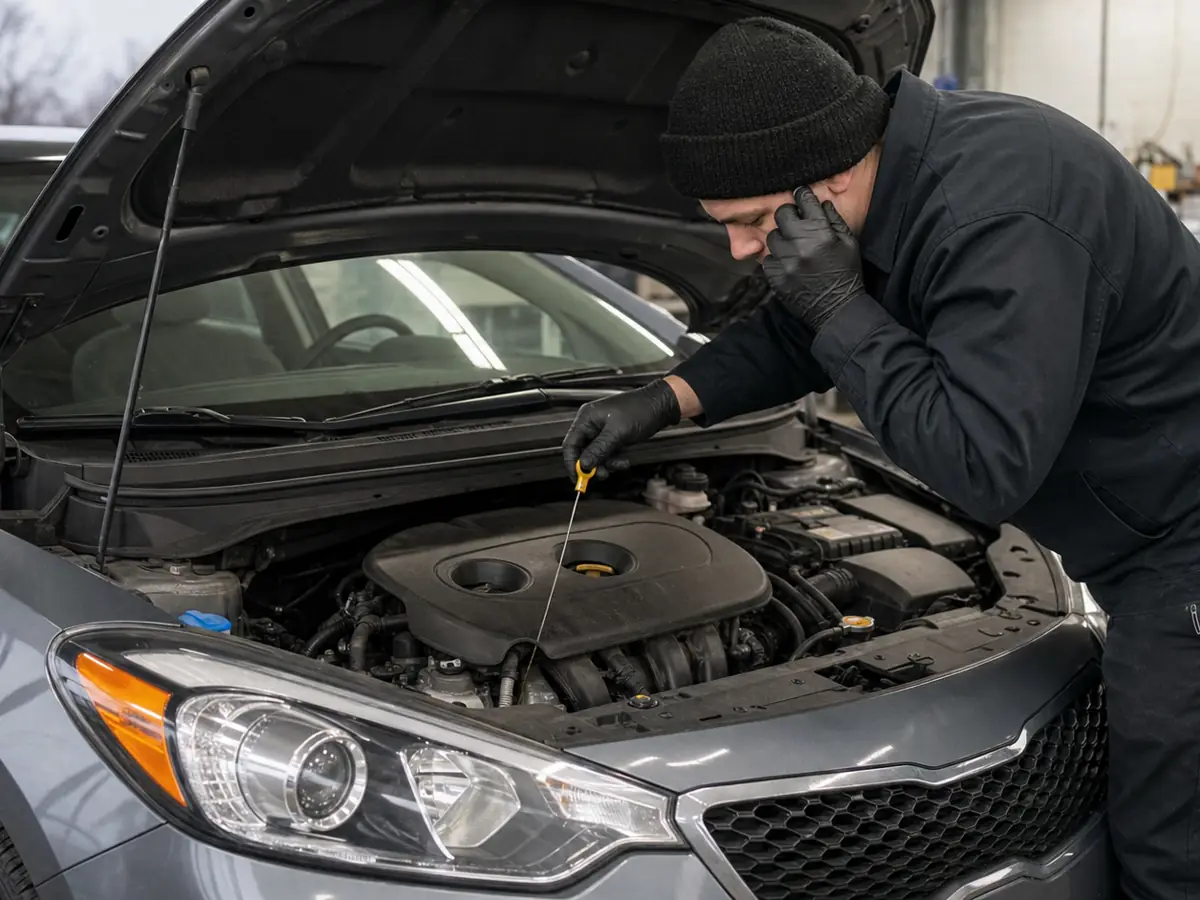
Test Reverse and Drive engagement from cold. Use light throttle in traffic, a steady 30 to 50 mph cruise, and one firm highway merge.
The car should respond consistently without vibration or a hot smell. Scan transmission and engine modules after the drive because a recently cleared fault may return once the unit warms.
The GT uses a turbo engine and may use a dual-clutch transmission, so it needs a different road test.
Check low-speed takeoff, clutch behavior, boost delivery, tire quality, and modifications. A stock commuter and a tuned GT should never receive the same risk rating.
Use the Forte specifications above to confirm the trim before comparing price. The Hyundai Elantra and Nissan Sentra show what similar compact-car money buys with different transmission and warranty histories.
IVT fluid history matters because the unit depends on the specified fluid and correct level. An invoice should identify the fluid, mileage, and service method rather than say only transmission service.
Do not request an aggressive flush from an unfamiliar shop just to create fresh paperwork before purchase. First have a Kia-capable technician identify the unit and compare its condition with the service schedule.
Repeat low-speed takeoff several times after the drivetrain is warm. Include a gentle incline, a parking maneuver, and a steady cruise.
Consistent engine speed under acceleration can be normal for this design. A new vibration, delayed Drive engagement, rising whine, overheated smell, or warning message changes the decision because those symptoms require diagnosis, not an adaptation reset.
Theft exposure and warranty claims change the price
Some keyed-ignition Kia vehicles from this period became theft targets because they lacked an engine immobilizer. Equipment varies by model year and trim, so inspect the exact ignition type and ask Kia whether the VIN received any available anti-theft software or hardware campaign.
Get an insurance quote before making an offer. A mechanically sound Forte can still be the wrong value when comprehensive coverage is expensive or unavailable in your ZIP code.
Check door locks, steering-column trim, glass, ignition damage, and body repairs for evidence of a prior attempt.
Kia's original long powertrain warranty also needs careful wording. Later owners may not receive the same coverage as the first retail owner unless the car qualifies under a certified program.
Confirm remaining coverage directly with Kia by VIN. Do not pay extra because a listing repeats the original 10-year figure.
A new-versus-used calculation helps when a late Forte sits close in price to a newer compact. The Toyota Corolla costs more in many used markets, but its resale and insurance picture can make the total difference smaller than the advertisement suggests.
Inspect the individual car in one cold visit
Arrange the visit before the seller starts the engine. Photograph the cold oil level, check coolant, and listen through the first minute.
Look underneath after the road test for fresh oil, coolant, or transmission fluid.
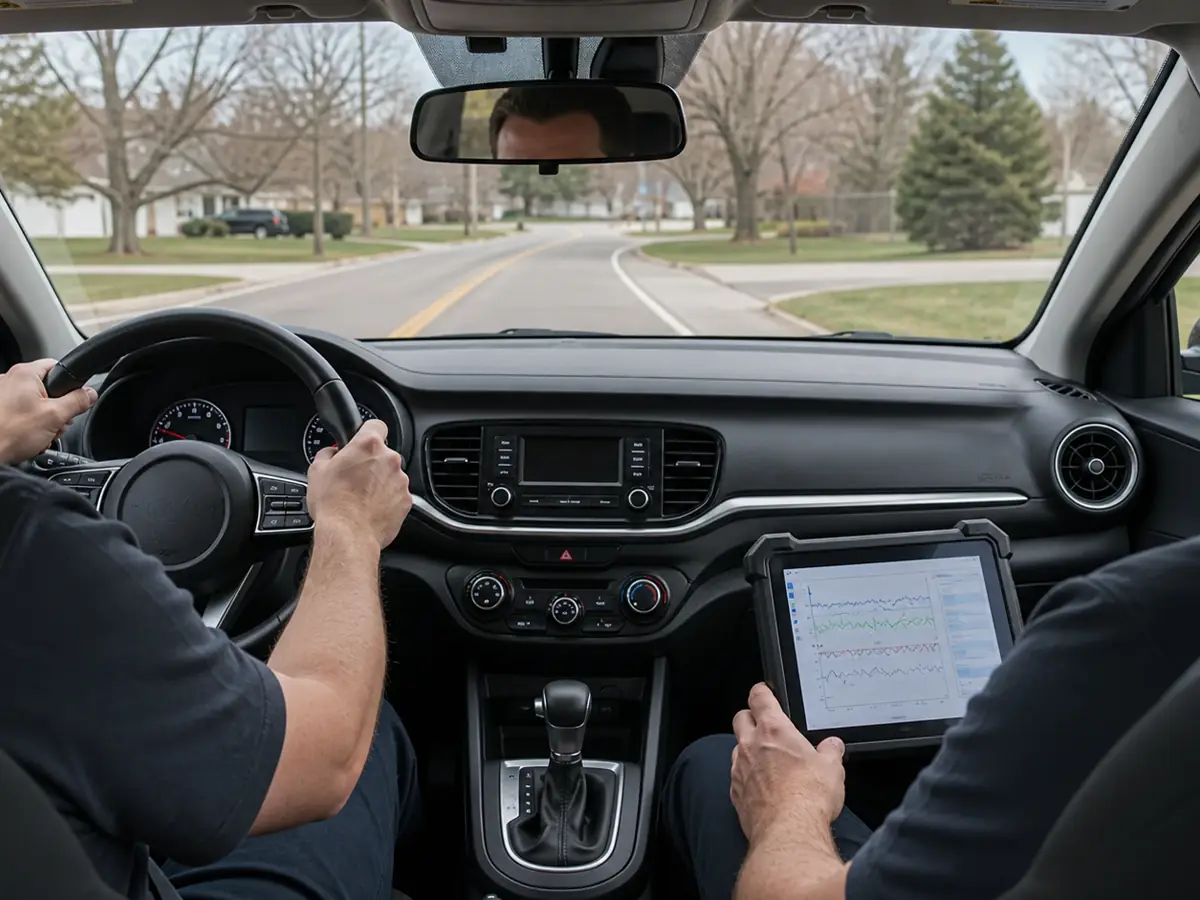
Complete these Forte checks:
- Run the VIN through NHTSA and Kia for every open campaign
- Match the engine and transmission to the recall and service records
- Listen for cold knock and confirm normal oil-pressure behavior
- Test IVT, DCT, or manual operation from cold through full temperature
- Scan engine, transmission, ABS, airbag, and body modules
- Inspect tires, brakes, suspension, theft damage, and collision repairs
A pre-purchase inspection should name findings rather than call the car generally good. Ask the shop to record oil condition, leaks, codes, tire depths, brake life, and campaign status.
The tire-pressure procedure helps after purchase, but mismatched or worn tires belong in today's price negotiation.
Price the inspection findings before choosing between two years. Tires, brakes, a damaged steering column, one missing key, and overdue fluids can cost more than the gap between a questionable 2019 and a cleaner 2020.
Obtain written estimates and subtract them from the offer rather than assuming a low asking price leaves enough room.
A private seller can provide cold-start access and long-term records that a lot may not have.
A dealer can provide recall and warranty paperwork more quickly.
The seller type does not decide quality. The buyer should favor the car whose VIN history, invoices, scan results, fluid condition, and road behavior agree without an unexplained gap.
Which Forte years should you buy?
Choose a 2020, 2022, or 2024 when the VIN is clear, the engine is quiet, and the correct transmission passes a cold and warm road test. These years sit outside the older engine-fire and oil-pump groups that drive the strongest warnings.
A repaired 2014, 2015, 2017, or 2018 can still work, but only when the exact campaign, engine condition, and maintenance history agree. A 2010 through 2013 car must clear the HECU campaign before its price deserves attention.
The Forte can be inexpensive to own. The wrong engine history can erase that advantage in one repair.