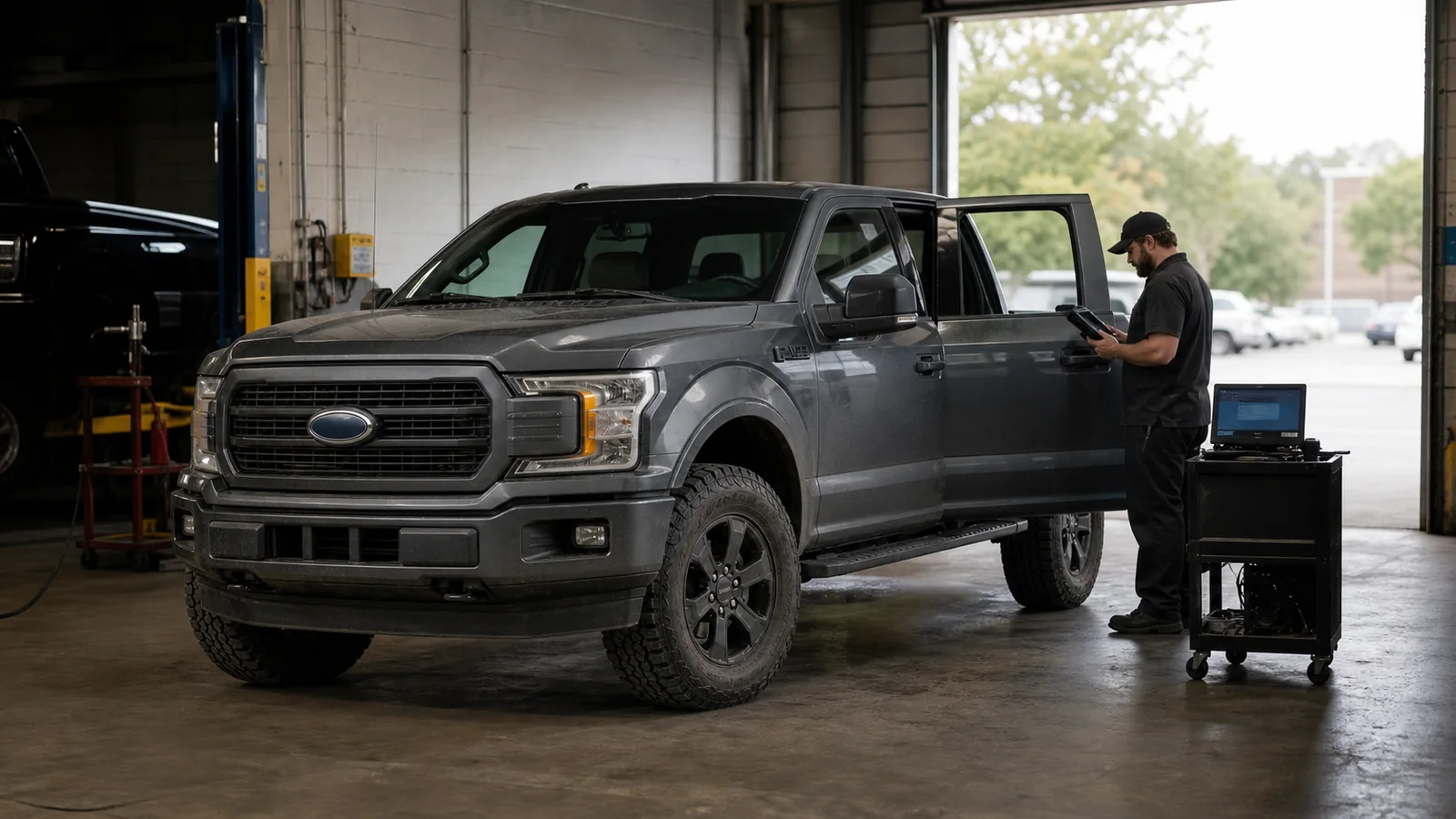
Three F-150 eras create three different risks
The F-150's overall record is decent, which is exactly why the bad years catch buyers out. CarComplaints logs more than a thousand complaints on the 2004 alone, its worst year on record, and RepairPal rates the truck about average for the class.
A shopper assumes any F-150 is a safe bet, and that assumption is what turns a cheap listing from a bad year into an expensive mistake.
With this truck, the engine and transmission under the hood matter more than the model year on the door, so the first question to ask about any used F-150 is which powertrain it carries.
The trouble clusters in three eras, and the failure is different each time:
Model-year risk map
- 2004-2008
- 5.4L Triton 3-valve V8: spark plugs break off inside the cylinder head, cam phasers rattle and wear
- 2009-2010
- Facelifted trucks with sorted engines, a safer late-run choice
- 2011-2013
- First EcoBoost V6: trapped intercooler condensation triggers a stumble and misfire
- 2013-2014
- Proven 5.0L V8 with the 6-speed, one of the best used combinations
- 2017-2018
- New 10-speed automatic shifts harshly and can slam into gear
- 2019-2020
- Later 10-speed calibration, but transmission and cam-phaser records still matter
- 2021+
- Newer trucks carry axle, camera, and park-system recall checks
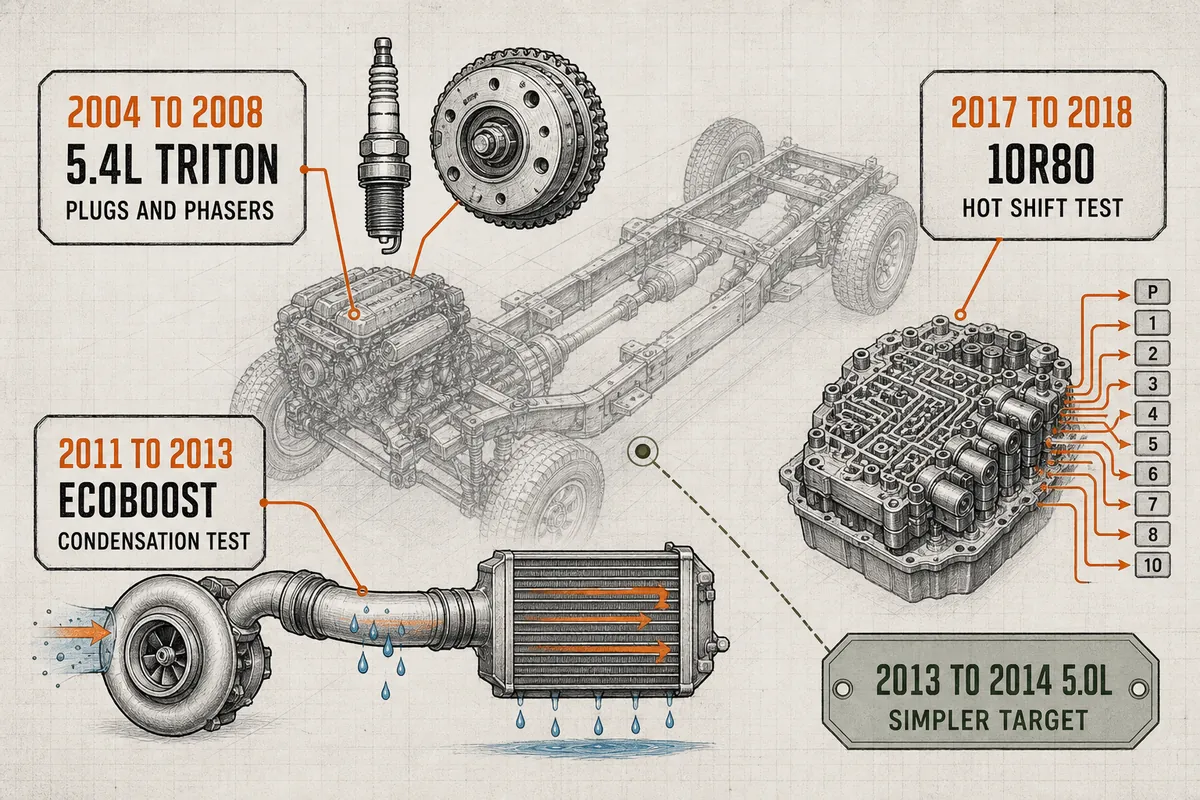
Triton timing hardware and the new 6R80 recall
The 2004-2008 5.4L Triton 3-valve is the one to fear most. The spark plugs on this engine seize into the aluminum head and snap in half during a routine change, and a single broken plug can cost $300 to $600 to extract.
Because the engine has eight plugs, one bad change can turn into a four-figure bill on its own.
On top of that, the variable cam timing phasers wear and rattle, often by 100,000 miles, and a full cam phaser job runs into the thousands once you add labor.
That rattle usually shows up as a diesel-like clatter on a cold start that fades as the truck warms.
If you look at one of these years, treat any cold-start rattle or rough idle as a phaser warning and walk away.
The earlier 2-valve 5.4L and the 4.6L V8 in the same era avoid both problems, so an F-150 from these years is only worth buying with one of those engines and a clear service history.
| Year or group | Starting verdict | Evidence | Required check |
|---|---|---|---|
| 2004-2008 5.4L | Avoid without major repair proof | Spark-plug, cam-phaser, and timing hardware risk | Cold rattle and documented engine work |
| 2009-2010 | Consider | Later twelfth-generation years | Rust, engine choice, and transmission service |
| 2011-2013 EcoBoost | Inspect carefully | Condensation-related stumble and early turbo hardware | Full-load drive, codes, and charge-air system |
| 2013-2014 5.0L | Target | Mature naturally aspirated V8 and six-speed pairing | Oil, cooling, towing history, and VIN recalls |
| 2015-2017 6R80 | Check recall 26V237 | Unintended downshift risk prompted a 2026 recall | VIN remedy and transmission behavior |
| 2017-2018 10R80 | Inspect carefully | Early 10-speed harsh-shift and cam-phaser complaints | Cold and hot shifts plus repair records |
| 2021+ | Consider by VIN | Newer trucks carry separate axle, camera, and park-system campaigns | Exact configuration and current recalls |
This grid separates engine, gearbox, and recall exposure. It cannot predict whether every truck from a listed year will fail.
Move a vehicle forward only when its VIN, repair history, and physical condition support the row.
EcoBoost condensation versus early 10R80 shifts
The 2017-2018 F-150 is a softer warning. These were the first years of the 10R80 10-speed automatic, and owners reported harsh upshifts, downshift clunks, and the transmission slamming into gear or slipping under acceleration.
Ford issued a reprogramming bulletin and recalled a batch of trucks, and several owners filed class-action claims over the shift quality.
The update helped many trucks but did not cure every one, and worn valve bodies still turn up on higher-mileage examples.
A 2017 or 2018 with the software applied and a clean, smooth shift on a long test drive is workable, but a 2019 or 2020 of the same generation sidesteps most of the first-year risk for a small price bump.
The 5.0L six-speed remains the simpler target
The useful F-150 choice comes from configuration and work history, not one brand-wide rating.
Decode the truck first, then use the filter to decide whether it deserves a road test.
Later F-150 hardware helps only when the build label and service file match it.
The 2009-2010 trucks arrived after the worst Triton problems were understood, the 2013-2014 trucks pair the tough naturally aspirated 5.0L Coyote V8 with the proven 6-speed automatic, and the 2019-2020 trucks run the reprogrammed 10-speed that shifts cleanly.
Across all of them, the 5.0L V8 is the safe engine bet, with no turbos to condense water and no phaser system to rattle.
It gives up a little low-end torque to the EcoBoost but asks for far less at the repair shop over 150,000 miles.
If you want the EcoBoost pull for regular towing, buy a later truck with clean service records rather than a first-year 2011.
F-150 parts are cheap and stocked at every shop, which keeps repair bills reasonable for a full-size truck and makes an independent mechanic an easy second opinion before you buy.
Load history appears in the hitch and rear axle
A used F-150 inspection must match the engine, transmission, cab, axle, and build date. Two trucks from the same year can have different recalls and a very different history of towing or commercial use.
NHTSA recall 26V237 now covers certain 2015-2017 F-150s with the 6R80 for an unintended downshift risk. This 2026 action makes older advice that automatically calls those years sorted incomplete.
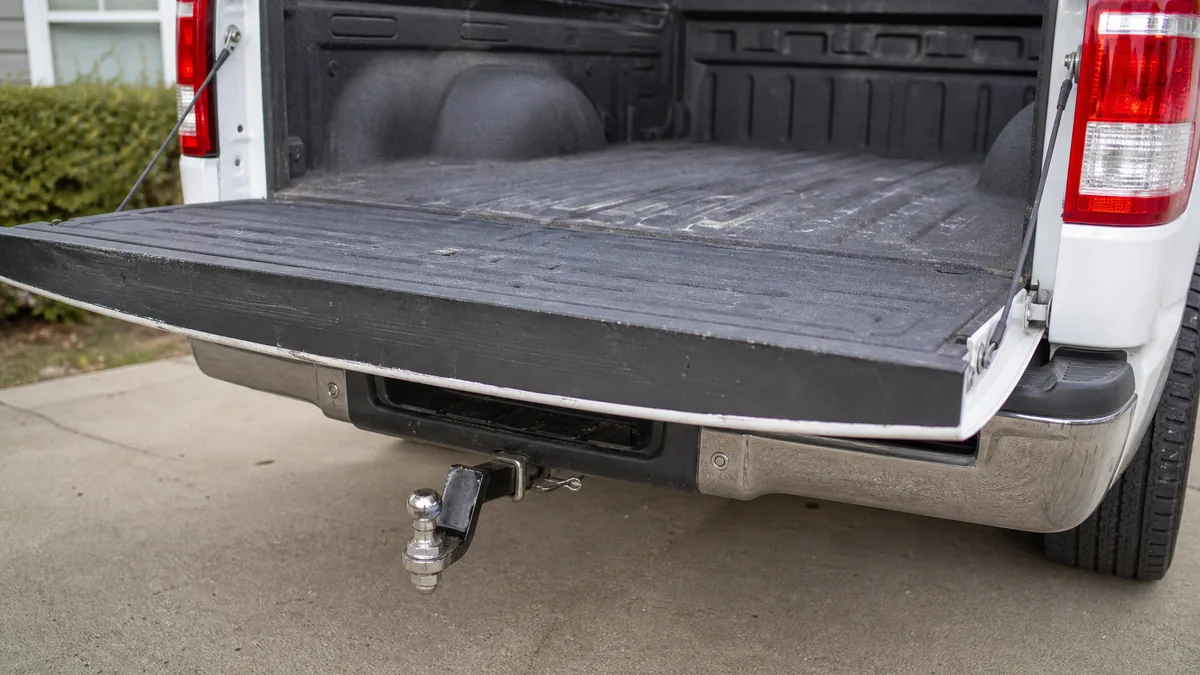
The F-150 profile illustrates how widely one model year can vary. A naturally aspirated V8, an EcoBoost V6, a six-speed, and a 10-speed do not share the same repair list.
Match the test drive to the hardware before treating a year-wide reputation as proof.
Inspect the configuration from the label outward:
- Decode engine and transmission from the VIN and build label
- Cold-start the engine and listen for timing or cam-phaser rattle
- Drive the truck unloaded and under safe moderate load
- Inspect hitch, bed, rear axle, and tires for hard-use evidence
- Compare configuration in the full-size pickup field and review the Ford lineup
Missing paperwork does not prove that a repair was unnecessary. Walk away when the build label and repair record cannot explain what the truck does on the road.
Recall proof and build data come before the F-150 test drive
The engine badge alone cannot identify the transmission calibration, axle ratio, or build window. Photograph the door-jamb label and VIN, then compare them with the recall and service records before driving.
Ford's 2026 6R80 recall report cited above covers a defined population. It does not make every six-speed truck defective, and it does not clear a truck whose VIN shows an incomplete remedy.
Use the VIN result to decide whether the drive can continue, not a seller's memory of a dealer visit.
A useful transmission invoice states the diagnostic code, failed component, software level, and repair mileage.
A line that says "checked transmission" proves very little. On an early 10R80 truck, look for adaptive-learning or valve-body work and ask what symptom led to it.
On a 5.4L Triton truck, timing-chain, cam-phaser, oil-pressure, and spark-plug records matter more than a folder full of tire rotations.
Evidence by powertrain
- 5.4L Triton
- Cold-start oil pressure and timing repair details
- 3.5L EcoBoost
- Intercooler, ignition, cooling, and turbo service history
- 6R80
- VIN recall status plus clean hot downshifts
- 10R80
- Calibration, valve-body, or internal repair record
A payload history changes the value of the same model year
Look under the truck before judging the cabin. A polished interior can sit above a worn hitch, sagging rear springs, leaking pinion seal, or mismatched load-range tires.
Check the bed for a fifth-wheel or gooseneck mounting pattern. Inspect the frame around those holes and look for wiring changes near the trailer connector.
Heavy towing is not an automatic rejection, but it raises the standard for cooling-system, transmission-fluid, axle, and brake records.
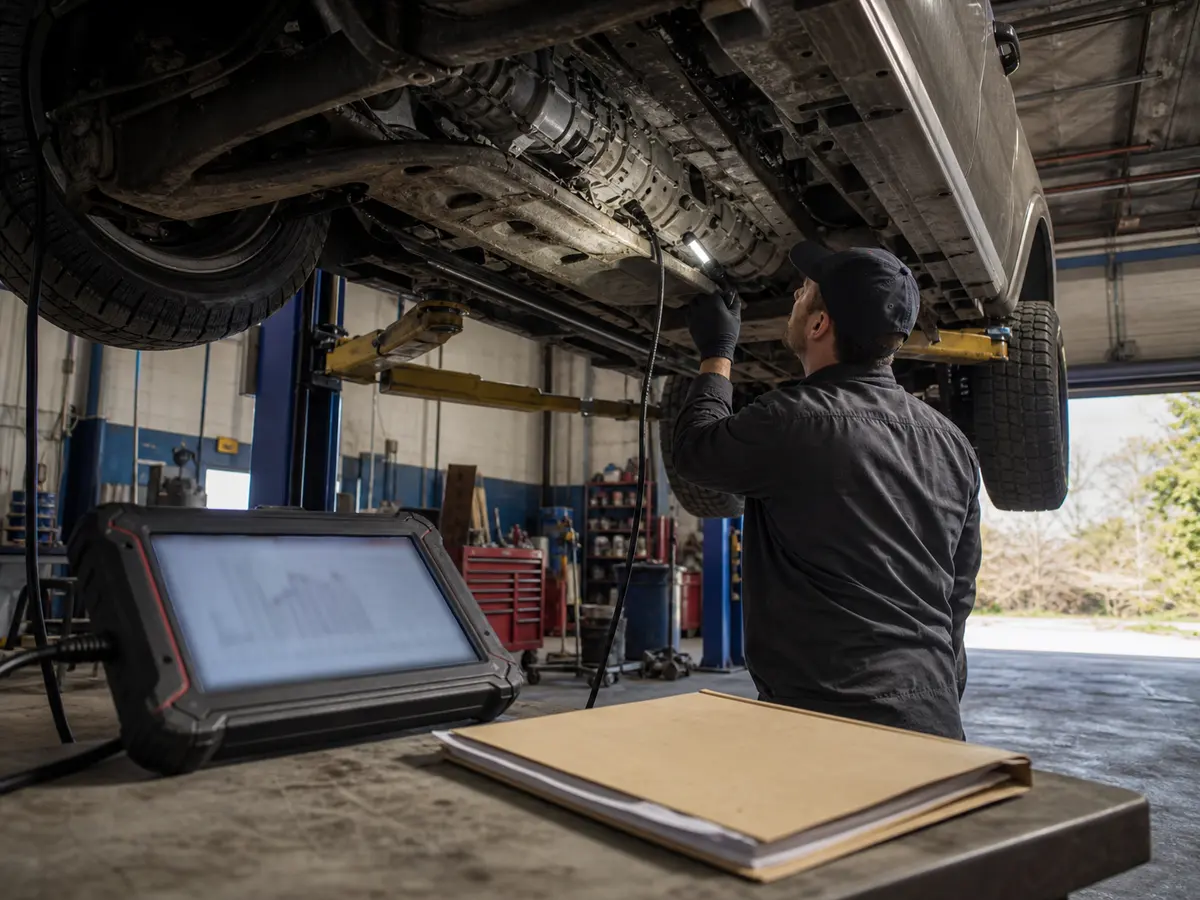
Drive unloaded first so a trailer cannot hide vibration or poor shift quality. Include a cold start, city upshifts, a gentle highway merge, coast-down behavior, and a hot reverse engagement.
Listen for timing rattle before the oil warms. Watch for a delayed gear selection after the drive.
A lower-risk engine and gearbox combination still needs this sequence, because the best F-150 year cannot erase neglected towing and maintenance.
A useful F-150 inspection should leave you with a short evidence file:
- VIN and door-label photographs that identify the build
- Cold-start video focused on timing noise and warning lights
- Hot transmission notes for upshifts, coast-down, and reverse engagement
- Tire, hitch, spring, and axle-seal photographs
- Full-module scan report before codes are cleared
- Recall status and named repair invoices
If the truck has a tune, lift, oversized tires, or aftermarket towing hardware, ask who calibrated and installed it.
Modifications can change shift behavior, cooling load, steering geometry, and warranty coverage.
They also make a stock comparison less useful.
A clean 5.0L and 6R80 combination remains attractive, but stock condition with traceable service is usually worth more than undocumented power or appearance parts.
Match the diagnostic shop to the F-150 powertrain
Choose the inspector after identifying the engine and transmission. A general shop may handle brakes, suspension, leaks, and a full scan well.
A Ford-focused engine shop is more useful when a 5.4L has timing noise, oil-pressure questions, or repeat misfire.
A transmission specialist is the better next stop for a 6R80 recall symptom or 10R80 shift complaint that appears after adaptive relearning and basic checks.
Ask the shop to separate symptom, test, finding, and recommendation.
A harsh downshift is the symptom. Scan data, fluid condition, road behavior, and inspection are tests.
A named valve-body, internal, calibration, or driveline finding is the evidence.
Replacing a transmission without that chain is an expensive guess.
Before the appointment:
- Do not clear codes or disconnect the battery
- Do not let the seller warm the truck before the cold-start check
- Bring the VIN, door-label photo, invoices, and recall result
- Tell the shop about towing, tunes, tire-size changes, and prior repairs
A stock truck with coherent records is easier to judge. Modified trucks can still be sound, but the inspector needs calibration and installation details.
The diagnosis is strongest when build data, owner history, scan results, and the drive all point to the same system.