Is the Ford F-150 reliable?
It is average for its class, which is a different claim from the one its sales figures imply. iSeeCars scores the Ford F-150 7.2 out of 10 and ranks it eighth of the ten full-size trucks it measures.
RepairPal reaches a similar place from repair data, at 3.5 out of 5.0 and seventh of seventeen.
Running costs are the better half of the picture. The average annual repair bill is $788 against a $936 full-size truck average, so an ordinary year of ownership is cheaper than the segment norm.
Popularity explains none of this. A truck sells in volume because of price, dealer coverage, financing and configuration choice, and none of those forces decide whether it reaches 200,000 miles.
Read this truck's own record rather than its sales rank, because the two point in different directions. The record turns out to be unusually specific.
One system leads the F-150 complaint record
Federal complaint volume on this truck is large, which is what a vehicle sold in these numbers produces. The useful part is not the size but the consistency of what owners file about.
The 2013 truck holds 2,796 complaints, 877 of them against the power train. The 2011 truck holds 2,137 with 501 power train, and the 2018 truck 1,875 with 551.
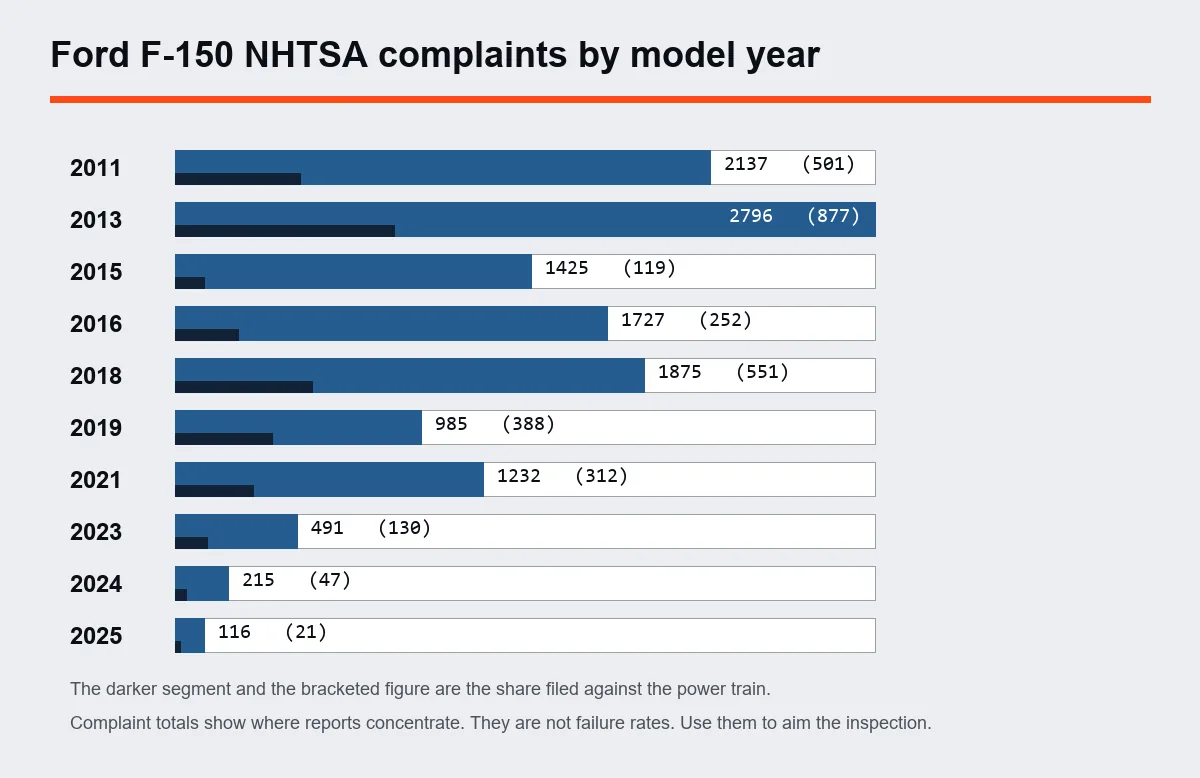
Power train leads in thirteen of the fifteen model years from 2011 to 2025. No other truck in this segment produces a record that one-sided.
The two exceptions are 2015 and 2016, both led by service brakes, and they have their own explanation. Ford recalled the brake master cylinder on 3.5-litre EcoBoost trucks for leaking fluid into the brake booster, which reduces front brake function.
That one defect took three campaigns to contain. It started with 2014 to 2017 trucks, widened to cover 2016 to 2018, and widened again in 2025 to take in 2017 and 2018 vehicles.
Even in those two years the power train sits close behind, second in 2016 at 252 filings.
Recent years look far quieter. Totals fall to 491 on the 2023 truck, 215 on the 2024 and 116 on the 2025.
Discount that heavily. A truck on the road for one year has had one year in which owners could file, so a young model year always looks clean and only time separates a good one from a quiet one.
What survives the discount is the leading component, which has not moved. Whatever else you inspect on an F-150, the transmission and driveline are where the record says to spend the time.
Which engine you buy is which risk you buy
Every F-150 conversation eventually becomes an argument about EcoBoost against the V8, and the complaint record suggests that argument is aimed at the wrong component.
The lineup spans a 2.7-litre and a 3.5-litre EcoBoost, a 5.0-litre V8, and the PowerBoost hybrid on recent trucks. They differ in what they cost to repair rather than in whether the dominant problem applies to them.
The ten-speed automatic arrived for 2017 and spread across the range. A 5.0-litre truck and a 3.5-litre truck from the same year share the component the record keeps naming.
The engine choice is still real, just financial. The V8 is the version an independent shop is most likely to quote competitively, while turbo hardware and hybrid high-voltage systems push more work toward specialists.
What to ask for by powertrain
- 2.7-litre EcoBoost
- Oil-service intervals and evidence the truck was not run at its tow rating
- 3.5-litre EcoBoost
- Oil history, cooling condition, and any turbo or timing work already carried out
- 5.0-litre V8
- Oil history and a cold start, with the lowest specialised-labour exposure of the range
- PowerBoost hybrid
- Everything above plus high-voltage system status and a full module scan
- Any truck from 2017
- Transmission fluid service history, because the ten-speed is the constant
Pick the engine on what it costs you to keep, then inspect the transmission regardless of what sits in front of it.
That inspection has a shape, and a short loop around the block will not produce it. The ten-speed needs to be warm before it behaves like itself.
Drive until the temperature gauge settles, then work through low-speed stop-start traffic and watch for harsh engagement into first and second. Hunting between the upper gears at a steady cruise is worth noting, and a clunk on a closed-throttle downshift is worth more.
Then check the paperwork against what you felt. A truck whose fluid has never been changed at 90,000 miles is a different purchase from one with a documented service, and neither the odometer nor the engine badge tells you which one you are looking at.
Forty-two recall campaigns, and power train leads those too
Forty-two separate safety campaigns cover 2011 to 2026 F-150 trucks. That number frightens people, and on its own it should not.
Campaign volume tracks how many vehicles are on the road, so the highest-volume vehicle in the country accumulates more campaigns than a truck selling a tenth as many. The count is a population artefact.
The category breakdown is the part worth reading. Power train is the largest single group at eight campaigns, with seats at five and engine at four.
That matters because it is a second source agreeing with the first. Owner complaints and manufacturer recalls are collected in completely different ways, and both land on the same system.
Two of those powertrain campaigns are worth knowing by name. Campaign 18V213 covers 2017 and 2018 trucks with the ten-speed automatic where a missing roll pin can let the truck roll away while the display still reads Park.
Campaign 26V237 is newer and matters more to used buyers. Ford issued it for 2015 to 2017 trucks where a lost signal between the transmission range sensor and the powertrain control module can drop the truck unexpectedly into second gear, which it states can cause a loss of control.
There is also a re-recall. Campaign 26V375 covers 2018 trucks that were already repaired under an earlier shift-indication campaign and were repaired incorrectly.
So ask for the dealer repair orders behind any closed campaign rather than accepting the status line. A closed line means the vehicle was assigned work, and the operation performed is the only thing that shows what was actually done to it.
The generation scores stop where the current truck starts
Durability modelling needs vehicles that have finished most of their service life, so the newest truck is always the least measured one.
The three scored F-150 generations land remarkably close together, within 0.05 of each other, which suggests the truck has been consistent across two decades of redesigns.
| Generation | Modelled durability score | Busiest model year on record |
|---|---|---|
| 2004 to 2008 | 8.56 | Outside the current complaint window |
| 2009 to 2014 | 8.61 | 2,796 filings on the 2013 truck |
| 2015 to 2020 | 8.58 | 1,875 filings on the 2018 truck |
| 2021 onward | No score published | 1,232 filings on the 2021 truck |
The current truck is unmeasured rather than judged. Its first model year drew 1,232 complaints, still led by the power train, and totals have fallen every year since without that leading component changing.
Treat a 2021-onward F-150 as unproven in both directions. The consistency of the three generations before it is mildly reassuring and is not evidence about this one.
What 163,190 miles means on a truck this common
iSeeCars models an average F-150 lifespan of 163,190 miles, roughly 10.7 years, with a 25.9 percent chance of any given truck reaching 200,000 miles.
The model assumes 12,910 miles a year over the first decade, which is where the figure becomes slippery on this particular vehicle.
No vehicle in America has a wider spread of duty cycles. The same model year covers a truck that commuted empty, a truck that towed five days a week, and a truck that lived on a job site.
A survival model averages all three together, so the resulting number describes a truck that does not exist.
That makes evidence of use more valuable here than the average. A worn hitch, a scarred bed, a debris-packed cooling stack and a service file thick with heavy-duty intervals all tell you which of those three trucks you are looking at.
Which F-150 to buy
Start from the era rather than the engine, because the era decides how much evidence exists.
A 2018 to 2020 truck is the strongest ordinary buy. It sits inside the 8.58-rated generation, it has enough years behind it to have shown its problems, and enough exist that you can reject the ones without records.
It also sits outside the campaign that landed on the 2015 to 2017 trucks in 2026. Buying three model years newer moves you past both the master cylinder population and the range sensor one.
The EcoBoost earns its place when you genuinely tow. If the trailer is occasional, the V8 gives up capability you were not going to use and hands back cheaper access to ordinary repairs.
A 2021-onward truck is a warranty purchase, which is a legitimate reason to buy one. You are paying for coverage on a truck nobody has modelled yet.
One document decides this purchase more than any other. Ask for the transmission service history first, because that is the system fifteen years of owner complaints and eight recall campaigns both keep pointing at.