
Decode the badge before choosing a year
The 3 Series name covers several engines inside the same model year. In 2014, a 320i and 328i commonly use the turbocharged four-cylinder N20 or its emissions-related N26 variant.
A 335i uses the six-cylinder N55. The risks, parts, and service history are different.
NHTSA currently lists 286 complaints and five recalls for the 2013 328i, 150 complaints and eight recalls for the 2014 328i, and 121 complaints and four recalls for the 2015 328i.
Those figures do not include every xDrive, wagon, diesel, hybrid, or six-cylinder badge.
They show why a broad 3 Series total would be misleading.
| Year and badge | Engine family | Starting verdict | Required evidence |
|---|---|---|---|
| 2007-2010 335i | N54 twin-turbo six | Specialist buy | HPFP, injector, turbo, cooling, and modification history |
| 2007-2011 328i | N52 naturally aspirated six | Consider with age checks | Cooling system, oil leaks, recalls, suspension, and records |
| 2012-2015 320i or 328i | N20 or N26 turbo four | Avoid without chain proof | Engine code, chain diagnosis or repair, oil history, and cold sound |
| 2012-2015 335i | N55 turbo six | Conditional buy | Charge pipe, cooling, leaks, turbo, and service history |
| 2016-2018 330i | B48 turbo four | Strong F30 target | Cooling, oil leaks, scan, tires, and normal maintenance |
| 2019 G20 | B48 or B58 depending badge | Inspect first-year build | Electronics, cooling, recalls, and collision history |
| 2020 and newer | B48 330i or B58 M340i | Target with records | Full scan, service history, tires, brakes, and modifications |
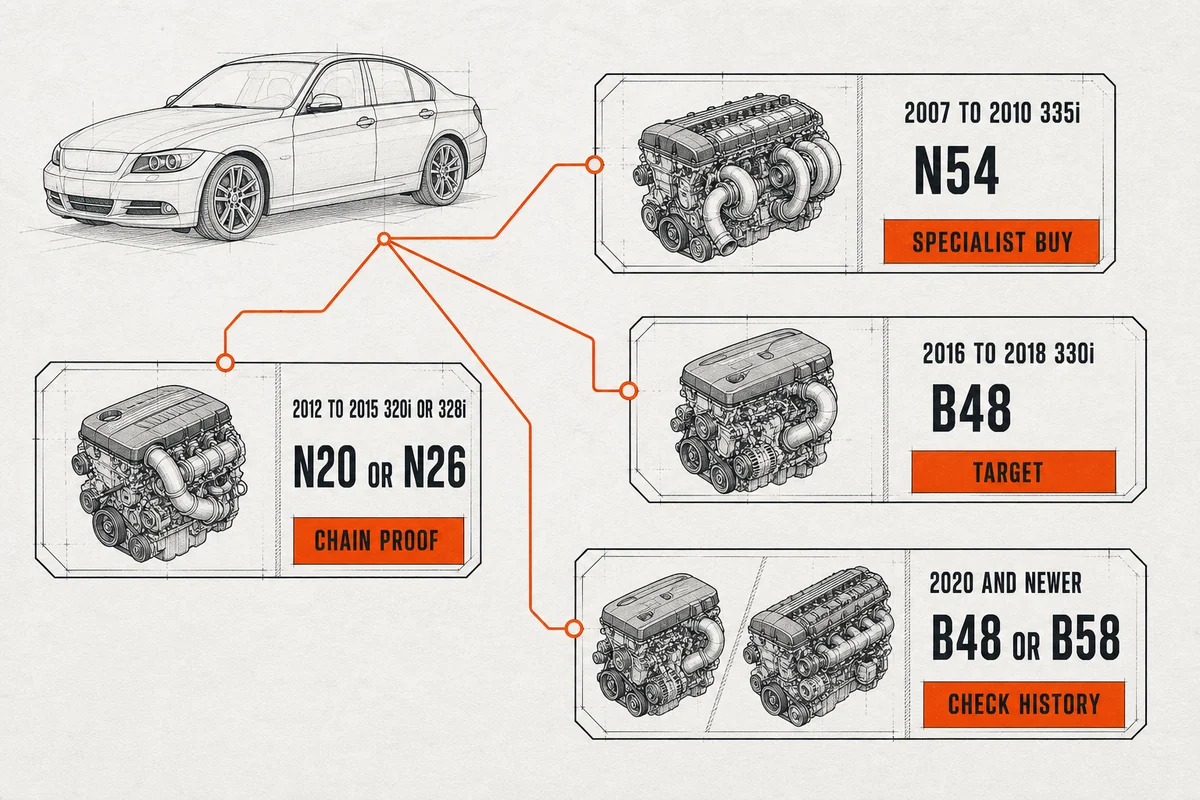
The live 2014 328i NHTSA results and 2013 335i results illustrate the badge split. Use the VIN decoder, underhood emissions label, and service system to confirm the engine before applying any row.
N20 timing-chain proof decides 2012 through 2015 cars
BMW issued Service Information Bulletin 11 03 17 for the N20 and N26 timing chain and oil-pump drive chain. The bulletin extended limited coverage to seven years or 70,000 miles for listed vehicles.
It names 2012 through 2015 F30 320i and 328i sedans, with exact production ranges that vary by badge and drivetrain.
That time-based coverage has expired for these cars. The document remains valuable because it identifies the component and eligible production spans.
A used buyer now needs proof of diagnosis, replacement, or current condition rather than a warranty promise.
A repair invoice should identify the timing chain, guides, tensioner, oil-pump drive chain, VIN, mileage, and parts used.
A valve-cover or drive-belt job does not prove that the timing system was renewed. A class-action settlement bulletin also describes N20 and N26 chain diagnosis, but settlement eligibility does not guarantee a repair on the car in front of you.
The risk is not equal across every 2012 through 2015 3 Series. A 335i with the N55 does not inherit the N20 chain verdict.
A 328d diesel has another engine and another inspection.
Skip the N20 or N26 car when the seller cannot prove its engine code and timing history.
The BMW bulletin uses production ranges, not a simple January-to-December model-year rule.
Decode the production date and engine designation before treating any listing as included.
An invoice from a timing repair should list more than a tensioner. Look for chain guides, chain, oil-pump drive components, seals, fasteners, oil service, and the diagnostic reason for the work.
A specialist can compare camshaft timing values, fault history, oil-filter debris, and cold sound, but no single reading guarantees the remaining life of an old assembly.
The decision is strongest when current diagnosis agrees with a detailed repair record and consistent oil changes. Missing chain history deserves a lower price only when the buyer is prepared to fund the repair immediately.
Early N54 335i cars fail in different places
The 2007 through 2010 335i uses the N54 twin-turbo six-cylinder. Its appeal is real because it responds strongly to tuning and delivers modern power in the compact E90 chassis.
The same tuning culture makes an unknown example risky.
NHTSA opened an investigation into high-pressure fuel-pump failures on the 2007 335i. BMW later extended component coverage for high-pressure pumps and injectors on affected vehicles.
A BMW injector bulletin describes a 10-year or 120,000-mile extension for N54 fuel injectors on listed cars.
That coverage is now old, so the repair history matters more than the former limit.
- 2007N54-powered 335i brings twin-turbo performance and early fuel-pump complaints
- 2011335i transitions to the single-turbo N55 in the sedan
- 2012F30 generation launches with N20 328i and N55 335i choices
- 2016330i badge and B48 four-cylinder replace the earlier 328i formula
- 2019G20 generation begins with newer electronics and B-series engines
Ask for high-pressure pump, injector index, turbo, wastegate, electric water-pump, thermostat, valve-cover, and oil-filter-housing records.
Check whether the engine control software is stock. A modified car needs the tuner, parts list, fuel used, boost target, and maintenance record.
During a cold road test, watch for long cranking, rough idle, misfire, smoke, limp mode, unstable boost, and cooling warnings.
Scan before and after the drive.
A fast N54 car with no history is a repair project, not a discounted commuter.
The fun-to-drive shortlist explains why buyers accept more upkeep for this chassis, but enjoyment does not lower the parts bill.
Fuel-system paperwork on an N54 should identify injector part numbers or index, coding, high-pressure pump work, and the mileage of each repair.
Mixed injector revisions or an invoice with no coding detail deserves a specialist review. During the drive, monitor fuel pressure and misfire counts under load rather than relying on a smooth idle in the seller's driveway.
Turbocharger condition also needs context. Wastegate noise, boost faults, oil smoke, or non-factory software can point to a larger job than one sensor.
Check charge pipes, vacuum lines, intercooler connections, catalysts, and emissions readiness. A recently cleared monitor can hide a fault that has not completed its self-test since codes were erased.
The 2016 through 2018 330i is the F30 sweet spot
The 330i replaces the 328i badge for the later F30 and uses the B48 turbo four-cylinder. This moves the purchase away from the N20 timing-chain group while retaining the mature sixth-generation chassis.
It is the clearest older used target when budget does not reach a G20.
A B48 still needs inspection for cooling leaks, oil leaks, ignition faults, engine mounts, and neglected fluid service.
The improved engine family does not make BMW maintenance optional. Confirm oil-change frequency by date and mileage rather than relying on a dashboard reset.
RepairPal reports an average annual repair cost of 773 dollars for the 328i and a 3.0 out of 5 reliability rating.
Its separate 328i xDrive estimate is 900 dollars. These are broad averages, but they show why a cheap purchase price needs a repair reserve.
A rear-wheel-drive 330i is mechanically simpler than an xDrive car. If winter traction is not essential, fewer driven components can reduce inspection and maintenance exposure.
Compare the BMW with the Toyota Camry when low operating cost matters more than steering feel.
xDrive adds a tire and transfer-case test
BMW's xDrive system depends on four closely matched tires. Different brands, sizes, rolling diameters, or large tread-depth differences can create unwanted load.
Read every sidewall and measure all four tread depths before judging the car by its clean bodywork.
Drive tight circles in both directions at parking-lot speed.
Watch for binding, shudder, hopping, or drivetrain warnings. Then check for transfer-case faults and fluid history.
An xDrive badge also changes oil-pan access and some repair labor.
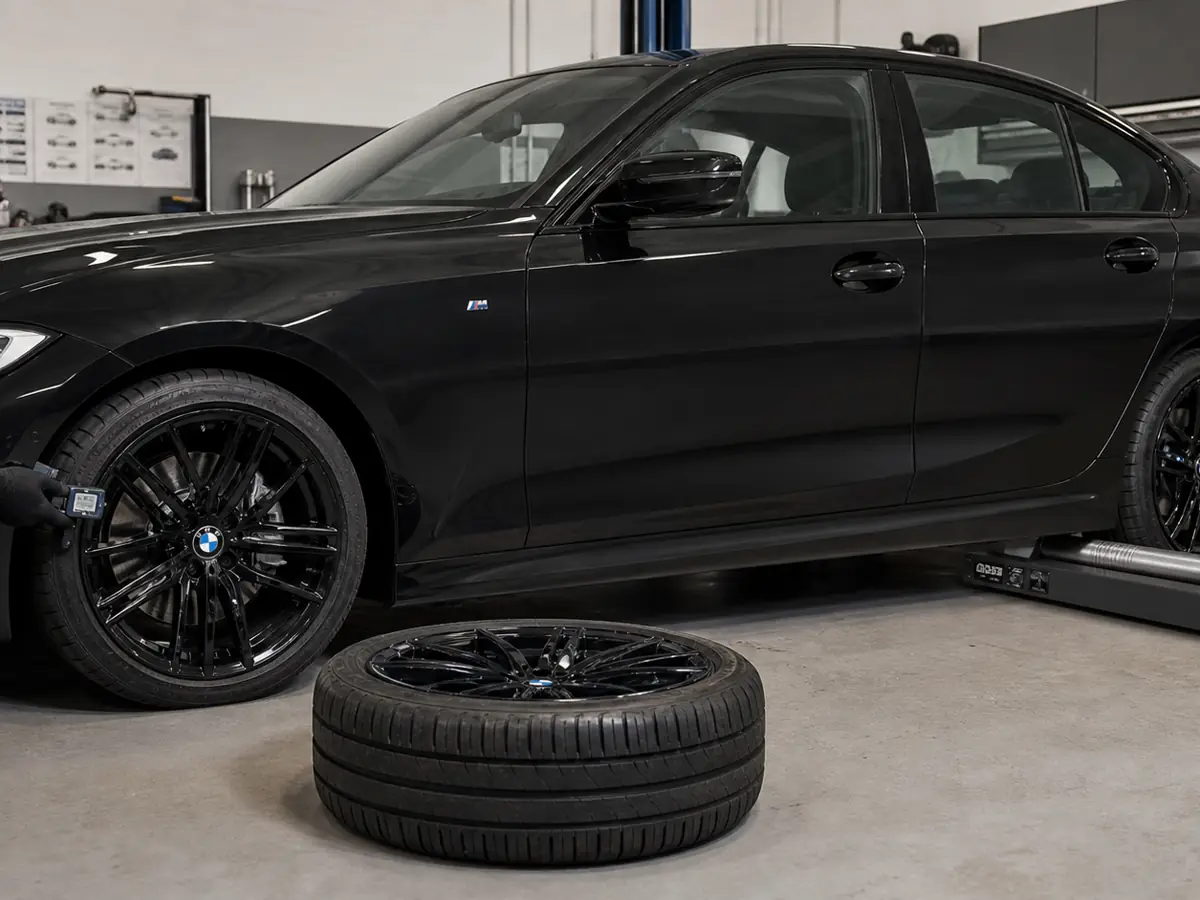
A seller may replace one damaged tire shortly before sale. Ask why it was replaced and whether the remaining tires match in model and wear.
The tire-pressure procedure protects the set after purchase, but pressure cannot correct incompatible tread depth or hidden wheel damage.
Rear-wheel-drive cars need the same wheel and alignment inspection. Bent wheels, sidewall bubbles, shoulder wear, and vibration are common price problems on cars with low-profile tires.
Tire quality is part of the service history on a sport sedan.
Cooling and oil leaks reveal deferred maintenance
A 3 Series can drive well while a plastic cooling part seeps slowly or oil collects on the undertray.
Inspect the car cold and again after the road test. Look around the valve cover, oil-filter housing, oil pan, coolant reservoir, water pump, thermostat, hoses, and radiator connections appropriate to the engine.
Burning-oil smell can come from a valve-cover leak reaching hot exhaust components.
Coolant residue may dry into a pale crust before a dashboard warning appears. Remove the lower shield only when the shop can do so safely and return it correctly.
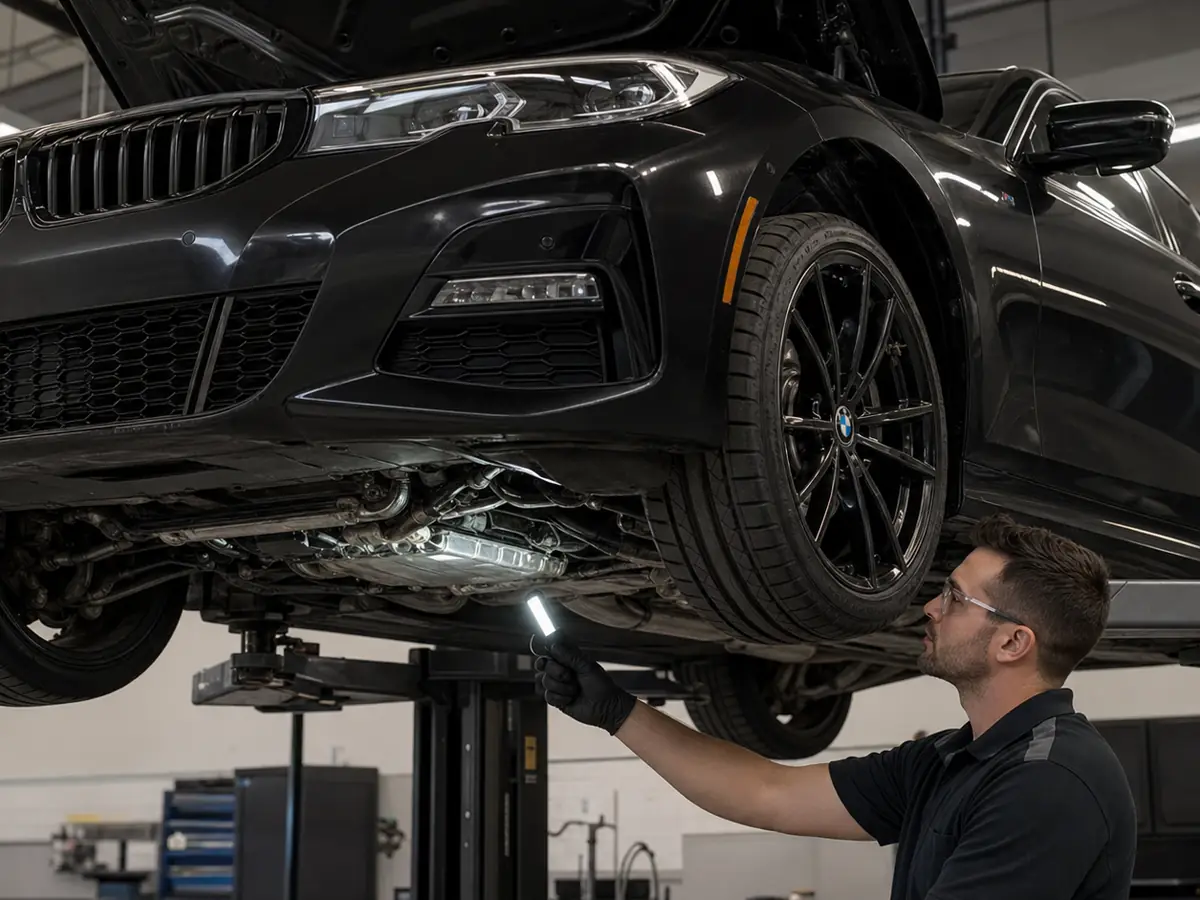
Ask the specialist to pressure-test the cooling system when history or residue justifies it.
Check electric water-pump operation on the applicable engine and scan for shadow faults. A recently washed engine bay needs extra scrutiny because cleaning can remove fresh evidence.
Complete the BMW inspection with these checks:
- Decode the VIN and confirm engine, drivetrain, body, and production date
- Scan every module with BMW-capable equipment before and after the drive
- Inspect timing, fuel, turbo, cooling, and leak history for that engine
- Measure tires, brakes, suspension play, alignment, and wheel runout
- Test every screen, camera, sensor, seat motor, light, and comfort feature
- Review recalls, collision repairs, modifications, and original invoices
The oil-change routine explains basic service logic, but a used BMW needs the actual oil specification and interval shown in its records.
Compare all four tire model names, sizes, load ratings, date codes, and measured tread depths. Matching brand names are not enough when two tires are a different model or have a meaningfully different rolling circumference.
Ask why any single tire or wheel was replaced and inspect the corresponding suspension corner for impact evidence.
During tight turns, distinguish tire scrub on dry pavement from a repeatable drivetrain bind.
Follow with a straight-road acceleration test and a module scan. Transfer-case fluid history helps, but a fluid change performed immediately before sale should be paired with the reason, previous symptoms, and current adaptation or fault findings.
Newer G20 cars still need a modification check
The G20 generation begins for 2019. The 330i uses the B48, while the M340i uses the B58 inline-six.
Both engines have a stronger modern reputation than the older N20 and N54 trouble groups, but they attract tuning and can hide expensive collision damage behind clean cosmetics.
Choose a stock car when reliability is the priority. Ask whether the engine computer, transmission software, exhaust, intake, suspension, or emissions hardware has been changed.
A flash counter, removed tune, or recently returned stock hardware deserves the same attention as an active modification.
A 2019 is the first G20 model year, so test its electronics, driver assistance, cooling, and cabin systems carefully.
A 2020-and-newer car with complete records gives the platform more production maturity.
The new-versus-used framework helps price warranty and known history against depreciation.
Use the BMW brand range to compare body styles without carrying sedan conclusions onto a 4 Series or X3. A Honda Civic is a useful cost baseline when the BMW payment leaves no room for specialist service.
Which 3 Series years should you buy?
Choose a 2016 through 2018 330i for the best F30 balance of the B48 engine and mature chassis. Choose a 2020-and-newer 330i or M340i when budget supports a newer car, full diagnostics, and higher consumable costs.
A naturally aspirated 2009 through 2011 328i can appeal to an enthusiast who accepts age-related cooling, leak, suspension, and recall work. It is not automatically cheaper to own because old rubber, plastics, electronics, and deferred service arrive together.
A 3 Series rewards correct maintenance. It charges heavily for guesswork.