
Is the Honda Odyssey reliable?
Yes, and it leads its class. iSeeCars scores the Honda Odyssey 7.5 out of 10 and ranks it first of the five minivans it covers, with the current 2018 to 2026 generation scoring 8.80.
First place in a five-vehicle class is partly a statement about the class. The number that matters more to a family is the modelled service life, and that sits at 156,732 miles, roughly 10.5 years.
That is a shorter life than most families assume when they cross-shop a minivan against a three-row SUV. The modelled chance of any given Odyssey reaching 200,000 miles is 24 percent.
Running costs are genuinely good. RepairPal puts the average annual repair bill at $547 and ranks the van third of eight minivans, which is a cheap vehicle to keep on the road for the years it has.
Buy the Odyssey expecting a decade of heavy family service rather than a truck-like second life. That expectation, set correctly, makes the rest of the inspection straightforward.
The 2018 redesign multiplied complaints twenty-five fold
The fourth-generation van finished quietly. Its final model year, 2017, holds 39 complaints in the federal database, which is about as clean a record as any vehicle produces.
The 2018 van, the first of the current generation, holds 965.
What makes that jump informative is how it spread. The 2018 filings split almost evenly across electrical at 90, engine at 90 and power train at 81, rather than concentrating in one system the way a single defect does.
The 2019 van holds 925, and its largest single group is forward collision avoidance and lane departure at 87 filings, which is a driver-assistance system rather than a mechanical one.
Then it settles properly. The 2021 through 2024 vans hold 133, 130, 95 and 89 filings, and the 2025 van sits at 318 with its filings concentrated around electrical and engine items.
Treat 2018 and 2019 as launch years that need specific evidence, and 2021 onward as the part of the generation that behaved. The gap between them is larger than the gap between many separate models.
One rearview camera, five separate recalls
A minivan reverses into a school car park several times a day, so the rearview camera is not a convenience feature on this vehicle. Honda has recalled the Odyssey's five times.
Campaign 20V438 came first, covering water entering the camera mounting holes and reaching the lens, producing a distorted image or none at all. Dealers replaced the camera, and the recall began on 23 September 2020.
Two software campaigns followed within days. Campaign 20V439 covered instrument panel control module software that could leave oil pressure, speedometer and gear position undisplayed alongside the camera, and 20V440 covered central network software that could delay or prevent the image appearing.
| Campaign | Model years | Cause | Remedy |
|---|---|---|---|
| 20V438 | 2019 to 2020 | Water entering the camera mounting holes | Replace the rearview camera |
| 20V439 | 2018 to 2020 | Instrument panel control module software | Software update covering camera and instrument display |
| 20V440 | 2019 to 2020 | Central network software programming | Software update |
| 23V431 | 2018 to 2023 | Faulty MOST coaxial cable connector | Replace the cable harness and fit a straightening cover |
| 26V423 | 2018 to 2020 | Water entering the rearview camera | Replace the rearview camera |
Read the first and last rows together. Honda recalled water intrusion into this camera in 2020, replaced cameras, and then in 2026 issued a further campaign for water entering the rearview camera that expands the earlier one.
Owner letters for that expansion were expected on 24 August 2026, which means many affected owners have not yet been told. A van whose camera was replaced under the 2020 campaign can still be inside the 2026 population.
So the campaign status on a vehicle history report is not the end of this question. Put the van in reverse, look at the screen, and then run the VIN yourself through the NHTSA recall lookup rather than reading a printout the seller brought with them.
Water is the thread running through the fifth generation
Once you have the camera campaigns in front of you, a pattern appears across systems that have nothing else in common.
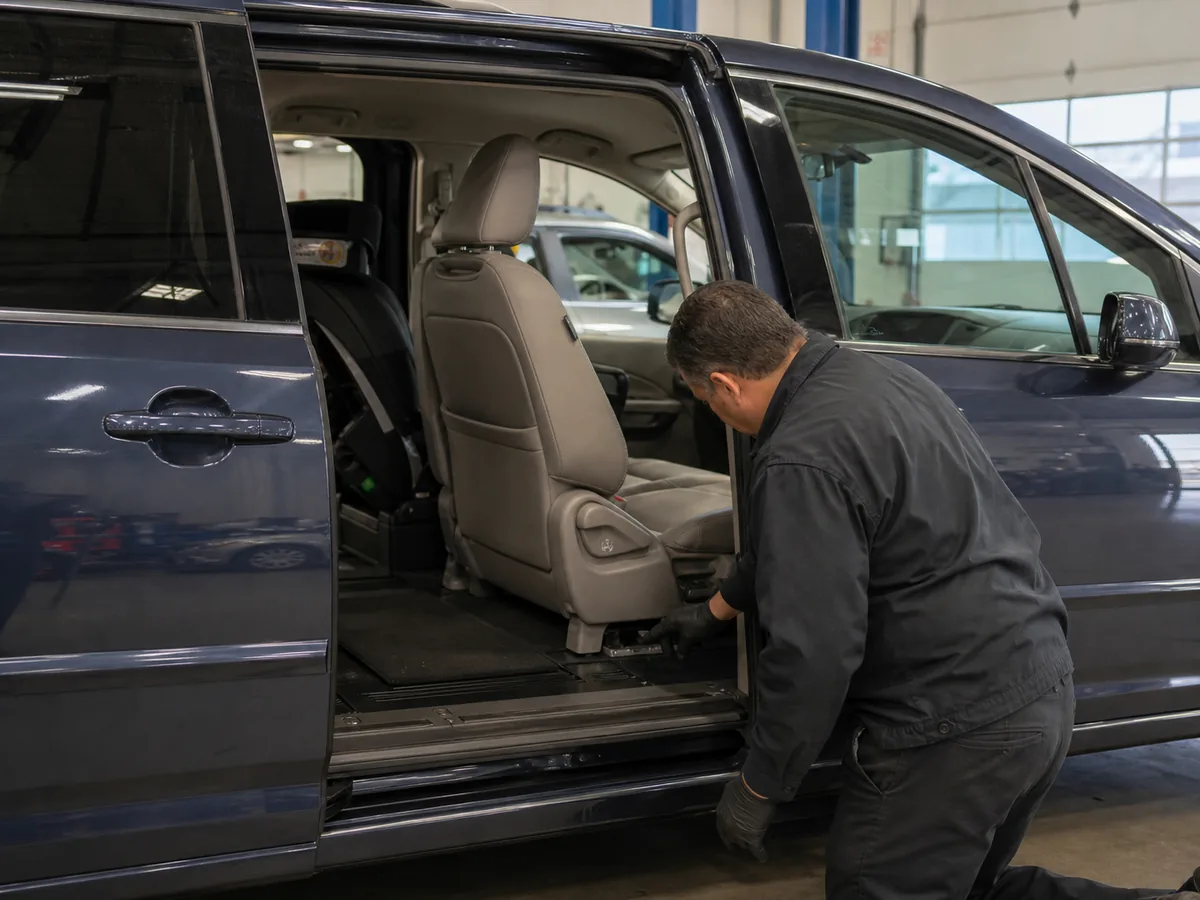
Campaign 20V437 covers water entering the outer door handle cables on the power sliding doors. In cold weather that water freezes, and the frozen cable prevents the front and rear sliding door latches from securing properly.
Honda replaced the outer handle cables under that campaign, which also began on 23 September 2020. A sliding door that fails to latch can open while the van is moving, which is why it is a safety campaign rather than a convenience one.
The third instance is more serious. Campaign 24V114 covers 2023 and 2024 vans whose steering gear box was not tightened properly, allowing water to enter, corrode the assembly and bind the gears.
Honda's stated consequence there is a loss of steering control, and the remedy is replacement of the entire electric power steering rack, with letters mailed on 4 April 2024.
Three unrelated systems failing because water reached them is a sealing and drainage story rather than a supplier story. It also tells you where a van's history matters, because one that has spent six winters parked outside in a wet or salted climate has had far more opportunity to develop each of these than a garaged van from a dry state.
Water-exposed components to check on a fifth-generation Odyssey
- Select reverse and confirm the rearview image appears immediately, clearly and without distortion
- Cycle both power sliding doors several times from the remote, the interior switch and the outer handle
- Check for a completed steering rack replacement on 2023 and 2024 vans, then feel for notchiness or binding at low speed
- Look for water staining and corrosion around the tailgate, rear quarter trim and third-row footwells
- Ask which climate the van has lived in, and weight every check above accordingly
None of these repairs costs the owner anything. The only question worth asking is whether the previous owner bothered.
The transmission fault that starts at a loose battery terminal
Buyers arrive at the Odyssey expecting a transmission problem, because older Honda vans earned that reputation and it has outlived the hardware that caused it.
The fifth generation's actual transmission campaign is not a wear failure at all. Campaign 19V299 covers 2018 and 2019 vans where loose battery terminal connections, or simply a degraded battery, can cause the transmission control unit to reboot without warning.
When it reboots, the control unit may shift the transmission into Park. If that happens while the van is moving, it can damage the parking rod.
The remedy secures the battery terminals, updates the control unit software and checks the parking rod, and the recall began on 31 May 2019.
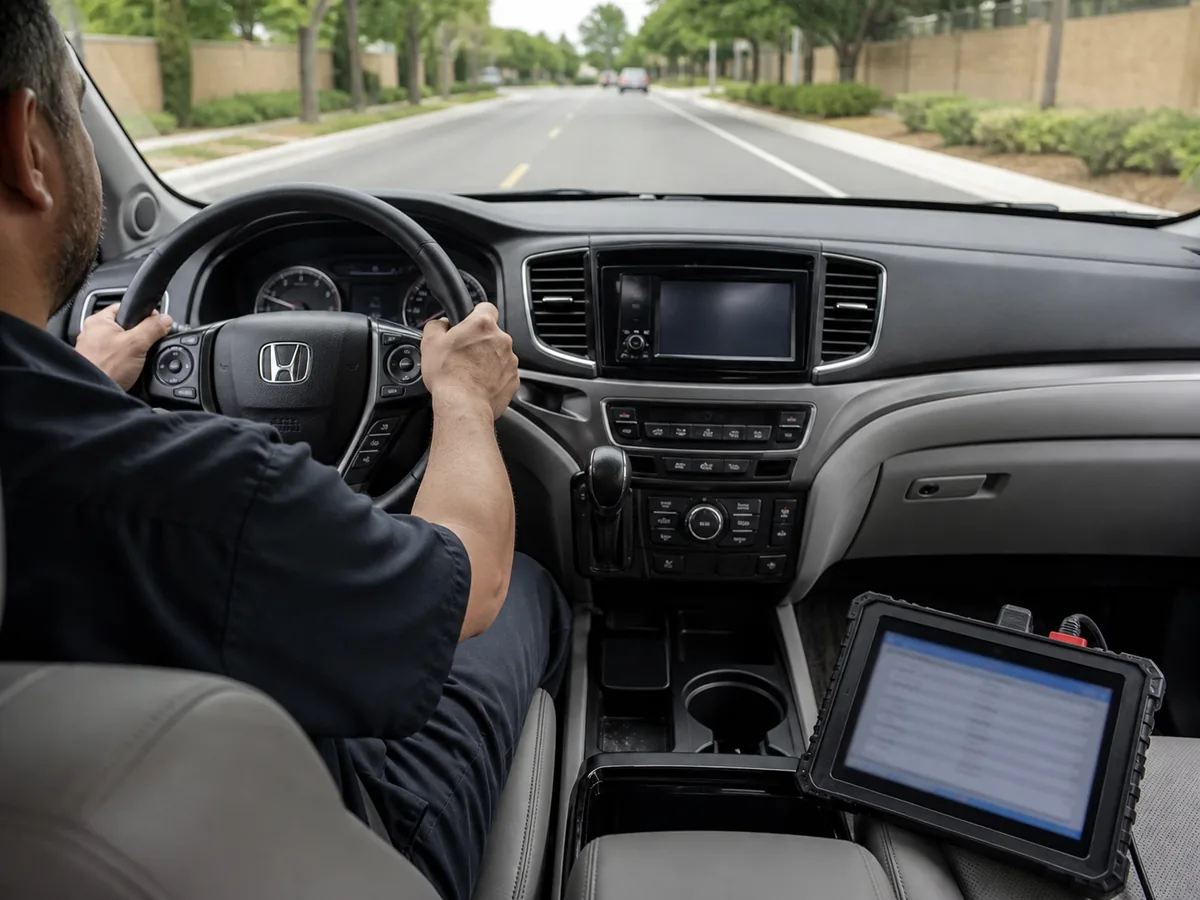
That mechanism is why the standard advice to drive the van until it is warm, while still correct, will not settle this. A rebooting control unit is an intermittent electrical event, and it will not appear on a thirty-minute test drive because the battery happened to be healthy that afternoon.
So check the battery date code, look at the terminal clamps for corrosion and looseness, and treat a recently replaced battery on an unresolved 19V299 van as a reason to ask more questions rather than fewer.
Four recalls for one second-row seat on the older vans
The 2011 to 2017 van scores 8.63 and is a genuinely sound used purchase. Its defining defect is one most buyers never think to test.
Honda issued four separate campaigns covering the second-row seats on that generation. Campaign 16V933 covers a release lever on the outboard seats that can leave the seat unlocked, and 17V725 covers a seat placed between its two lateral positions that will not latch to the floor at all.
Campaign 18V170 covers a walk-in release lever that can leave a fully reclined seatback unlocked, and 16V932 covers a centre seat adjuster bar that can stick in the unlocked position.
Four campaigns on one seat assembly is a signal about how the hardware behaves in use rather than about how it was built. These seats get slid, folded, reclined and removed constantly, and a latch that works in a showroom has years of family handling ahead of it.
Second-row seat checks on a 2011 to 2017 Odyssey
- Outboard seat release lever
- Slide each seat to both lateral positions and confirm it locks, then push and pull hard at the seatback
- Seat set between positions
- Deliberately leave a seat mid-travel and confirm it will not accept a latch, then set it correctly
- Walk-in release lever
- Recline a seatback fully, operate the walk-in lever, then return it and confirm the seatback locks
- Centre seat adjuster
- Move the centre seat through its full travel and confirm the adjuster bar releases and re-locks each time
This is the rare inspection that needs no tools and no lift. Ten minutes in the back of the van tells you what four campaign records cannot.
A 156,732-mile average is the shortest life in this class comparison
The Odyssey's modelled 156,732-mile lifespan is the best in the minivan class and still lower than what a family cross-shopping a large SUV is likely to expect.
The reason is duty cycle rather than construction. Minivans do short trips, carry weight most of the time, spend their lives in traffic and rarely see the steady highway running that is easiest on an engine and a transmission.
A van that has done the opposite beats the figure comfortably. A commuting Odyssey with highway mileage, complete fluid records and one owner is a very different proposition from a school-run van with the same odometer reading.
That is the practical use for the number. Treat 156,732 miles as the average outcome for average use, then adjust up or down based on what this van's records show it actually did.
What should end an Odyssey purchase
Almost everything in this article is a free repair at a Honda dealer. That single fact is what makes an unresolved campaign so informative.
A van arriving with open safety work has told you that its previous owner did not act on letters about a camera that shows nothing, a door that may open while moving, or steering that may bind. None of those required a decision about money.
Some findings are a price conversation. Ordinary wear on tires, brakes, battery and suspension, scuffed trim, worn floor mats and a third row that has clearly been used are all normal and all negotiable.
Others are not. Campaign 26V227 covers 2018 to 2022 vans where a software error can deploy the side and curtain airbags unexpectedly, and 23V751 covers 2018 and 2019 vans where a connecting rod bearing can wear and seize.

The Odyssey deserves its position at the top of the minivan class. The version of it you should buy is the one whose owner opened the letters.