Which Honda Odyssey years should you avoid first?
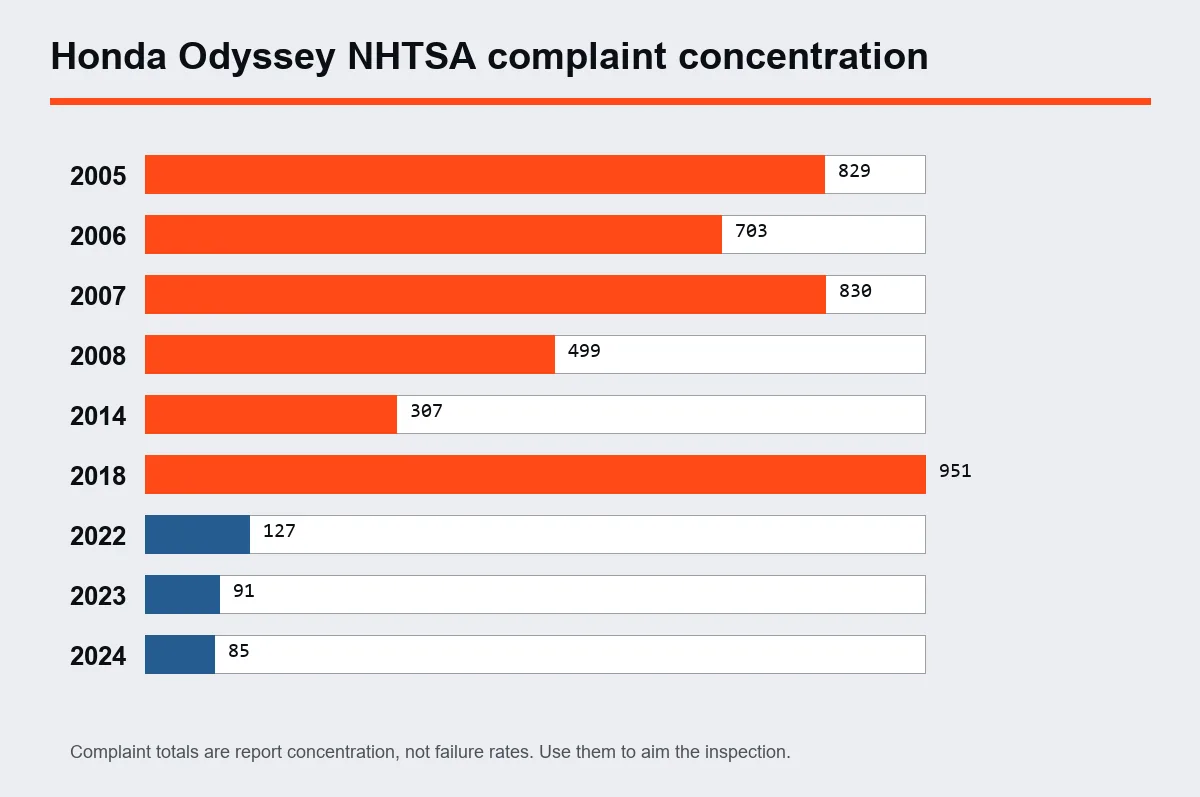
Put 2018 and 2019 at the top of the modern caution list. The current NHTSA pull contains 951 complaints for 2018 and 915 for 2019, far above 131 for 2021 and 127 for 2022.
Add 2005 to 2008 when you cannot document transmission behavior, braking, structure, airbag work, and rust condition. Treat 2014 as a narrower mid-cycle caution year rather than placing it beside the two loudest modern years.
| Year group | Starting verdict | Evidence that changes the deal | Proof to obtain |
|---|---|---|---|
| 2005 to 2008 | Avoid first when age history is vague | Brake, structure, steering, powertrain, airbag, and corrosion exposure | Lift inspection, transmission test, brake measurement, recall record, door and seat check |
| 2014 | Inspect before shortlisting | Mid-cycle engine, powertrain, brake, structure, and electrical reports | Cold start, shift quality, oil-leak check, brake test, scan, complete service history |
| 2018 to 2020 | Highest modern scrutiny | Heavy electrical, driver-assist, engine, and powertrain evidence | Bearing-recall status, camera and sensor test, hot road test, scan, repair invoices |
| 2021 to 2024 | Better starting range | Quieter complaint pattern, but high family-use wear remains | Door cycles, seat latches, tires, brakes, software history, VIN check |
| 2025 | Current-status year | Complaint history is still developing | Warranty start date, current campaigns, dealer history, fresh scan |
Complaint totals are reports, not failure rates. They do not control for vans sold, mileage, trim, climate, or whether one vehicle carried several complaints.
Use the groups to set the proof burden. A caution-year van should arrive with better records and a cleaner inspection than a quieter-year van at the same price.
The list becomes useful when it changes which van you inspect first.
It should never replace a VIN-specific recall search or an independent pre-purchase inspection.
Why 2018 to 2020 Odysseys need strict modern proof
The 2018 redesign is the main modern dividing line. NHTSA records in this pull show 951 complaints and 16 recalls for 2018, 915 complaints and 20 recalls for 2019, then 442 complaints and 14 recalls for 2020.
Electrical, forward-collision, lane-departure, engine, and powertrain categories appear prominently across those years. That mix can create intermittent faults that a short drive around a dealer lot will not expose.
Start the test with the van cold, then operate the infotainment, cameras, parking sensors, power doors, climate system, and every warning-light self-check. Repeat the drive after the engine and transmission are fully warm.
Do not accept cleared warning lights as a repair.
Ask for the diagnostic report before and after the road test, plus invoices that identify the failed part and completed work.
Driver-assist complaints also make windshield and camera history relevant. Replacement glass can be normal, but missing calibration paperwork leaves an avoidable safety and cost question.
A clean scan does not overrule harsh engagement, shudder, warning messages, or repeat electronic resets.
When symptoms and paperwork disagree, diagnose the symptom before valuing the van.
Why does the 2018 to 2019 engine recall change the Odyssey decision?
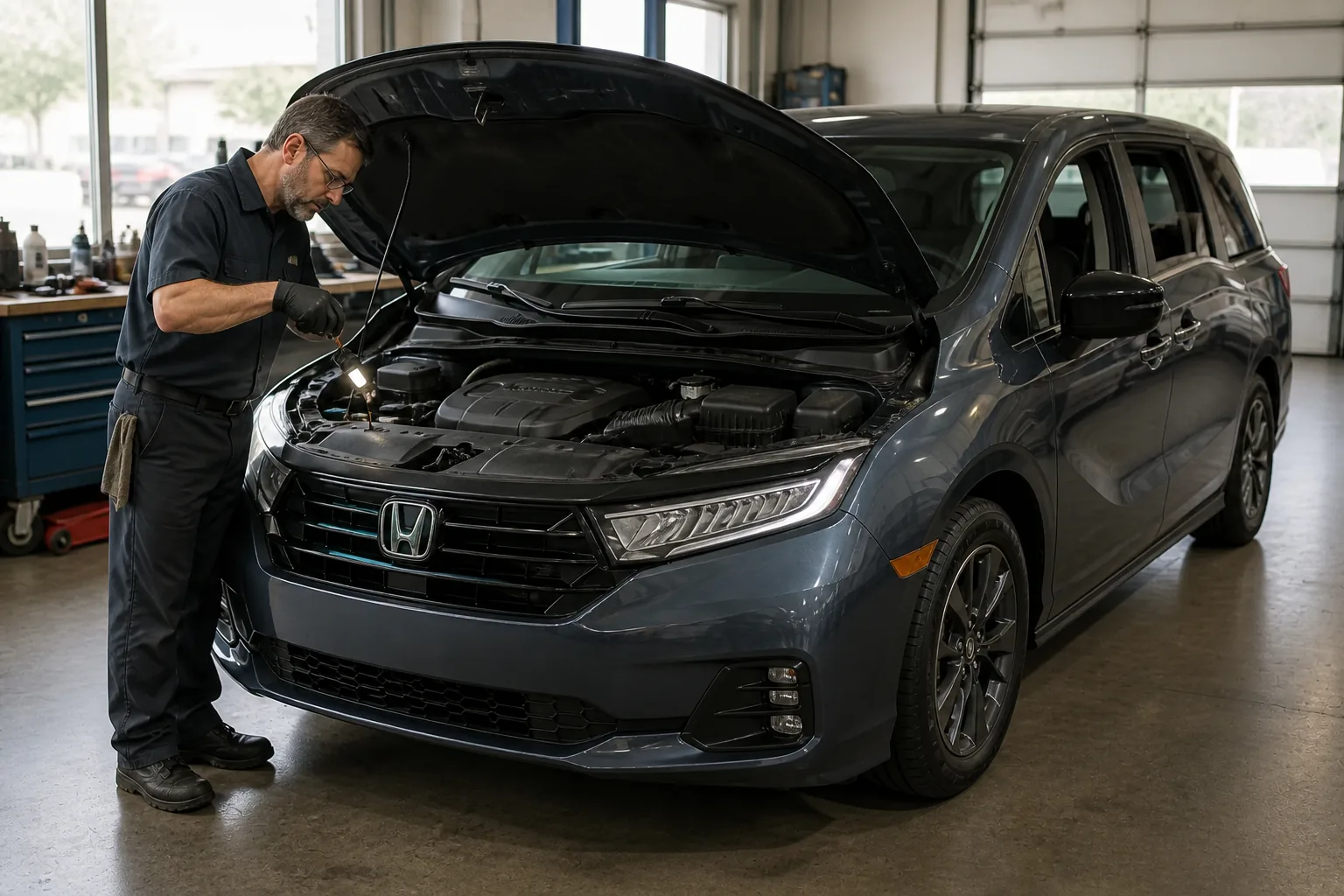
Honda recall 23V-751 includes certain 2018 and 2019 Odyssey engines with possible internal connecting-rod bearing damage. The official consequence includes engine failure, loss of motive power, and a possible fire if the engine is damaged.
This turns a broad internet complaint into a precise VIN question. A Honda dealer should be able to print whether the campaign applies, whether inspection was completed, and which remedy was recorded.
Match the dealer printout to the repair order and vehicle mileage. If an engine or bearing-related repair occurred, ask what parts were replaced, whether oil contamination was found, and what warranty covers the work now.
Campaign completion reduces one known uncertainty.
It does not explain low oil pressure, metallic noise, oil debris, overheating, poor idle, or a seller who warmed the van before you arrived.
Read the NHTSA recall 23V-751 remedy instructions before inspecting a matching VIN. It states the affected model years and remedy process more precisely than a listing description.
Why 2005 to 2008 Odysseys need old-van proof
The first caution group is no longer just a model-year question. A 2005 van is more than two decades old in 2026, so deferred maintenance, rust, collision repairs, rubber deterioration, and obsolete electronics can dominate its original design risk.
NHTSA returns 829 complaints for 2005, 703 for 2006, 830 for 2007, and 499 for 2008 in the current pull. Brake, structure, steering, powertrain, and airbag categories justify a broad inspection rather than one famous-problem check.
Put the van on a lift and inspect subframes, brake and fuel lines, exhaust hangers, suspension mounts, and areas hidden by plastic covers. Fresh undercoating deserves photographs of the metal beneath it.
The transmission test needs cold engagement, light-throttle shifts, a highway merge, deceleration, and a hot restart. Fluid color or a recent service sticker cannot prove that engagement and shift quality are normal.
An old Odyssey can still be a useful low-cost van, but only when its condition is unusually well documented.
Cheap purchase price does not compensate for structural corrosion or multiple unresolved systems.
What about the 2014 Odyssey?
The 2014 Odyssey is a conditional year, not an automatic rejection. Its 307 complaints and five recall records are lower than the loudest old and modern groups, but engine, powertrain, brake, structure, and electrical evidence remains relevant.
Ask for timing-belt, water-pump, spark-plug, fluid, brake, and oil-leak history at mileage-appropriate intervals. A maintenance summary without dated invoices cannot show when expensive V6 work occurred.
During the drive, watch for brake pulsation, steering vibration, delayed transmission response, misfire behavior, and power-door interruptions. Test every second-row seat release because family-use damage often appears there before it appears in a mechanical inspection report.
Price the 2014 against documented 2015 to 2017 vans, not against the cheapest listing online.
A small model-year discount disappears quickly when tires, brakes, belt service, or door hardware are due together.
Sliding doors, seats, brakes, and family use decide many Odyssey deals
A minivan carries evidence that a sedan does not. Repeated school runs wear door rollers, latches, seat mechanisms, brakes, tires, interior switches, and low-mounted trim through thousands of short cycles.
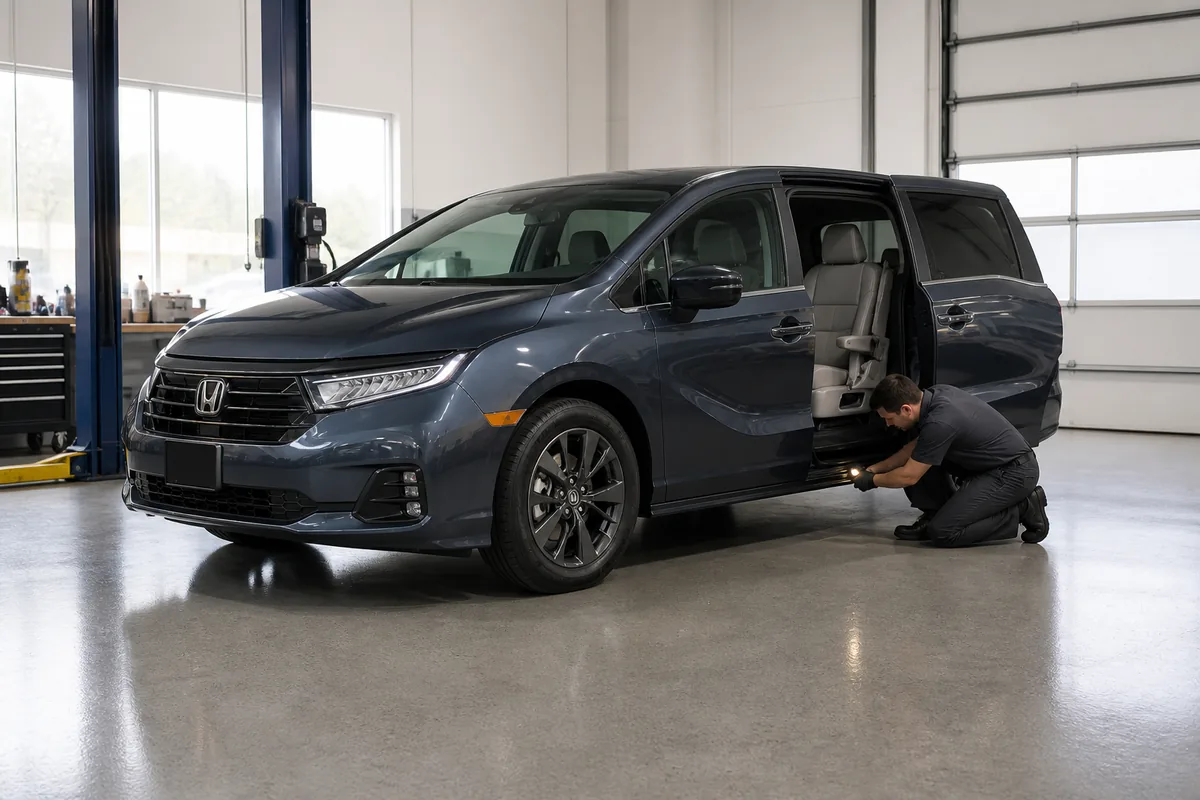
Cycle each sliding door from the dashboard switch, remote, exterior handle, and interior handle. Interrupt closing with the approved obstacle test, listen for cable or roller strain, and inspect both lower tracks for damage or improvised lubrication.
Move and latch every removable seat, then pull each belt fully out and let it retract. Check the cargo well, spare-tire area, door seals, roof drains, and carpet edges for water or sugary residue that can damage wiring and connectors.
Measure all four brakes and read every tire date code. A van with new front tires and old rear tires may have been prepared for sale rather than maintained as a set.
Family cosmetics become mechanical money when a door will not reverse, a seat will not lock, or water has reached a harness.
Put those faults on a written estimate before you discuss price.
Which later Odyssey years deserve a shortlist?
The better starting ranges in this dataset are 2015 to 2017 and 2021 to 2024. The first range avoids the loud 2014 signal without entering the 2018 redesign, while the second follows the 2018 to 2020 complaint concentration.
A quieter year only changes where the inspection begins. High mileage, intensive child transport, rideshare use, collision work, neglected fluids, and repeated short trips can erase the year advantage.
- Print open and completed VIN recalls on the day of inspection
- Cycle doors, seat latches, belts, interior switches, and cargo-well hardware
- Match V6, transmission-fluid, brake, tire, battery, alignment, and cooling records to mileage
- Test cameras, sensors, driver-assist functions, stored codes, and software repair history
Compare like-for-like vans with the same seating layout and equipment because power features add both value and repair exposure. A lower trim with complete records can be the stronger family purchase.
When two vans pass inspection, choose the cleaner history before the newer badge.
Documentation helps you predict the next service bill and preserves resale confidence.
How should you treat a 2025 Odyssey?
The 2025 Odyssey should be treated as a current-status year, not declared one of the best or worst. Its complaint record is still developing, and early counts can move quickly as more vehicles accumulate mileage.
A nearly new van should have the simplest paper trail in the market. Confirm warranty start date, dealer service history, open campaigns, software work, glass replacement, collision disclosure, and any buyback or lemon-law notation.
Use the remaining factory warranty to value documented issues, not to excuse them. A promise that a dealer will repair a symptom later is weaker than a scheduled appointment and written due-bill before delivery.
Near-new pricing requires near-new proof.
Walk away from unexplained warning lights, door faults, camera errors, uneven tires, or missing service records even when the odometer is low.
What proof makes a risky Honda Odyssey worth buying?
A caution-year Odyssey can be worth buying when every known question closes with a record, normal behavior, or a priced repair. The seller must allow enough time for a cold start, extended drive, lift inspection, and diagnostic scan.
Use unresolved wear to negotiate the car price, but do not price safety or structural uncertainty as routine maintenance. A discounted mystery is still a mystery after purchase.
The final choice should make one coherent story from year, VIN, mileage, service history, physical condition, road behavior, scan data, and price. Any contradiction needs diagnosis before money changes hands.
For long-term ownership context beyond model-year screening, use the Honda Odyssey reliability research after this purchase filter.
Sources
- NHTSA 2005 Honda Odyssey complaints
- NHTSA 2007 Honda Odyssey complaints
- NHTSA 2014 Honda Odyssey complaints
- NHTSA 2018 Honda Odyssey complaints
- NHTSA 2019 Honda Odyssey complaints
- NHTSA 2020 Honda Odyssey complaints
- NHTSA 2021 Honda Odyssey complaints
- NHTSA 2025 Honda Odyssey complaints
- NHTSA 2005 Honda Odyssey recalls
- NHTSA 2007 Honda Odyssey recalls
- NHTSA 2014 Honda Odyssey recalls
- NHTSA 2018 Honda Odyssey recalls
- NHTSA recall 23V-751 remedy instructions