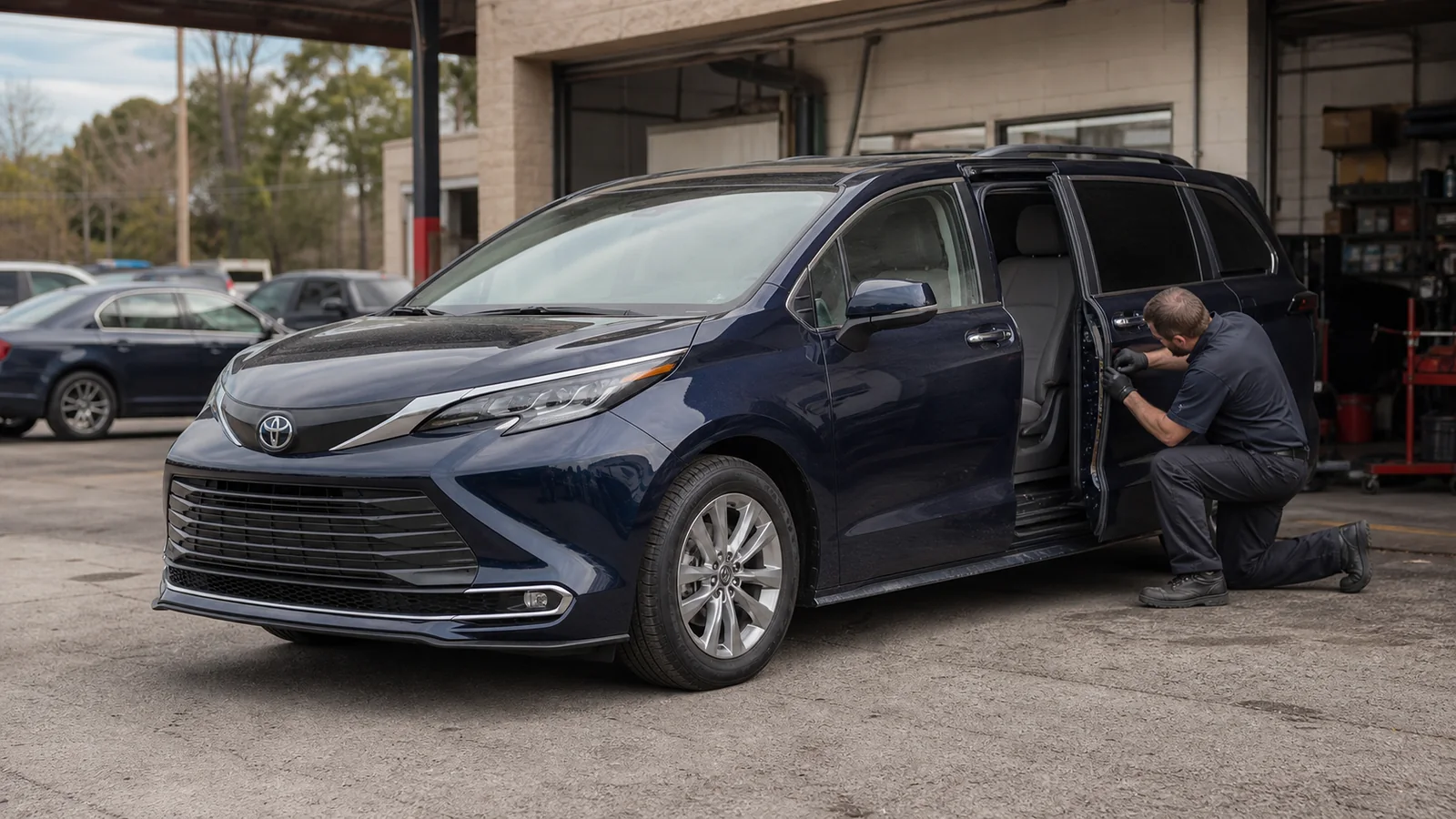
The worst Sienna years cluster around two generation changes
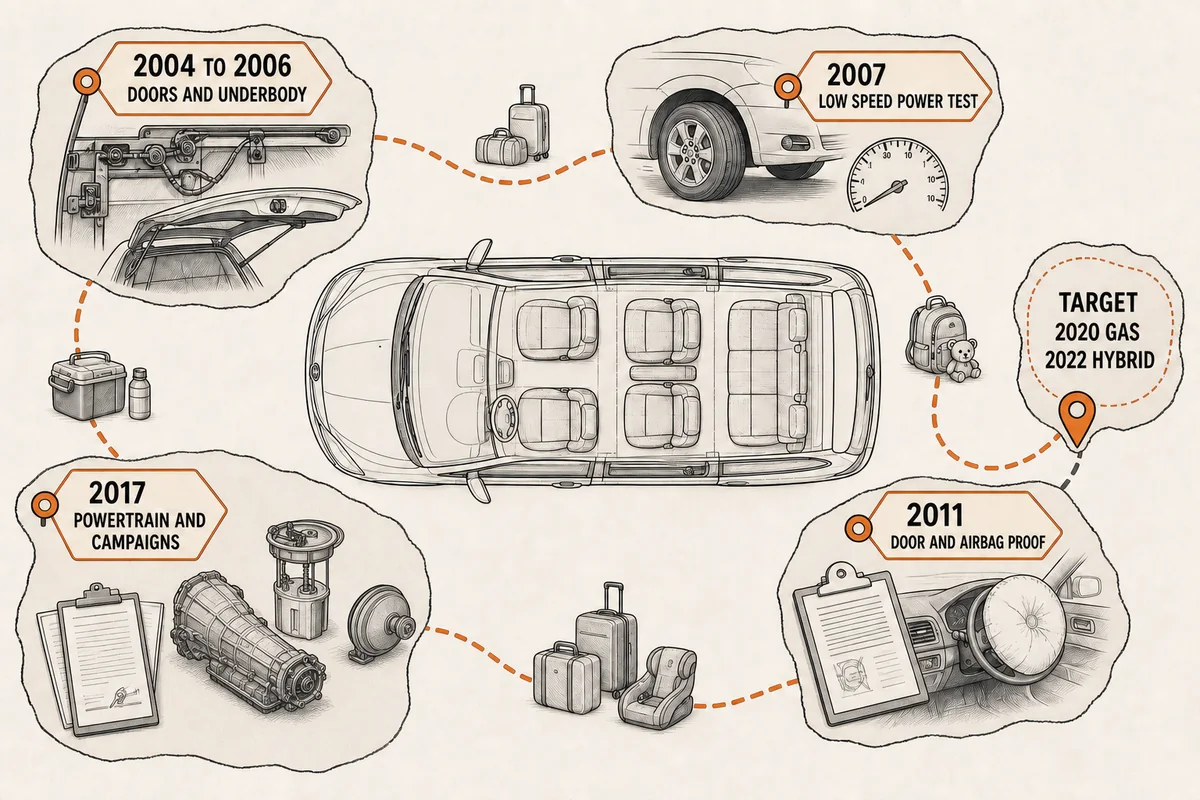
The largest warning sits at the 2004 launch of the second generation. NHTSA returned 2,062 complaints and ten recalls for that model year in the July 12, 2026 snapshot.
Counts stay high for 2005 and 2006, then CarComplaints rates 2007 as its worst Sienna year because of repair cost and the mileage at which reported problems occurred.
The 2011 launch of the third generation creates another inspection point. NHTSA returned 610 complaints and 14 recalls for 2011, including later sliding-door and airbag campaigns.
The year is newer than a 2004, but its safety record cannot be treated as an extension of Toyota's general reputation.
| Year | NHTSA complaints | NHTSA recalls | Main evidence | Starting verdict |
|---|---|---|---|---|
| 2004 | 2,062 | 10 | Structure, doors, dashboard, liftgate, spare carrier | Avoid without proof |
| 2005 | 1,130 | 12 | Structure, restraints, doors, transmission campaigns | Avoid without proof |
| 2006 | 1,016 | 11 | Airbags, structure, tires and wheels | Avoid without proof |
| 2007 | 364 | 10 | Power-loss reports, steering and transmission concerns | Inspect deeply |
| 2011 | 610 | 14 | Airbags, structure, sliding-door campaign | Inspect deeply |
| 2017 | 151 | 10 | Powertrain reports, fuel-pump and brake campaigns | Verify by VIN |
| 2020 | 36 | 2 | Lower report and recall load | Stronger target |
| 2022 Hybrid | 11 | 1 | Lower accumulated count, new hybrid generation | Stronger target |
Complaint totals do not measure the chance that one van will fail. Older Siennas have had more years to accumulate reports, and one submission can name several components.
Use the table to decide what must be proved, not to replace a physical inspection.
The 2004 through 2006 van can turn every family feature into a repair
The 2004 Sienna has the highest complaint concentration in the nameplate data. Structure leads the NHTSA component groups, with door and latch categories close behind.
CarComplaints lists 203 owner complaints for 2004 in its own model-year comparison, including 35 reports for dashboard cracking and 12 for sliding-door issues.
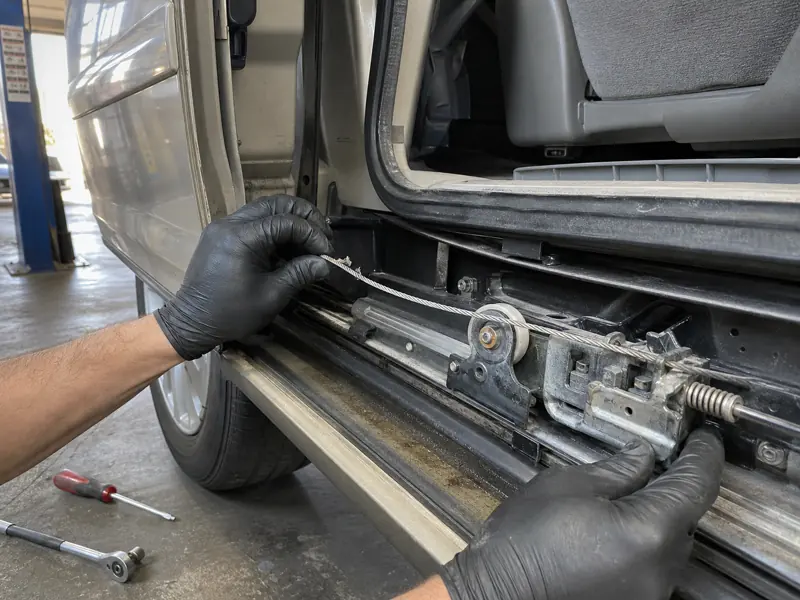
Those concerns reach beyond appearance. A power door cable can fray, bind, or damage the mechanism.
A weak latch or worn roller can keep the door from closing consistently. Power liftgate struts on certain 2004 through 2006 vans were covered by a safety improvement campaign because corrosion could weaken the struts and allow the liftgate to fall.
Door diagnosis should separate the motor, cable, roller, latch, switch, and body alignment.
A motor may sound healthy while a frayed cable binds under load. A new cable may fail again if the roller or track remains damaged.
A door that reverses can be responding to real resistance, a pinch sensor, or poor alignment, so lubrication alone is not a complete diagnosis.
Inspect the wiring harness where repeated door movement flexes it. Test speakers, locks, windows, and warning switches on the moving door while it is open, half open, and closed.
Water entry around the seals can corrode connectors and leave stains behind the trim. Those clues explain why a mechanism fails instead of merely proving that it failed once.
Inspect the lower and center tracks for dirt, bent metal, worn rollers, and improvised repairs. Look at the cable where it enters the body and check whether strands are separating.
Confirm that the fuel door interlock, pinch protection, child lock, and dashboard warning all behave correctly.
Run a family-use sequence instead of one quick cycle:
- Open each door from every available control
- Stop and reverse the door during travel
- Check the latch warning after closing
- Fold and slide each second-row seat
- Test child locks and interior handles
- Listen for cable scrape and roller knock
A door that works once may fail after the motor warms or the van sits on a slope. Do not accept a disabled switch as a repair when the power mechanism is part of the price.
Dashboard damage and road-salt hardware can condemn an older van
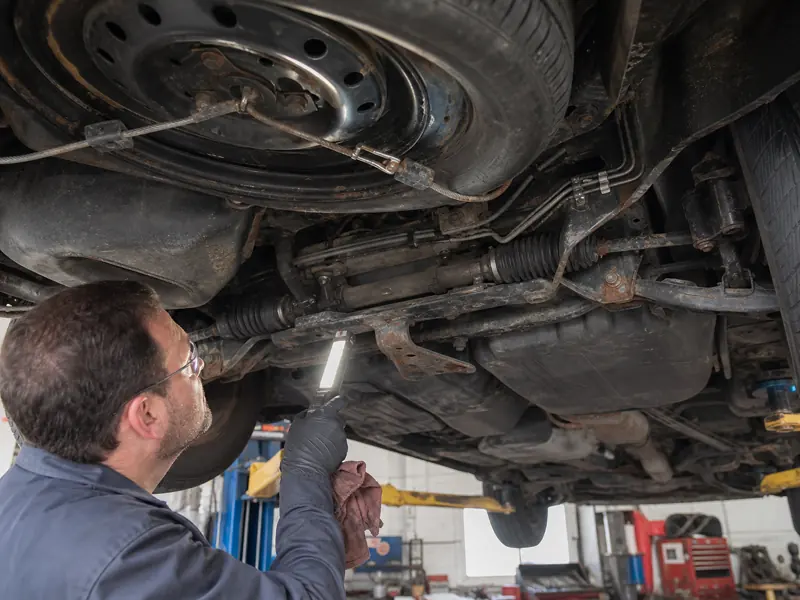
Cracked dashboard material is the visible 2004 problem, but the underbody carries the safety-critical work. Recall 14V-273 covered certain 2004 through 2011 Siennas in road-salt states because corrosion could damage the spare-tire carrier cable.
A dropped spare creates a road hazard, and a missing spare may mean someone removed the risk without repairing the carrier.
Recall 10V-160 also involved certain 1998 through 2010 Siennas in cold-climate states because corrosion could affect the spare-tire carrier.
The exact campaign depends on VIN and history. Inspect the carrier, cable, spare wheel, mounting plate, surrounding floor, brake lines, exhaust shields, and suspension attachment points rather than treating the presence of a spare as proof.
A cracked dashboard affects value and can complicate interior repair, though an owner report is not proof of airbag impairment.
Inspect around the passenger airbag seam without pressing or cutting the material. Check whether prior dashboard work left gaps, broken clips, warning lights, or disconnected trim.
Look underneath before buying an old van from a snow state:
- Lower and raise the spare carrier if it is safe to operate
- Check brake and fuel lines for scaling corrosion
- Inspect steering-rack boots and hydraulic-fluid seepage
- Look at subframe seams and suspension mounts
- Verify that liftgate struts hold the hatch through its full travel
The minivan body layout makes the Sienna valuable because every opening serves a daily task. Reject an older van when corrosion, door damage, or liftgate weakness removes that usefulness or creates a safety question.
The 2007 low-speed power-loss pattern needs a long road test
CarComplaints rates 2007 as the worst Sienna year in its model comparison. Its specific loss-of-power-after-slowing category contains 16 owner reports, a typical reported repair cost of $3,000, and average mileage around 37,800 miles.
The reports describe a delay or abrupt response when accelerating after slowing, but they do not establish one cause for every vehicle.
NHTSA returned 364 complaints and ten recalls for 2007. Engine, powertrain, structure, airbags, and vehicle-speed-control reports all appear in the data.
Recall 13V-429 covered certain 2007 through 2009 vans for a transmission shift-control issue that could allow the vehicle to move from Park without pressing the brake under defined conditions.
Recall 17V-657 later covered certain 2005 through 2007 and 2009 through 2010 vans for the shift-lock assembly.
Start from cold and include repeated slow-down and reacceleration events. Drive through a right turn, a rolling stop, a parking-lot crawl, a hill, and a highway merge.
Note delayed response, harsh downshift, flare, shudder, warning lights, or engine noise.
Repeat the same sequence after the drivetrain is hot.
Separate engine response from transmission response during the test. If engine speed rises but road speed does not, the transmission needs attention.
If both remain low despite a larger accelerator input, throttle control, engine management, or fuel delivery may be involved.
A scan tool and road-test data are more useful than guessing from the driver's seat.
Check service records for transmission fluid work, engine oil intervals, ignition parts, and any throttle or control-module update.
A flush invoice with no fluid specification or complaint diagnosis carries limited value. Ask the shop to inspect mounts and axle joints too because movement or vibration during reacceleration can imitate a transmission fault.
2007 road-test evidence
- Low-speed response
- Predictable acceleration after slowing
- Shift quality
- No flare, bang, slip, or delayed engagement
- Scan history
- No stored engine, transmission, ABS, or throttle codes
- Fluid condition
- Correct level, no burn odor, no unexplained leak
- Shift lock
- Cannot leave Park without the required brake input
A seller may describe a delay as normal electronic throttle behavior. That explanation should not overrule a repeatable hesitation or harsh shift.
Stop the purchase when the van cannot deliver smooth, predictable power in the exact low-speed situations a family uses every day.
A 2011 needs sliding-door and Takata proof before convenience matters
The 2011 started a new Sienna generation and carries the highest NHTSA complaint and recall counts of that generation in this comparison.
Airbags and structure lead its component groups. NHTSA's Takata recall spotlight includes 2011 through 2014 Siennas, so the VIN must show the applicable inflator work completed.
Recall 16V-858 covers certain 2011 through 2016 Siennas. Toyota's owner notice says an obstructed sliding-door opening could overload the motor circuit and open a fuse while the latch was unlatched, allowing the door to open while driving.
That campaign makes door function and dealer history part of the safety inspection, not a comfort check.
Test both doors at least five times, then inspect the warning display and latches. Ask whether a door motor, cable, latch, or junction switch was replaced and match the invoice to the correct side.
A recently greased track may quiet a worn roller for the visit without fixing the mechanism.
Airbag verification needs the same precision. The warning lamp should illuminate at startup and then go out.
A lamp that never comes on can be as concerning as one that stays lit. Inspect seat-belt buckles, pretensioner wiring under the seats, and evidence of dashboard or steering-wheel replacement after a collision.
Ask the dealer for campaign completion, then compare it with labels and repair invoices when available.
NHTSA's public VIN search shows unrepaired recalls but may not display older completed work. A dealer history can clarify which inflator or door remedy was installed and when, especially on a van that changed owners or states.
The seven-seat field shows why buyers accept a van's extra mechanisms.
Seats and doors save time only when they work.
A 2011 with incomplete airbag or sliding-door work should stay off the shortlist regardless of trim.
The 2017 combines powertrain reports with later fuel-pump campaigns
NHTSA returned 151 complaints and ten recalls for the 2017 Sienna, with powertrain reports leading the component groups.
The three figures point to a powertrain-first inspection, but the ten campaigns still need VIN filtering because accessory and conversion recalls can inflate the generic year list.
Recall 18V-211 included certain 2017 Siennas for a brake-assist vacuum-pump concern. Later fuel-pump campaigns 20V-012 and 20V-682 included certain 2017 through 2020 Siennas because the low-pressure pump could fail and stall the engine.
Not every one of the ten recalls applies to a standard retail van.
Some concern regional distributor equipment or mobility conversions. This is why a VIN lookup and build inspection are more accurate than quoting the total alone.
A converted wheelchair van needs the conversion manufacturer's campaigns as well as Toyota's.
Scan the powertrain, test brake assist, and drive through hot restart and steady cruise. Confirm that the brake pedal remains consistent after repeated stops and that the engine starts promptly.
Ask the dealer to identify the installed fuel-pump remedy by VIN.
The 2017 can be a workable buy after those checks, but it is not the easiest year to approve. Choose it only when the campaign record, brake behavior, and transmission response are uneventful.
Better years depend on whether you want gas or hybrid
A 2016 is the lower-price target within the third generation. CarComplaints lists five owner complaints in its comparison, while NHTSA returned 75 complaints and five recalls.
It remains inside the sliding-door campaign range, so door proof is mandatory. Its value comes from being a mature gas-generation year before the larger 2017 powertrain concentration.
A 2020 is the strongest gas-era starting point. Its snapshot contains 36 NHTSA submissions and two campaigns, while CarComplaints records five owner complaints in its separate comparison.
The fuel-pump campaign may apply, so do not confuse a lower total with a recall-free VIN.
It gives buyers the older V6 drivetrain at the end of its generation.
A 2022 Hybrid is the cleaner early-hybrid target in the current data. Querying the model as Sienna Hybrid returned 11 NHTSA complaints and one recall, compared with 34 complaints and two recalls for the 2021 launch year.
The newer hybrid has less time in service, so this comparison is a starting point rather than a lifetime forecast.
Hybrid inspection adds a cooling and high-voltage layer. Check that battery cooling inlets are clean and unobstructed, confirm there are no hybrid-system warnings, and scan the dedicated control modules.
Listen for abnormal brake blending or pump cycling because the regenerative and hydraulic systems share the stopping task.
A family that drives mostly city miles may benefit most from the hybrid's lower fuel use.
A buyer who wants a lower purchase price may prefer the mature 2020 V6. Compare either van against three-row SUV alternatives using passenger access, cargo behind the third row, fuel cost, and door convenience instead of treating the newer powertrain as an automatic win.
The current Sienna profile explains the hybrid system and packaging. Use the hybrid powertrain field to compare fuel savings, and the gas-car field to understand the older V6 alternative.
Pick the powertrain generation first, then choose the cleanest year and service file inside it.
Inspect a Sienna as a family tool, not an empty van
Bring the child seats, stroller, mobility gear, or cargo you use every week. Load the seats and operate every door with the real obstruction and reach constraints your family faces.
A third row that will not fold, a seat track that binds, or an intermittent door changes daily use even when the engine is healthy.
Check every seat belt for smooth pullout, locking, retraction, and visible damage.
Confirm airbag and occupant-sensor lights complete their startup check. Test rear climate controls, vents, cameras, parking sensors, outlets, entertainment equipment, and the power liftgate.
Water marks around the roof, hatch, or sliding-door seals need a leak diagnosis.
Use a complete appointment:
- Cold-start and hot-restart the engine
- Scan every available control module
- Measure brakes and test assist
- Inspect both sliding doors manually and under power
- Fold, slide, and latch every seat
- Raise the van for corrosion, leaks, and spare-carrier inspection
- Verify Toyota and conversion-company recalls by VIN
The new versus used process covers title and collision history. The Toyota model range and family SUV shortlist help test whether a van is still the right shape.
An all-wheel-drive Sienna also needs four compatible tires with close tread depth.
The best Sienna is the one that passes the family's full routine before money changes hands.
Use sources in the right order, then make the decision
NHTSA complaint data identifies concentrations, while recall filings define the affected defect and remedy.
Toyota and dealer records show whether the individual VIN received that work.
CarComplaints supplies owner-report categories and reported cost context. RepairPal lists sliding-door mechanisms among common Sienna problems and reports an average annual repair cost of $554 across model years.
The working sources are NHTSA recall search, the Toyota sliding-door notice, NHTSA's Takata list, CarComplaints Sienna data, and RepairPal Sienna data. The VIN and the physical van outrank a generic year label whenever evidence conflicts.