Is the Toyota Sienna reliable?
Yes, with a caveat that most summaries skip. iSeeCars scores the Toyota Sienna 7.7 out of 10 overall, and scores its 2011 to 2020 generation 9.01.
RepairPal sits lower, at 3.5 out of 5.0 and sixth of eight minivans, with a $554 average annual repair cost.
What each figure actually covers
- iSeeCars, whole nameplate
- 7.7 out of 10, averaged across every generation
- iSeeCars, 2011 to 2020 van
- 9.01 out of 10, the highest any Sienna has scored
- RepairPal, whole nameplate
- 3.5 out of 5.0, sixth of eight minivans
- RepairPal, running cost
- $554 a year, described as below the class average
A sixth-of-eight class rank sitting beside a nine-out-of-ten generation score looks like a contradiction. It resolves once you notice which van each figure is really describing.
The strongest evidence belongs to the generation that ended in 2020, and the current van has not been on the road long enough to have produced anything comparable.
So the useful question is not whether the Sienna is reliable, but which Sienna you are buying. The 2021 changeover is where that splits.
The 2021 Sienna is a different vehicle from the one before it
This was not a facelift. Toyota moved the van to a new platform, dropped the petrol V6 entirely, made it hybrid-only, and offered all-wheel drive for the first time in years.
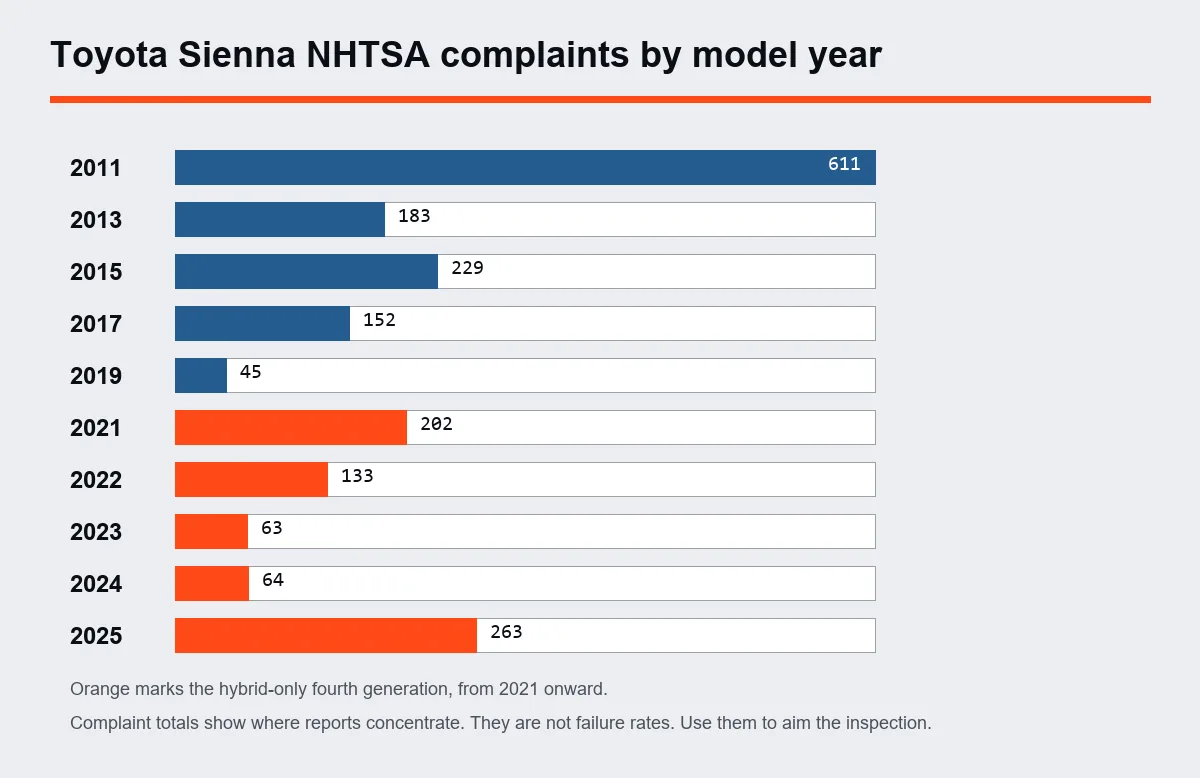
The complaint record changed character at exactly that line, which is a more useful signal than the volume.
Before the boundary, structure leads the 2013 through 2016 vans, at 34, 36, 49 and 19 filings respectively.
That category is worth translating, because it sounds alarming and mostly is not. On a minivan it covers body and door hardware rather than anything holding the vehicle together.
In practice it means power sliding doors, their tracks and rollers, latches, and the tailgate. These are the parts a family operates several times a day for a decade, and they wear accordingly.
Toyota recalled exactly that. Campaign 16V858 covers 2011 to 2016 vans where a power sliding door that cannot open when commanded can damage the door wiring, and the remedy replaces the junction block, the rear sliding door harnesses and two additional sub harnesses.
That makes the doors cheap to check and expensive to ignore. Cycle both ten times from the remote, the interior switch and the outer handle, and watch for one that reverses, hesitates or drags.
After it, service brakes lead 2021, 2022 and 2023 without interruption.
Volume rose across the boundary too, from 36 complaints on the 2020 van to 202 on the 2021. Discount that part, because a brand-new model attracts attention and filings that a run-out model year does not.
What publicity cannot manufacture is which component owners name. A leading category that changes at exactly the platform boundary is the signal worth keeping.
For a buyer that means one checklist does not cover both vans. The older one is inspected around its body and sliding doors, the newer one around how it stops.
Brakes lead every early hybrid-era model year
Three consecutive model years led by the same category is a pattern rather than a coincidence.
| Model year | Total complaints | Filed against service brakes |
|---|---|---|
| 2021 | 202 | 59 |
| 2022 | 133 | 53 |
| 2023 | 63 | 21 |
The mechanism is worth understanding before you read those numbers as failures. A hybrid slows itself with the electric motor much of the time and blends friction braking in as needed.
That blending is what owners feel. A pedal that changes weight at low speed, or grabs slightly as the system hands over from regenerative to friction braking, is a characteristic of the design rather than a fault.
Some filings do describe genuine problems, and the two are not separable from a complaint total. The proportion falling from 59 to 21 across three years is consistent with early software calibration improving.
This is the one thing worth building a test drive around. Brake from low speed repeatedly in stop-start traffic, then brake harder from a road speed, and decide whether what you feel is a characteristic you can live with.
The 2025 van has a seat problem, and it took two campaigns
The 2025 Sienna holds 263 complaints, and 191 of them are filed under seats. That is the largest single-category concentration anywhere in this van's record.
Two separate campaigns sit behind it. Campaign 25V086 covers 2021 to 2025 vans where the bolts for the third-row seatbacks may not have been tightened properly, with owner letters mailed on 1 April 2025.
Campaign 25V668 is narrower and more serious. It covers 2025 vans whose second-row seat rails were welded improperly, and the remedy is replacement of the rails rather than a tightening operation.
Both are free repairs. On a vehicle bought specifically to carry children in the second and third rows, neither is a campaign to take on trust.
The van Toyota stopped building scores highest
If the hybrid van's record is still forming, the obvious question is whether to buy the one whose record is finished.
The gap between that generation and the two before it is unusually wide. Toyota did something right with the van it built through the 2010s, and the data has had a decade to confirm it.
Its quietest years are also its newest. The 2019 and 2020 vans hold 45 and 36 complaints, the two lowest totals in the entire record.
The cheap end of the generation is a different proposition. The 2011 van holds 611 complaints, the highest in the record, and 141 of them are filed against air bags.
That has a specific cause rather than a quality one. Campaign 19V741 covers 2011 to 2013 Siennas among many other Toyotas for airbag inflators, and the remedy replaces the inflator or the airbag assembly outright.
It is free work and most vans have had it, which is precisely why it needs checking rather than assuming. An inflator campaign left open on a fifteen-year-old van tells you how the previous owner treated free safety work generally.
There is one internal break worth knowing about. The transmission changed to an eight-speed for 2017, and that model year holds 152 complaints with power train leading at 29.
Those filings describe the transmission rather than the engine, reporting whining, gear hunting and slipping between gears. They are owner reports rather than a measured failure rate, and 29 filings across a model year is a small number in absolute terms.
It is still a reason to prefer 2018 onward within the generation. The later years carry the same transmission with a year of production behind it and roughly a third of the complaint volume.
The trade is honest. You are buying a petrol V6 with no all-wheel drive, a van that is at least six years old, and the structure-led wear history of its era, which means sliding doors, body hardware and everything a family has done to the interior.
Target the last two years of that generation rather than the cheapest ones. They are the strongest evidence in the whole nameplate and they are still the newest examples you can get.
What 170,240 miles means for a van that carries weight
iSeeCars models an average Sienna lifespan of 170,240 miles, roughly 12 years, which is longer than the leading petrol minivan manages.
That figure is earned under harder conditions than the number suggests. Minivan duty is short trips, carried weight, stop-start traffic and a full cabin, which is the most demanding ordinary cycle a passenger vehicle sees.
A highway-heavy Sienna beats the average comfortably, and a school-run van with the same odometer has done considerably more work to get there.
That difference does not show up on a dashboard, which is why the service file matters more than the mileage. Look for brake and fluid intervals that match a loaded duty cycle rather than a commuter one.
At $554 a year in average repair spend, twelve years of ownership is a genuinely affordable way to move seven or eight people, provided the van you buy has been serviced for the work it actually did.
Which Sienna to buy
This is a choice between proven and modern, and both answers are defensible.
A 2018 to 2020 petrol van gives you the strongest durability evidence any Sienna has produced, the two quietest model years in the record, and a considerably lower price.
A 2022 to 2024 hybrid gives you the fuel economy, the option of all-wheel drive, and a van that has skipped both the 2021 launch year and the 2025 seat spike.
One factor usually decides it. If you need all-wheel drive, the choice is made for you, because only the hybrid van offers it.
That option is also the Sienna's clearest advantage over its main rival, which does not offer driven rear wheels at all. For a family in a snow state it is often the entire reason the Sienna is on the shortlist.
It is worth knowing what the system is before paying for it. The rear wheels are driven by a separate electric motor rather than by a driveshaft from the front, so there is no transfer case and no propshaft to service.
That simplicity is genuinely good news for long-term ownership, and it means the all-wheel-drive van adds a motor rather than a mechanical driveline. Check that it engages without a warning lamp and move on.
If you do not need it, the older petrol van stops giving anything away. The saving is real and the durability evidence behind it is the strongest in the nameplate.
Whichever side you choose, buy it on its own record rather than on the badge the two vans share.