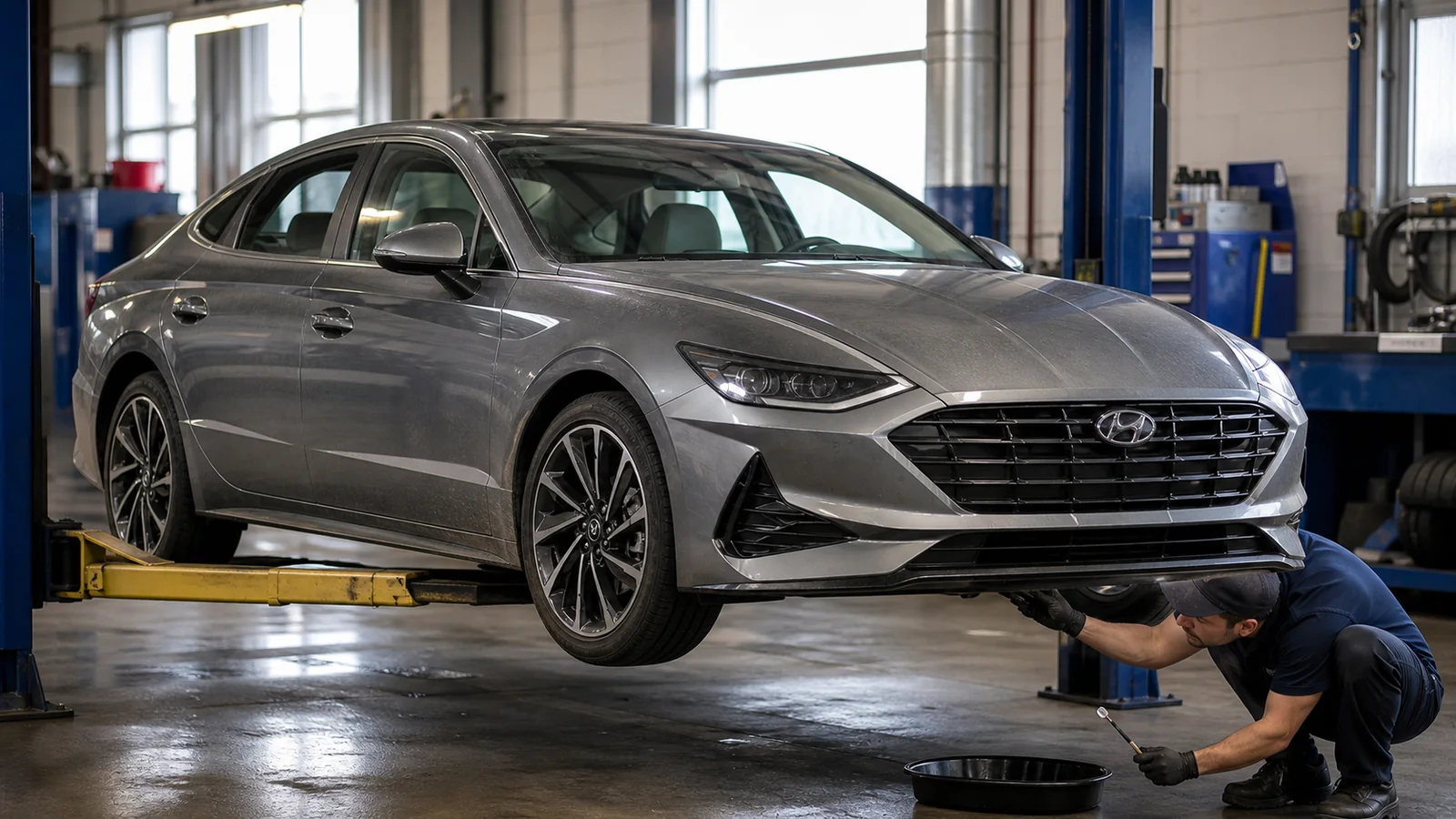
Theta II history divides the Sonata market
The Sonata's problem is concentrated, not general. CarComplaints logs the 2011 model as the worst by a wide margin, with roughly 880 complaints and engine seizure as the top-reported failure.
The average repair ran near $5,100 at about 80,000 miles, which is often more than the car is worth.
That single failure, not a pile of small ones, is what makes year selection matter here.
The trouble tracks one engine family across several years, and the severity fades as you move newer:
- 2011-2012Theta II 2.0L and 2.4L GDI engines: rod-bearing wear leads to seizure, stalling, and fire risk
- 2013-2014Same Theta II failure, now covered by the recall and the warranty settlement
- 2015-2017Excessive oil consumption and engine shutdowns, plus hybrid system faults on some cars
- 2018-2019Seventh-gen finally settled, with the lowest complaints and recalls of the generation
- 2020+Eighth-gen redesign with Smartstream engines and a different recall and service profile
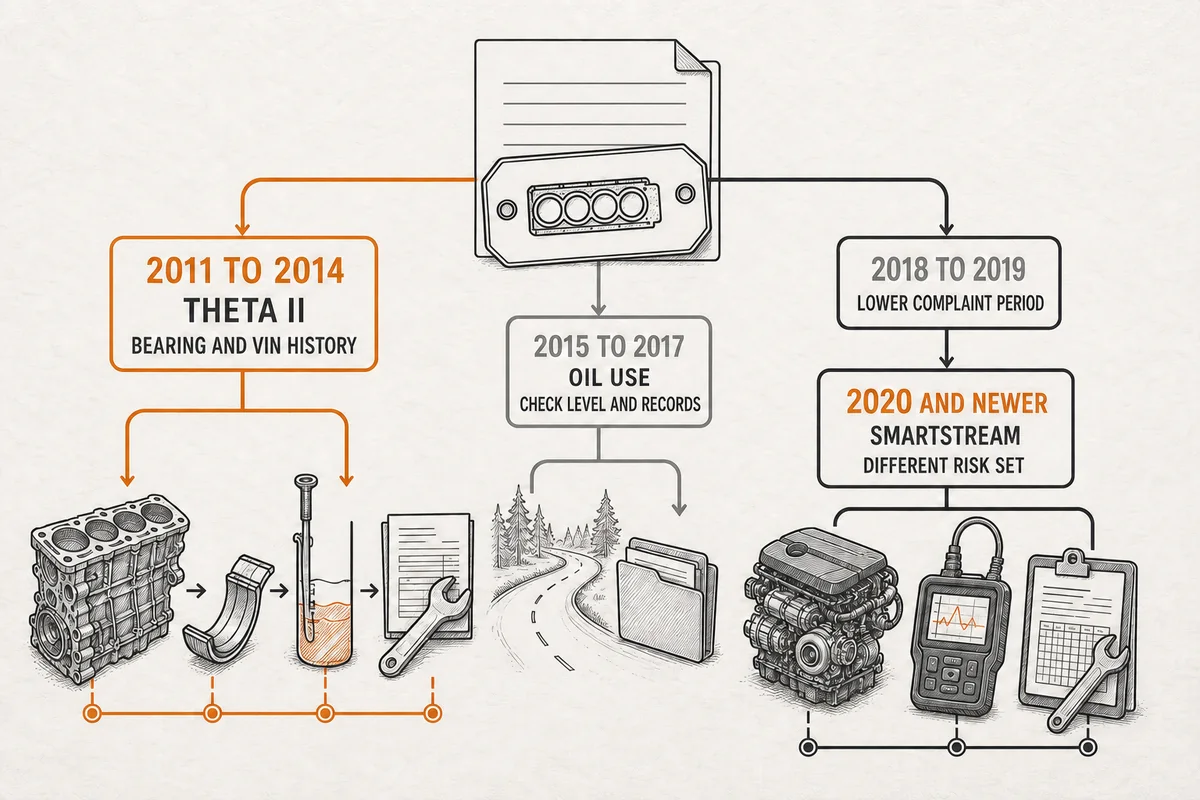
Bearing debris makes 2011-2014 a records-first purchase
The recall history is the part to understand before you shop. Hyundai recalled about 470,000 model-year 2011 and 2012 Sonatas in September 2015 over the Theta II defect, then expanded coverage to the 2013 and 2014 cars, pushing the total past one million vehicles.
Further recalls in 2020 added engine software and more affected cars. Regulators later fined Hyundai and Kia $210 million for how the recalls were handled.
A 2017 class-action settlement added a lifetime warranty on the short block that transfers to later owners, so that coverage can still pay for a failed engine today.
The catch is proof: on a private sale, a car with no recall paperwork and no service records is a gamble, because you cannot confirm the inspection was done or the engine already replaced.
| Year or group | Starting verdict | Evidence | Required check |
|---|---|---|---|
| 2011-2012 | Avoid unresolved engines | Theta II bearing debris, seizure, and recall history | VIN, cold knock, KSDS, and engine invoice |
| 2013-2014 | Avoid without proof | Recall scope expanded to these Theta II years | Recall completion and replacement history |
| 2015-2017 | Inspect carefully | Oil-use and shutdown complaints continue on some engines | Oil level, knock codes, and consumption records |
| 2018-2019 | Consider by engine and VIN | Later seventh-generation cars have lower complaint concentration | Engine identity, recalls, and service history |
| 2020-2022 | Consider | Smartstream generation changes the main risk set | Fuel system, recalls, and normal inspection |
| 2023+ | Consider by VIN | Newer age reduces wear but not campaign exposure | Current software and safety recalls |
The Sonata table organizes recall and engine exposure by year. It does not convert complaint reports into a personal failure forecast.
Move a vehicle forward only when its VIN, repair history, and physical condition support the row.
Oil use keeps 2015-2017 on the caution list
The 2015-2017 cars are a softer warning. They avoided the worst of the early bearing failures but drew complaints for burning oil between changes and occasional engine shutdowns, and Consumer Reports rated the 2017 below average.
CarComplaints logs the 2015 oil-consumption repair at roughly $5,000, close to what a seized 2011 costs, so this is not a minor gripe.
A car from these years is workable if it has clean oil-change records and passes an oil-consumption check, but it is not the safe pick the newer years are.
If the seller cannot show you receipts, treat the engine as an unknown and price it accordingly.
The case for the good years is clear once the engine is sorted.
The 2018 and 2019 cars are the same seventh-generation Sonata with the Theta II bugs largely behind them, and a 2017 mid-cycle update cleaned up the styling and dropped the recall and complaint counts to the lowest of the run.
The 2019 in particular shows very few owner complaints and no major recalls of its own.
The 2020-and-newer eighth generation dropped the Theta II for the Smartstream 2.5L, added a sharper design and more standard safety kit, and is the best-built car Hyundai has put under the Sonata name.
It also carries the same long factory warranty that makes a new Hyundai cheap to own in the early years.
Smartstream years change the risk set
The engine family, replacement history, and campaign status decide a Sonata purchase.
Confirm those three items before treating a later year as safer.
All of the good years undercut a comparable Nissan Altima on price, and the platform-mate Kia K5 is worth a cross-shop if you want the eighth-gen mechanicals in a different suit. If you want the same long warranty in a smaller, cheaper car, the Hyundai Elantra is the compact to look at.
Prove the engine history from a cold start
Do not let a quiet warm idle settle the engine question. A fresh battery disconnect can also erase useful readiness data, so confirm the emissions monitors have completed before treating a clean scan as final proof.
Ask for a cold start, watch the oil-pressure and warning lights, and scan for knock-sensor and misfire history after the road test.
NHTSA's Hyundai consent-order record describes recall 17V-226, the Theta II engine scope, and the related warranty actions. Coverage still depends on the exact VIN and failure condition.
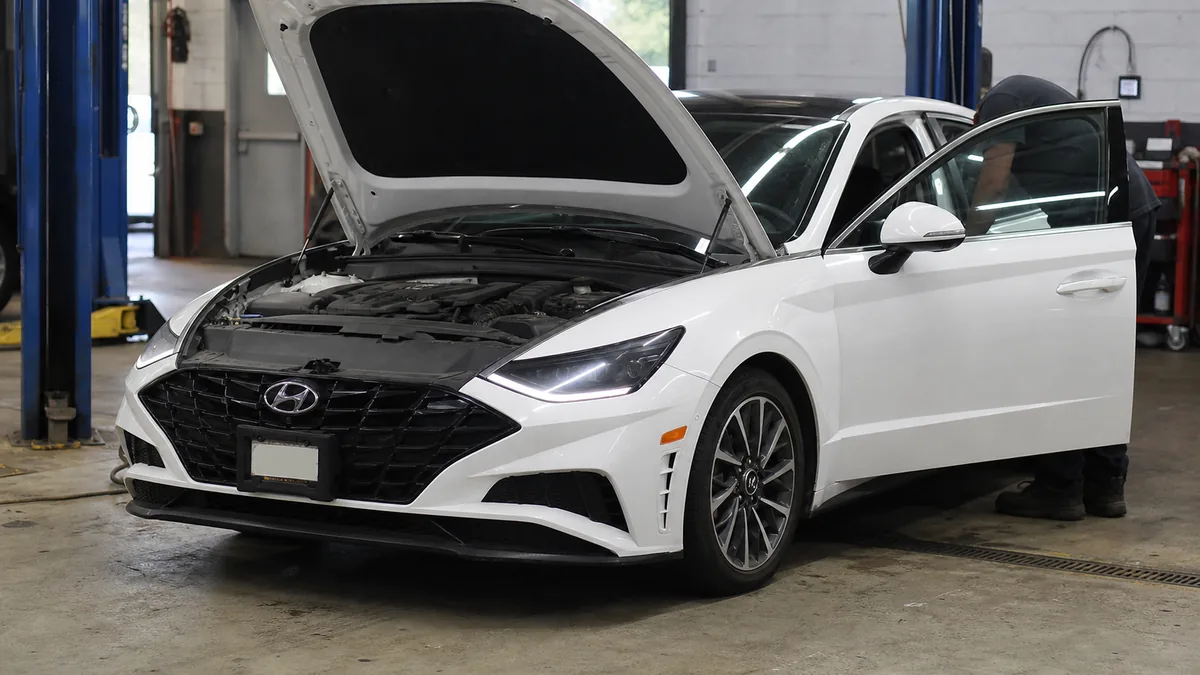
The Sonata profile helps identify Theta II, hybrid, and later Smartstream cars before the inspection. On a Theta II example, a replacement engine is useful evidence only when the invoice lists the VIN, mileage, part number, and reason for replacement.
Confirm that the knock-sensor software and every open campaign were completed after the engine work.
Verify the Sonata from cold engine to paperwork:
- Match the VIN to every engine campaign and replacement invoice
- Check cold oil level before startup
- Listen for bearing knock under light load, not only at idle
- Scan for P1326, misfire, and catalyst history
- Compare the example with the Hyundai model range and sedan choices
Missing paperwork does not prove that a repair was unnecessary. Leave when the VIN, engine invoice, and cold-start behavior cannot be reconciled.
A replacement engine needs a traceable history
A Sonata with an engine replacement is not automatically a bad buy. The useful question is what was installed, at what mileage, under which campaign or warranty, and what coverage remains.
Match the invoice to the VIN and look for the engine assembly description. Ask whether related oil, cooling, fuel, and knock-sensor work was completed at the same visit.
A replacement claim without a VIN-linked record should not raise the car's value.
Use the NHTSA consent order and recall lookup cited above as starting points, then confirm the individual car.
Listen from a cold start and keep the scan tool connected during warm-up. Oil-pressure warnings, knock, misfire, smoke, or a rising oil-use history require diagnosis.
A clean recent oil change is routine maintenance, not proof that the bearing or consumption concern has been resolved.
Records that strengthen the case
- Engine assembly
- VIN, install mileage, supplier, and warranty
- Campaign work
- Dealer completion record and current recall lookup
- Oil history
- Level between services and documented consumption
- Cold test
- Quiet start, stable pressure warning, and clean scan
Insurance, fire campaigns, and normal wear remain separate gates
Verify open safety campaigns before negotiating. Then obtain an insurance quote for the exact VIN, since theft exposure and local underwriting can change the monthly cost.
These checks sit beside the engine decision.
They do not replace it. A low premium cannot make an unhealthy engine safe, and a replacement engine cannot guarantee affordable coverage.
Check steering, brakes, tires, suspension, A/C, electronics, and collision repair after the major gates.
Drive long enough to reach full temperature and repeat acceleration under load.
Recheck the oil area and coolant after shutdown.
Buy only when the VIN history, cold behavior, and hot drive tell the same story.
A seller who refuses those checks is asking the buyer to accept uncertainty that belongs in the price.
Build the Sonata decision from evidence that can be saved:
- VIN recall and campaign results captured on the inspection date
- Cold-start video before the engine has been warmed
- Oil level, service interval, and any consumption notes
- Engine replacement invoice with install mileage and warranty
- Hot road-test observations under light and moderate load
- Insurance quote for the exact VIN and location
If knock, pressure warnings, smoke, or repeat misfire appears, stop and obtain an engine diagnosis.
Do not negotiate first and diagnose later. A lower price does not limit the repair exposure.
Collision repair, tires, brakes, and suspension can be priced after the engine gate because they are easier to inspect.
The Sonata becomes a reasonable purchase when its engine story is complete, current, and consistent with the car in front of you.
A replacement engine still needs maintenance after installation. Review oil-change dates from the replacement mileage forward and check whether cooling-system or fuel issues were left unresolved.
If the current owner cannot explain the post-repair history, treat the new unit as an unknown rather than a reset to zero risk.
Ask the inspector to document oil pressure warnings, knock-sensor codes, and any signs of oil or coolant leakage.
The record should describe today's car, not only the event that happened years ago.
Judge the installed Sonata engine from its own service life
When an engine has been replaced, stop using total vehicle mileage as the only age measure.
Record the install mileage and calculate how far the replacement has run. Then review oil changes, cooling work, warning history, and any consumption notes from that point forward.
A new unit installed years ago with no later records is not the same as a recently installed unit with documented follow-up.
Ask whether the replacement included related parts and software required by the campaign or diagnosis.
The invoice should answer that question. A clean cold start adds current evidence, while a hot load test checks behavior after oil and coolant reach operating temperature.
Build the engine timeline from:
- Original failure date and stated cause
- Replacement source, assembly type, and install mileage
- Campaign, knock-sensor, and software work
- Oil and coolant services after replacement
- Later warning lights, oil use, or repeat repair
A gap does not prove failure, but it weakens the price case. The buyer should not pay a replacement-engine premium without a traceable post-install history.
If the current car knocks, smokes, loses oil, or stores related faults, diagnose it regardless of the earlier replacement.
Today's evidence controls the verdict, and the old invoice only explains how the engine arrived here.