
The three Corvette years that need the most caution
The Corvette changed dramatically across the C6, C7, and C8 generations. A 2005 C6 problem does not predict a 2020 C8 problem.
Start by decoding the VIN, trim, engine, transmission, option codes, and production date.
NHTSA currently lists 536 complaints and six recalls for the 2005 Corvette, 255 complaints and four recalls for 2017, and 34 complaints and four recalls for 2020.
These totals are useful signals, but older cars have had more time to accumulate submissions.
Vehicle condition and documented repairs decide whether an individual car is worth buying.
| Year | Generation | Main reason for caution | First inspection priority |
|---|---|---|---|
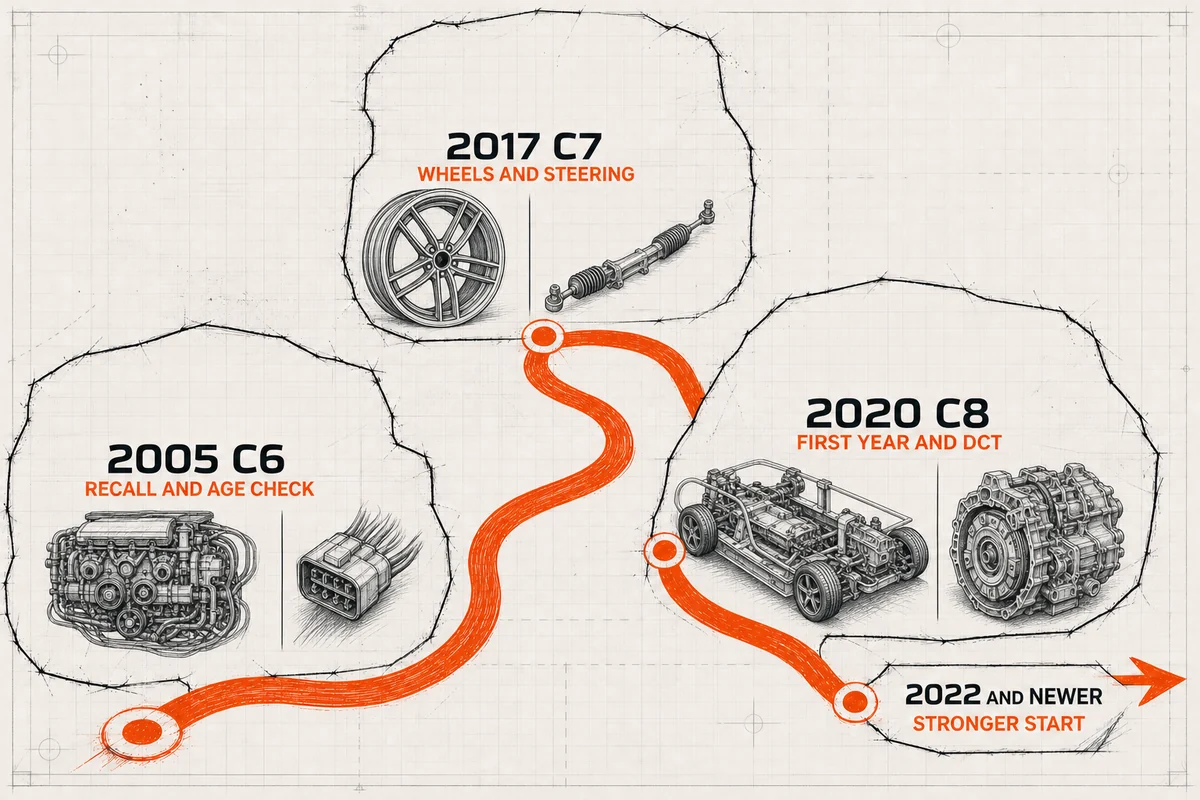
| 2005 | C6 | First-year build and multiple recalls | Recall completion, electrical operation, roof, steering, brakes |
| 2006-2008 | C6 | Age, history, and higher complaint totals | Harmonic balancer, cooling, driveline, leaks, tires |
| 2014 | C7 | First-year C7 build | Electronics, cooling, differential, recalls, fit and finish |
| 2015-2019 automatic | C7 | GM 8-speed shudder history | Fluid service, road test, scan, torque-converter behavior |
| 2017 | C7 | Complaint peak, wheel reports, steering recalls | Wheel inspection, alignment, EPS recall completion |
| 2020 | C8 | First mid-engine year and four recalls | Frunk, seat belt, brake sensor, DCT history |
| 2022 and newer | C8 | Better starting point, still complex | DCT records, lift system, electronics, cooling |
The badge alone is not enough. A base Stingray, Z06, Grand Sport, and ZR1 can require different checks in the same year.
Why the 2005 C6 is the clearest year to avoid
The 2005 Corvette launched the C6 generation. NHTSA lists recalls involving low-beam headlamp wiring, the active-handling system, removable roof-panel separation, brake-line routing, and a power-steering hose.
A seller should prove that every applicable recall is closed by VIN.
The 2005 also uses a four-speed automatic, while later C6 automatics moved to six speeds. Age now adds cracked tires, tired rubber, leaking seals, worn suspension, failing displays, and neglected fluids to the original first-year concerns.
A low odometer reading does not stop seals and tires from aging.
Run the VIN through NHTSA recall lookup. Test the headlamps long enough for heat-related faults to appear.
Verify active handling, steering assist, brake operation, roof fit, windows, door releases, keyless entry, and every warning light.
A documented 2006 or later car can be a better C6 starting point, but later years are not maintenance-free. The goal is to avoid buying first-year uncertainty plus twenty years of deferred work in one car.
The removable-roof campaigns involved more than wind noise. On an included car, separation could allow the panel to detach.
Confirm the campaign by VIN, then inspect panel bonding, edges, latch operation, weather seals, headliner, and the storage mounts in the rear compartment.
A used replacement panel needs its own fit and part-history explanation.
Electrical age also deserves time. Test both key fobs, passive entry, electronic door releases, the mechanical emergency release, windows, seat controls, head-up display, instrument cluster, climate control, and battery voltage.
Low voltage can create scattered warnings, but replacing the battery does not prove that every stored fault was harmless.
Scan first, record the codes, then diagnose their cause.
C6 inspection points beyond the 2005 recalls
A C6 inspection should begin cold. Listen for abnormal belt drive noise and watch the harmonic balancer for wobble.
Inspect the radiator and condenser area for debris, check coolant condition, look for oil and differential leaks, and test the clutch or automatic transmission through a full warm drive.
The 2008 model shows 587 NHTSA complaints despite no listed recalls in the current API response.
A complaint count without a matching safety campaign does not identify one universal defect. It tells the buyer to read complaint categories and inspect the actual car rather than assuming a later C6 is automatically safe.
RepairPal estimates average annual repair cost for the Corvette at $737. That figure covers ordinary repair history across many years and cannot budget for track consumables, damaged wheels, a worn clutch, or a major engine repair.
Keep a separate reserve for tires and brakes, especially on wide-wheel performance trims.
High-performance C6 models need extra expertise. A C6 Z06 with the LS7 should receive a specialist engine assessment that considers valve-guide condition, oil use, modifications, and track history.
There was no broad GM safety recall that turns this into a simple pass-or-fail VIN check.
The 2017 C7 needs wheel and steering scrutiny
CarComplaints identifies 2017 as its worst Corvette model year and highlights cracked-rim reports.
NHTSA lists 255 complaints and four recalls for the year. Two steering campaigns matter here, including recall 19V086 and the later 25V175 campaign involving loss of electric power steering on certain vehicles.
A bent or cracked wheel can cause vibration, pressure loss, uneven tire wear, and repeat damage.
Wide low-profile tires provide little cushion on sharp road impacts. Replacement wheels and tires can quickly erase an attractive purchase price.
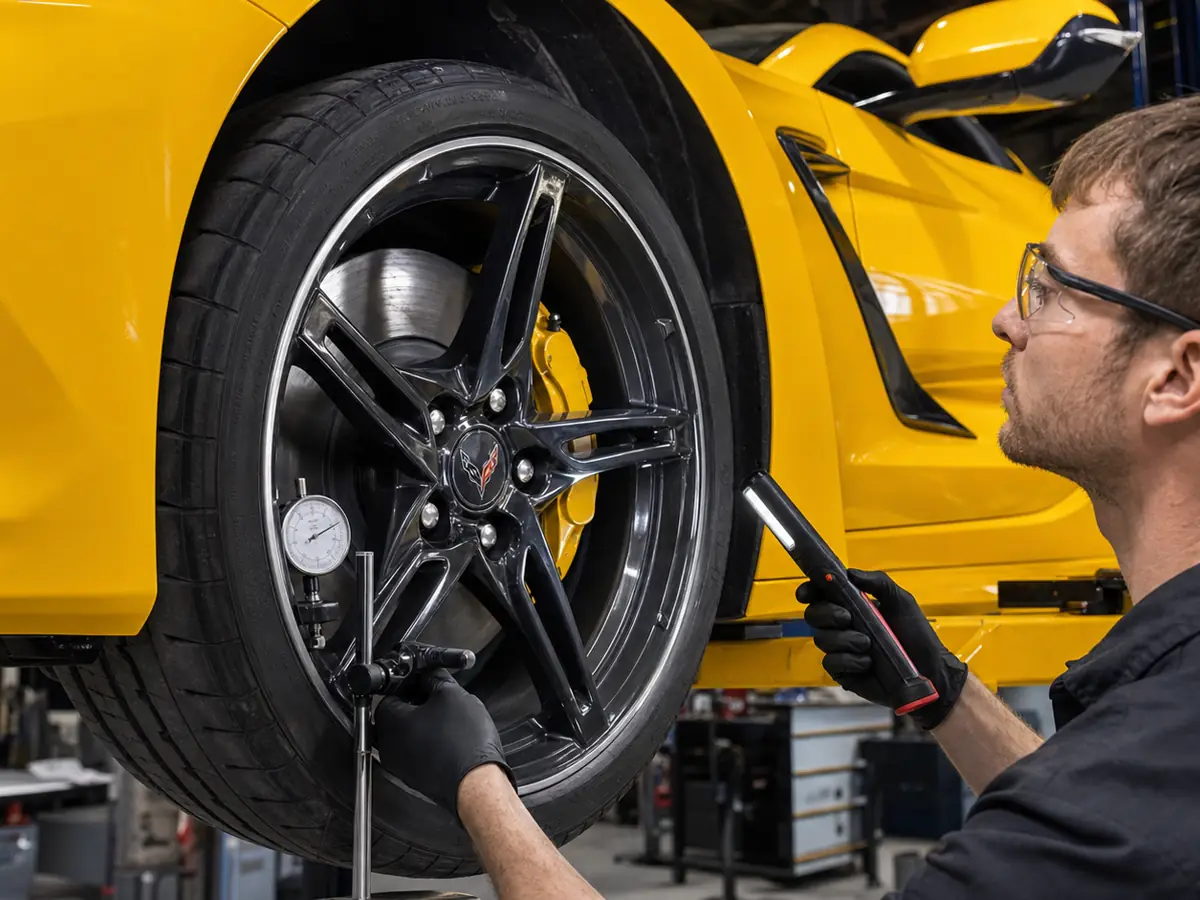
Inspect both faces and the inner barrel of every wheel. Measure runout, check for welds, examine tire date codes, and compare tread depth across each axle.
Then road-test at several speeds on a smooth road. Steering shake, repeated balancing weights, or fresh tires on one corner deserve an explanation.
- 2016GM issued an airbag software recall affecting certain 2017 Corvettes
- 2017A follow-up campaign addressed vehicles that may not have received the correct software update
- 2019Recall 19V086 addressed loss of electric power steering on certain 2014-2016 cars
- 2025Recall 25V175 expanded steering attention to certain 2015-2017 Corvettes
A 2017 with straight wheels and completed recalls can still be good, but the inspection must prove both.
A wheel repair should be documented as clearly as an engine repair.
Ask whether a damaged wheel was replaced, straightened, or welded. A cosmetic refinish can hide a weld or crack on the inner barrel.
Compare wheel part numbers and offsets, then inspect the tire mounted on that corner for sidewall injury and uneven wear.
Steering recall completion needs a VIN record and a current functional test. Turn the wheel from lock to lock at parking speed, repeat after the car is hot, and scan the power-steering module.
Heavy steering, an intermittent warning, damaged wiring, or a history of assist loss requires diagnosis even when the campaign database says closed.
C7 automatic shudder changes the buying decision
Certain 2015 through 2019 C7 automatics use GM's eight-speed transmission. GM technical bulletins describe shake or shudder conditions and revised fluid procedures for 8L45 and 8L90 units.
A seller saying the behavior is normal is not adequate evidence.
Drive the car after it is fully warm. Use light throttle at steady road speeds, then test gentle acceleration and deceleration.
Watch for a rumble-strip sensation, flare, harsh engagement, delayed response, or vibration that changes with converter lockup.
Scan the transmission module and review fluid, flush, torque-converter, and repair invoices.
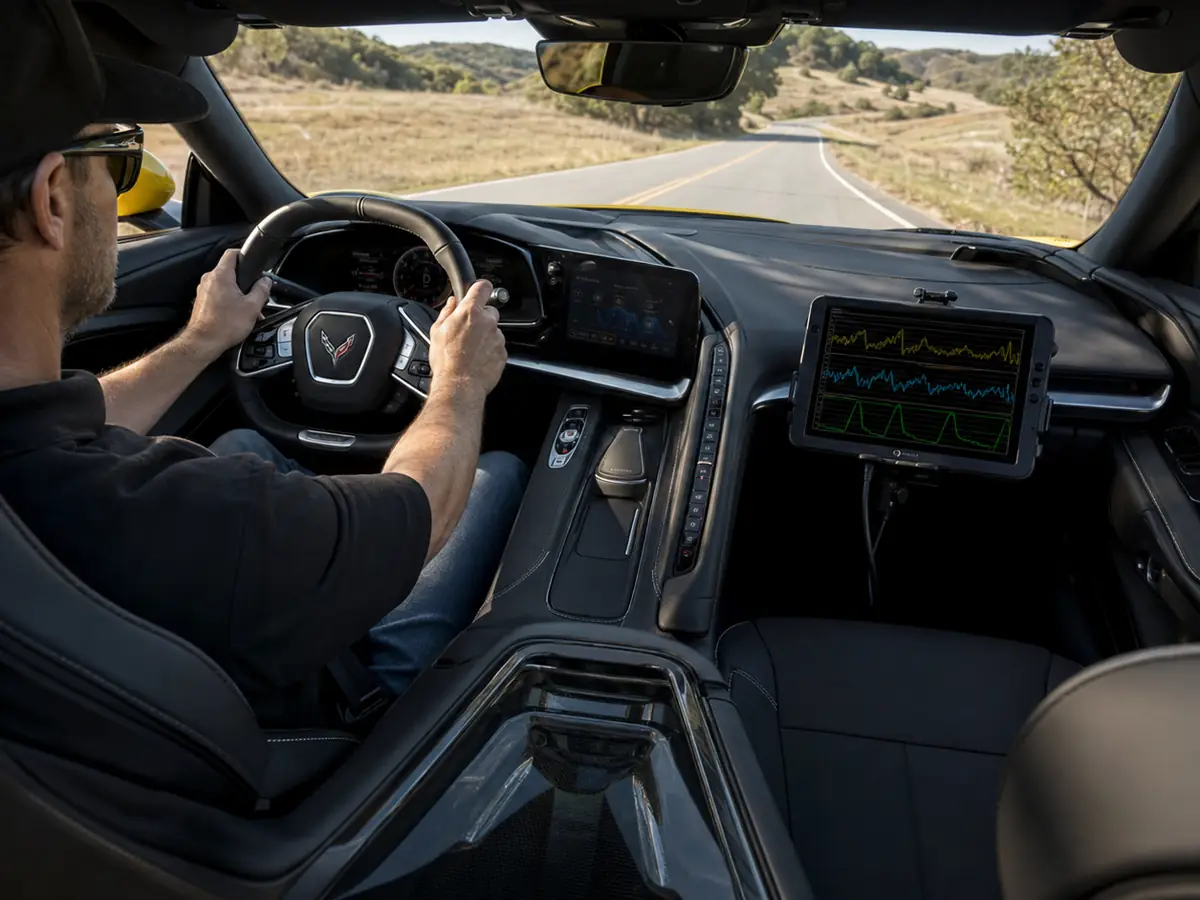
A manual C7 avoids the eight-speed shudder question but adds clutch condition, hydraulic operation, shift quality, and driver-abuse checks. On either transmission, inspect the differential, cooling system, underbody, splitter, and tires for signs of track use or curb impact.
The fun-to-drive shortlist can help choose the layout, but service records and test results decide which individual car to buy.
Transmission shudder can overlap with wheel imbalance, driveline vibration, or active-cylinder behavior. A specialist should reproduce the condition at a recorded speed, gear, temperature, and throttle position.
That evidence keeps a seller from treating every vibration as a tire problem and keeps a buyer from demanding a torque converter when the wheel is bent.
Review the exact fluid procedure and part numbers on prior invoices. GM revised service guidance over time, so a vague receipt for a flush is not enough.
After the warm road test, check for leaks and stored transmission faults. A smooth five-minute drive from a cold shop does not reproduce the steady-speed conditions where converter shudder often appears.
The 2020 C8 is a first-year engineering change
The 2020 Corvette moved the engine behind the cabin and introduced a dual-clutch transmission. NHTSA lists four recalls involving seat-belt retractors, a front trunk that could be driven while unlatched, the interior front-trunk release, and brake sensor contamination.
Verify each campaign by VIN and test the front trunk from inside and outside. Confirm dashboard warnings, cameras, front-lift operation when equipped, seat belts, climate control, infotainment, battery condition, and every drive mode.
Low mileage can hide long storage and a weak battery.
The dual-clutch transmission needs clean shifts, complete service history, and no unresolved warnings.
Check launch counts or other available usage data with appropriate diagnostic equipment. Inspect cooling circuits and underbody panels because the C8 layout places expensive components in unfamiliar locations.
A 2022 or newer C8 is the stronger general starting point because it moves beyond the launch year.
It still needs a specialist inspection. A newer badge does not protect a car that has accident damage, tuning, repeated track use, or missing DCT service.
C8 service history should record dual-clutch filter and fluid work by date and mileage. Ask about over-temperature warnings, launch use, track days, software updates, and any transmission replacement.
Inspect for fluid seepage and underbody impact around expensive castings and cooling lines. A low odometer reading does not answer how the car accumulated those miles.
Test the front lift repeatedly when equipped and inspect saved-location behavior without assuming every old address belongs to the seller.
Check the nose and undertrays for scraping, then examine radiators and condensers through the openings for bent fins or road debris.
Complete a battery test because low voltage can trigger body and infotainment complaints on a car that spends long periods parked.
What a pre-purchase inspection must include
Book a shop that knows the Corvette generation and trim. A normal used-car inspection may miss composite-body repairs, wheel damage, dry-sump checks, adaptive suspension faults, performance-data evidence, or generation-specific scan modules.
Ask the shop to complete these steps:
- Decode the VIN, option codes, engine, transmission, and production date
- Check all open recalls and request repair invoices for completed campaigns
- Scan every available module before clearing any code
- Inspect wheels, tire ages, tread, alignment, brakes, and suspension
- Check cooling, engine, transmission, differential, and hydraulic fluids
- Look for collision repair, paint mismatch, underbody impact, and track debris
- Complete a cold start and a fully warm road test
- Price every finding before negotiating
Use the research method to organize the visit. The sports-car collection gives useful alternatives, while the Mazda MX-5 Miata and BMW 3 Series show how purchase price, rear seating, and service costs change the choice.
These are buying-confidence scores for a documented stock example after inspection. They are not reliability ratings and do not apply to modified or heavily tracked cars.
Keep the final inspection report with the purchase records. Its baseline measurements will help a future shop separate new wear from an old condition.
Which Corvette years should you buy?
Choose a 2009 through 2013 base C6 when you want simpler performance and can accept age-related work.
Choose a 2018 C7 when its wheels, steering recall status, and transmission history check out. A manual is the simpler transmission choice, while an automatic needs clear shudder-related service evidence.
Choose a 2022 or newer C8 when you want the mid-engine layout and can budget for specialist diagnostics and complex systems.
Compare insurance, tire cost, storage, and repair reserves before deciding that the newer car fits the household budget.
The lease-versus-buy guide covers the expenses beyond the purchase price.