Is the Toyota Camry reliable?
Yes, and unusually, two different methods agree at the top of the class. iSeeCars scores the Toyota Camry 7.6 out of 10 and ranks it first of the eleven midsize cars it measures.
RepairPal builds its rating from repair cost, frequency and severity instead, and lands at 4.0 out of 5.0 and third of twenty-four.
That $388 figure is worth pausing on, because it is the lowest of any vehicle in this comparison set by a wide margin. A full-size truck in the same ratings runs at roughly twice it.
Agreement across two methods is what separates this from a marketing claim. One model asks how long the car survives and the other asks what it costs while you own it, and the Camry wins both.
So the nameplate question is settled, and the model-year question is not. That is where the rest of this belongs.
Camry complaints spike in the first year of every generation
Read the federal complaint record across fifteen model years and the shape is not a quality trend. It is a redesign cycle.
The 2012 car, the first of the seventh generation, holds 644 complaints. The 2018 car, the first of the eighth, holds 762.
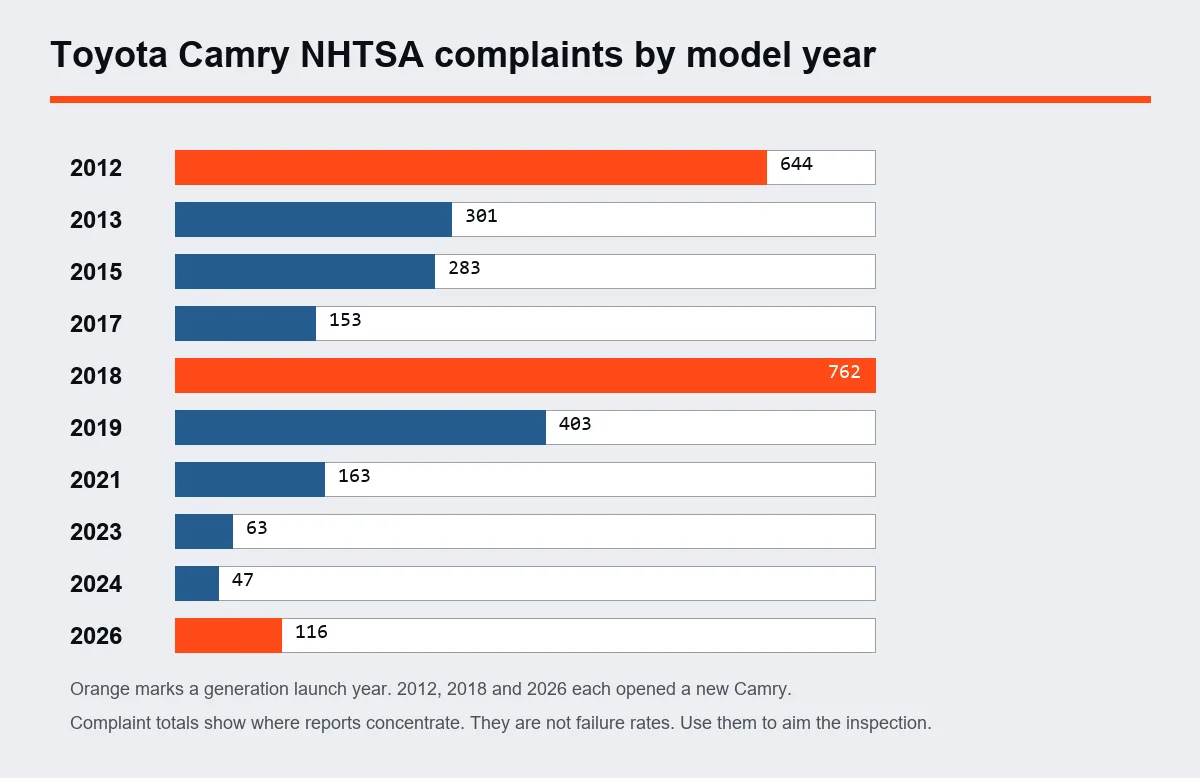
Then look at what follows each peak. By 2022, 2023 and 2024 the same generation is producing 60, 63 and 47 complaints a year.
A sixteenfold swing inside one generation is not something the nameplate's reputation prepares a buyer for.
The current car repeats the pattern. The 2026 Camry holds 116 filings, and its largest single group is hybrid propulsion at 35, which is a category the previous generation barely registered.
One honest caveat applies to every recent year. A car that has been on sale for a year has had a year in which owners could file, so some of that quiet is maturity and some is simply less time.
There is one exception to the cycle worth naming, and it has its own cause. The 2015 car sits at 283 filings led by steering at 80, which is mid-generation and fits no redesign.
Toyota recalled it. Campaign 15V144 covers the electric power assist system on 2015 Camry and Camry Hybrid cars, and the owner filings behind that year describe the assist warning lamp and steering going heavy.
That is worth knowing because it is the one year where a mid-generation car carries a genuine mechanical campaign rather than launch teething.
Shop the middle and late years of a generation, not its first. On this car that single rule does more than any amount of brand loyalty.
What actually went wrong with the 2018 car
Calling a launch year weak is not useful to someone standing in front of one. The 2018 Camry's record has specific campaigns behind it.
Campaign 18V200 covers 2018 cars built with the 2.5-litre four-cylinder engine, and 18V108 covers V6 cars for fuel lines. Those are two different engines and two different problems in the same model year.
The brakes drew their own. Campaign 18V211 covers the brake vacuum pump rotor, and 21V890 followed for 2018 and 2019 cars where a vane cap inside the vacuum pump can break.
Each one has a different consequence to check for. An engine campaign is settled on paper and by a cold start, a fuel-line campaign by looking for the repair on the record, and a vacuum pump campaign by how the brake pedal behaves after the engine has been running.
Several unrelated campaigns landing in one model year is the signature of a new platform rather than of one bad component. Engine, fuel and brakes do not fail together for a common reason.
That is also why the recovery is so complete. A platform gets debugged, and by 2020 the same car is producing a quarter of the complaints.
The quiet years are the ones worth shopping
If the launch years carry the risk, the shopping window follows directly from that.
The 2022, 2023 and 2024 cars are the quietest Camrys in the modern record, and they share a generation with the 2018 car that produced sixteen times the volume.
Camry model-year groups
2012 to 2013
Seventh-generation launch. Power train leads both years and volume is high by Camry standards.
2014 to 2017
The settled seventh generation, easing from 480 filings to 153 as the platform matured.
2018 to 2019
Eighth-generation launch, with four separate campaigns and the highest total in the record.
2020 to 2024
The settled eighth generation and the strongest window to shop, bottoming at 47 filings.
This is what a generation score cannot show you. iSeeCars rates the whole 2018 to 2024 generation 8.72, a figure that averages the worst year in the record together with the best.
The 2012 to 2017 generation scores 8.68, within 0.04 of it, which tells you the two generations are near-identical in quality and says nothing about which year inside them to buy.
The hybrid models a longer life than the petrol car
Buyers routinely discount the hybrid on the assumption that more systems mean more to go wrong. The published figures point the other way.
Camry variants compared
- Petrol Camry
- 7.6 out of 10, modelled lifespan 163,603 miles
- Camry Hybrid
- 7.7 out of 10, modelled lifespan 172,769 miles
The mechanical reason is unglamorous. A Toyota hybrid uses a planetary transaxle with no clutch packs and no stepped gear changes, so the part a conventional automatic wears out is not present.
Regenerative braking helps in the same quiet way, because a car that slows itself electrically much of the time is a car whose friction brakes work less.
The question most buyers actually want answered is the battery, and the complaint record is reassuring on it. Across the whole 2012 to 2024 span, hybrid propulsion never leads a Camry model year.
It appears for the first time on the 2026 car, at 35 filings, which is the new generation finding its feet rather than a verdict on the technology.
What that means in practice is that the hybrid battery is not the thing to inspect hardest on a used Camry. Confirm it holds charge and cycles normally on a longer drive, then spend the remaining attention on the same campaigns and service history you would check on the petrol car.
What 163,603 miles costs you at $388 a year
Take the two headline numbers together rather than separately, because that is how ownership actually works.
A modelled lifespan of 163,603 miles across about 12.1 years, at an average of $388 a year in repairs, is roughly $4,700 of repair spend across the life of the car.
That is an average across many cars rather than a quote, and it excludes tires, brakes, fluids and everything else that is maintenance rather than repair.
It is still the most useful ownership figure in this article. A vehicle that reaches twelve years while costing under $400 a year to fix is doing something the segment mostly does not.
The estimate breaks in the usual place. Short-trip city use, deferred servicing and a neglected cooling system will beat any modelled average, and none of that shows on an odometer.
Which Camry to buy
Search a window rather than a nameplate, and the rest of this decision is small.
A 2020 to 2024 car is the settled part of the strongest generation, with the lowest complaint volumes in the record and enough supply that you can reject anything without service history.
Take the hybrid if the choice is available at a similar price, because it carries the longer modelled life and the transaxle has less to wear out.
A 2018 car is not disqualified, and it is a price conversation. Four campaigns apply to it, and a car with all four closed and documented is a genuinely cheap way into the generation.
The Camry rewards choosing a model year and punishes choosing a badge. Two cars from the same generation can be very different purchases, and the search filter is what separates them.