
The CX-5 is a strong reliability bet once you identify the engine
Mazda built the CX-5 around the Skyactiv-G engine family and a six-speed torque-converter automatic. That combination avoids a belt-driven CVT and has remained mechanically familiar across much of the model's life.
The broad verdict is favorable, especially for a naturally aspirated car with clean oil and cooling history. The answer becomes more specific when cylinder deactivation or the 2.5-liter turbo enters the listing.
A trim badge may not identify every mechanical detail. Confirm the VIN, engine specification, drivetrain, production history, and completed campaigns before using a general review to price the car.
The six-speed automatic is a meaningful strength, but it cannot excuse low coolant, a leaking cylinder head, uneven tires, or a harsh warm shift. A durable design still needs a sound individual example.
The best CX-5 is usually the least complicated engine configuration with the clearest service and condition evidence.
The naturally aspirated and turbo engines carry different cylinder-head evidence
Mazda service information for certain 2018 through 2020 naturally aspirated 2.5-liter engines with cylinder deactivation addresses cylinder-head and valvetrain repair scenarios. That history is different from the coolant leak covered by Mazda Customer Service Program CSP11.
CSP11 applies to certain 2019 CX-5 models equipped with the 2.5-liter turbo engine. Mazda extended coverage for a qualifying coolant leak at the cylinder head near the exhaust manifold to 10 years or 120,000 miles from the original warranty start date.
| Configuration | Main question | Evidence to collect |
|---|---|---|
| 2.5 without cylinder deactivation | Ordinary oil, cooling, and compression condition | Cold start, fluid levels, records, scan |
| 2.5 with cylinder deactivation | Prior head or valvetrain diagnosis | VIN, repair order, oil and coolant history |
| 2.5 turbo in CSP11 range | Coolant leak near exhaust manifold | Eligibility, residue, pressure test, repair documentation |
| Any engine | Present overheating or misfire | Codes, cooling test, compression context |
The turbo program does not cover every coolant loss and it does not apply to every CX-5. A dealer must verify the qualifying condition and exact vehicle eligibility, so a seller's statement that the car is covered needs VIN confirmation.
Inspect the reservoir only when the engine is cool and never open a hot pressurized cooling system. Look for a falling level, dried residue, coolant odor, staining near the exhaust side of the head, overheating history, or an invoice that names the diagnosed location.
A naturally aspirated engine can leak oil or coolant for reasons unrelated to cylinder deactivation. A turbo car can also need hoses, pumps, a radiator, or ordinary cooling repairs that are outside the named cylinder-head condition.
The paper trail should specify the engine, affected part, mileage, date, and repair. Do not let the phrase cylinder head merge two different engines and two different ownership decisions.
The six-speed automatic avoids a CVT but still needs a complete drive
The CX-5 automatic uses fixed ratios and a torque converter. You should feel defined ratio changes rather than the sustained engine-speed behavior of a CVT.
Cold engagement should be prompt, and light-throttle shifts should remain consistent as the drivetrain warms. A hard repeated shift, delayed selection, flare, vibration under load, or warning history deserves diagnosis.
Automatic-transmission check
- Cold Reverse
- Engages without a long pause or heavy impact
- Light acceleration
- Ratios change cleanly at modest throttle
- Steady cruise
- No hunting, shudder, or speed-dependent vibration
- Warm restart
- Engagement remains consistent after the drive
- AWD tight turn
- No binding or repeated driveline protest
Use manual selection where equipped to confirm that commands produce predictable changes. One aggressive downshift under a sudden throttle input can be normal, while the same harsh event during gentle driving is different evidence.
Fluid service records should identify the transmission and correct product. A generic receipt that says transmission service without the fluid or procedure cannot prove what entered the unit.
On an all-wheel-drive car, separate transmission behavior from the rear coupling, differentials, axles, wheel bearings, and tires. A speed-dependent hum or tight-turn bind may come from another component.
A conventional automatic reduces one category of uncertainty. It does not make a short, seller-directed drive sufficient.
Recall completion and low-mileage short trips reveal different risks
Some CX-5 model years were included in low-pressure fuel-pump recalls because an impeller could deform and cause the pump to stop working. Exact applicability and remedy completion belong to the VIN, not to a broad year assumption.
A completed campaign resolves the defined recall condition. It cannot prove that the car's battery, fuel system, engine, or electrical equipment has no separate current fault.
- Before the driveRun a VIN recall check
- Cold startObserve cranking, idle, warning lights, and exhaust
- After warm-upRepeat acceleration, idle, and restart checks
- After the visitMatch repair orders to the VIN record
Low mileage can look like protection, but years of short trips may leave a weak battery, moisture in oil, rusty brakes, flat-spotted tires, and incomplete warm-up history. Long storage can also age rubber, fuel, and seals without adding miles.
Ask how the vehicle was used and compare the answer with service dates. Several years between oil changes cannot be explained away solely because the odometer moved slowly.
The correct question is whether a campaign was completed and whether the vehicle is healthy now. Recall status and present condition are separate facts.
Steering feel can expose tires, brakes, and suspension wear quickly
A sound CX-5 should track cleanly, take a set through a broad bend, and settle after a bump. Its responsive steering makes pull, vibration, wheel imbalance, and worn bushings easier to notice than they are in a softer vehicle.
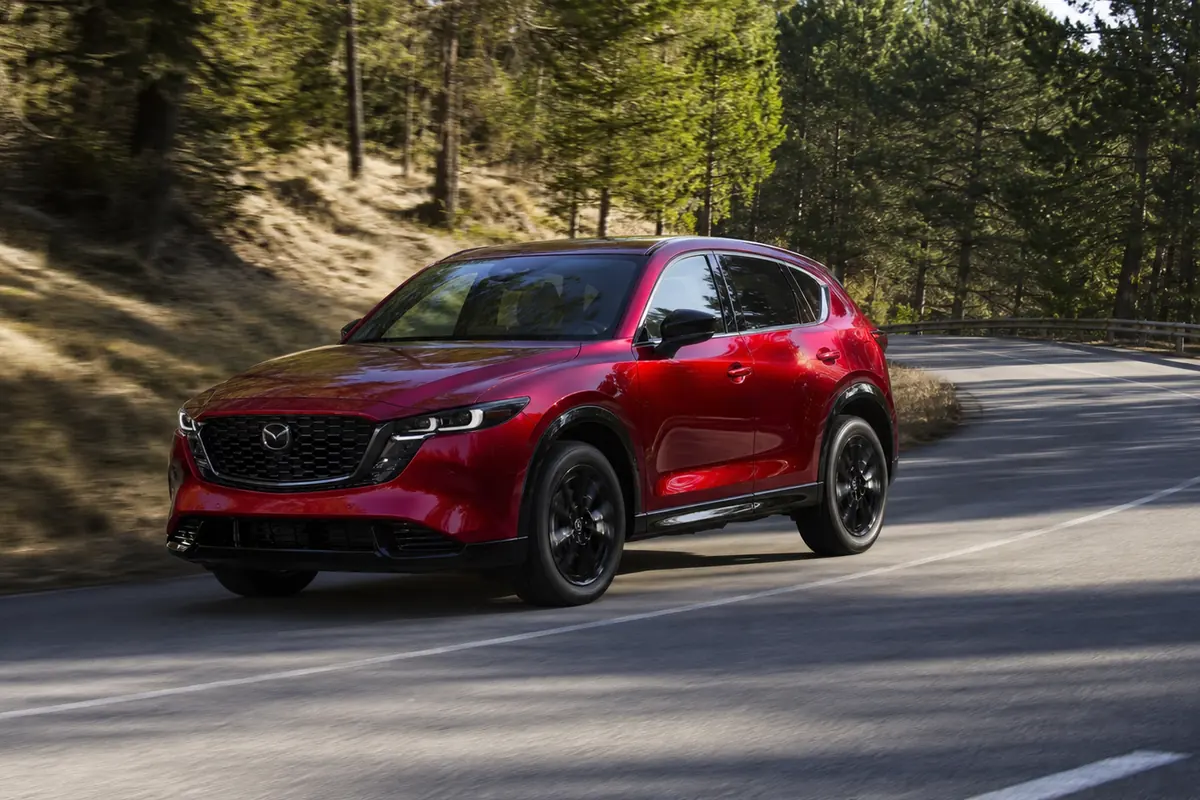
Measure tread across every tire, including the inner shoulder. Nineteen-inch wheels can make a full replacement set meaningfully more expensive than the smaller standard setup.
Brake condition should be judged by pad thickness, rotor surface, fluid history, pedal feel, and repeatable noise. A single rusty imprint after storage differs from vibration that returns during every moderate stop.
Use smooth pavement to hear a wheel-bearing hum, then a broken surface to expose bushings, links, struts, and loose trim. A hum that changes with gentle cornering load needs inspection before it is blamed on tires.
Check the steering center on a level road. New tires can hide an old wear pattern, so ask for the alignment invoice and inspect wheels for curb or pothole damage.
The CX-5's road feel is useful evidence when the drive includes more than a smooth block near the seller.
How many miles can a Mazda CX-5 last?
A high-mileage CX-5 can remain economical when oil changes, coolant condition, spark plugs, belts, brakes, tires, and drivetrain fluids were handled consistently. Several deferred jobs arriving together create the expensive version of an otherwise durable car.
All-wheel-drive examples add rear differential and coupling concerns. Confirm the correct tires, inspect for leaks, and listen for binding or noise after the system is warm.
A six-figure odometer reading is not a failure threshold for the CX-5. It is the point where a buyer should price the next round of plugs, belts, fluids, mounts, brakes, and suspension work instead of assuming that the engine record covers the whole vehicle.
The naturally aspirated engine offers the simpler high-mileage case because it removes turbo hardware from the decision. A turbo can still be a sound long-term buy when coolant remains stable, the named cylinder-head coverage is understood, and the added heat and load have not produced contradictory evidence.

Look beneath the cargo floor for water, damaged trim, and signs of a hard loading life. Check hatch seals, rear bumper repairs, tow accessories, and the spare-tire well when fitted.
Underbody corrosion depends on climate and storage more than the badge. Inspect subframes, brake lines, suspension mounts, exhaust hardware, shields, and fasteners on a lift.
A documented highway car can be easier to value than a low-mileage example with missing annual service. Highway miles still wear bearings, tires, paint, and seats, while short trips concentrate other kinds of aging.
There is no defensible maximum mileage for every CX-5. The repair backlog and the quality of previous work decide whether the odometer represents useful life or an approaching bill.
Choose the CX-5 whose engine, road test, and paperwork agree
The strongest used CX-5 has an identified engine, stable oil and coolant levels, VIN-specific campaign proof, a consistent six-speed automatic, even tires, quiet chassis hardware, and no unexplained warning history. Those facts should fit the asking price.
A repaired cylinder head can be acceptable when the work is documented and the current system holds pressure. A supposedly untouched car is not automatically better when its coolant level, oil history, or road behavior is uncertain.
Choose the CX-5 whose mechanical specification and present evidence support the same favorable verdict.