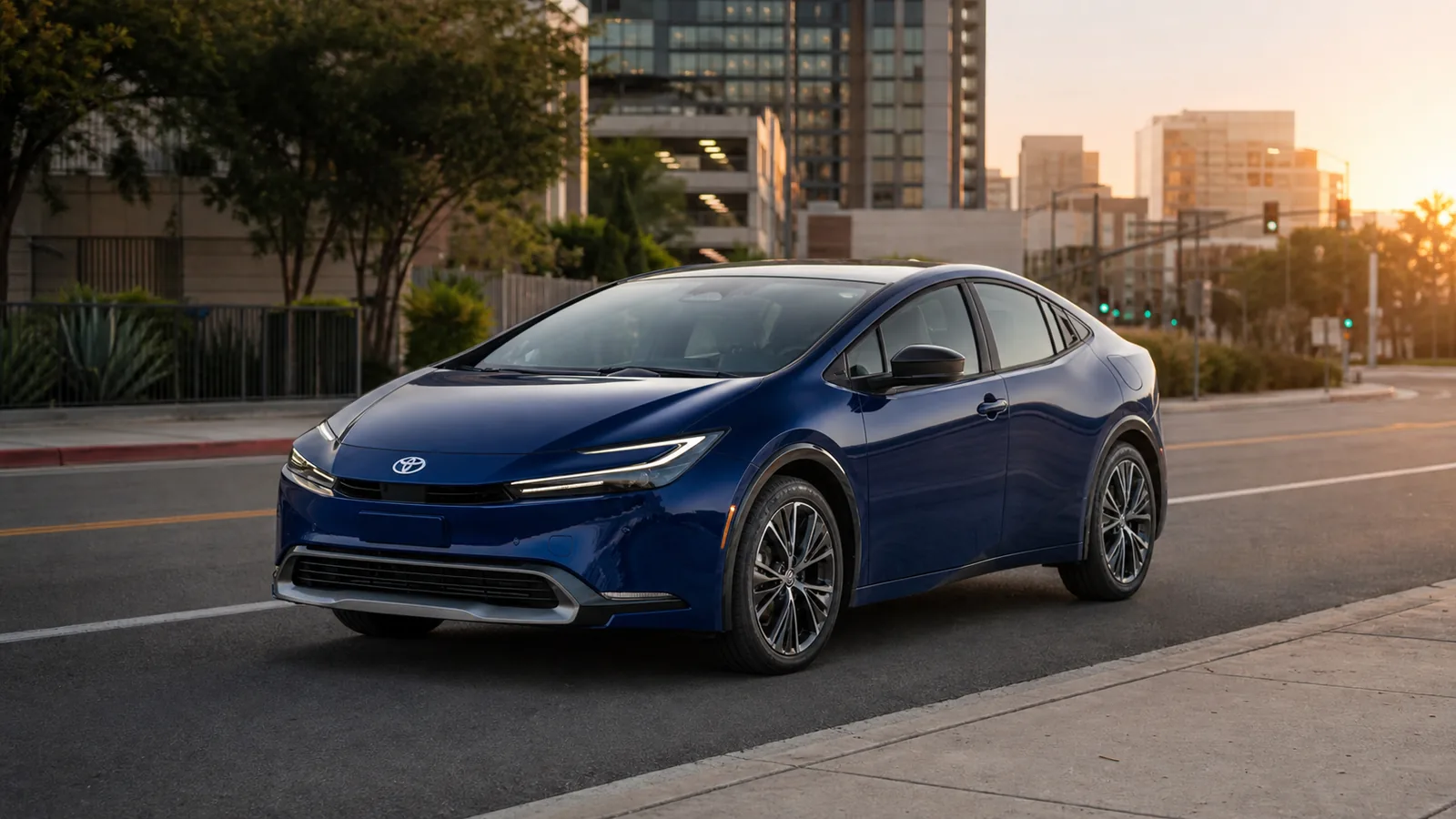
The worst Prius year is 2010
The 2010 Prius is the year I would avoid first unless the price leaves room for a deep inspection and immediate repair reserve. NHTSA returned 2,820 complaints and 10 recalls for the 2010 Prius in the August 8, 2026 snapshot, more than any other Prius year I checked from 2004 through 2025.
Complaint totals are not failure rates. They show where public reports concentrate, and the 2010 concentration is too large to ignore on a used hybrid with safety and propulsion systems in the record.
| Model year | NHTSA complaints | NHTSA recalls | Main reason to pause | Starting verdict |
|---|---|---|---|---|
| 2010 | 2,820 | 10 | Brake-control reports, inverter campaigns, early third-generation age | Avoid unless evidence is unusually strong |
| 2007 | 2,003 | 4 | Steering, cooling, accelerator-pedal recall history, old hybrid battery age | Avoid unless cheap and documented |
| 2008 | 1,497 | 4 | Similar late second-generation exposure with aging hybrid hardware | Deep inspection year |
| 2006 | 1,439 | 6 | High complaint load, age, steering and cooling campaign context | Deep inspection year |
| 2005 | 1,051 | 6 | Age-heavy hybrid, steering and cooling campaign context | Conditional only |
| 2012 | 684 | 6 | Inverter campaign population plus third-generation EGR and oil-use checks | Inspect carefully |
The 2010 also sits at the start of the third generation, which means buyers face both launch-year issues and old-hybrid realities. Brake-control behavior, inverter recall completion, oil use, EGR condition, coolant evidence, and hybrid battery health all need proof.
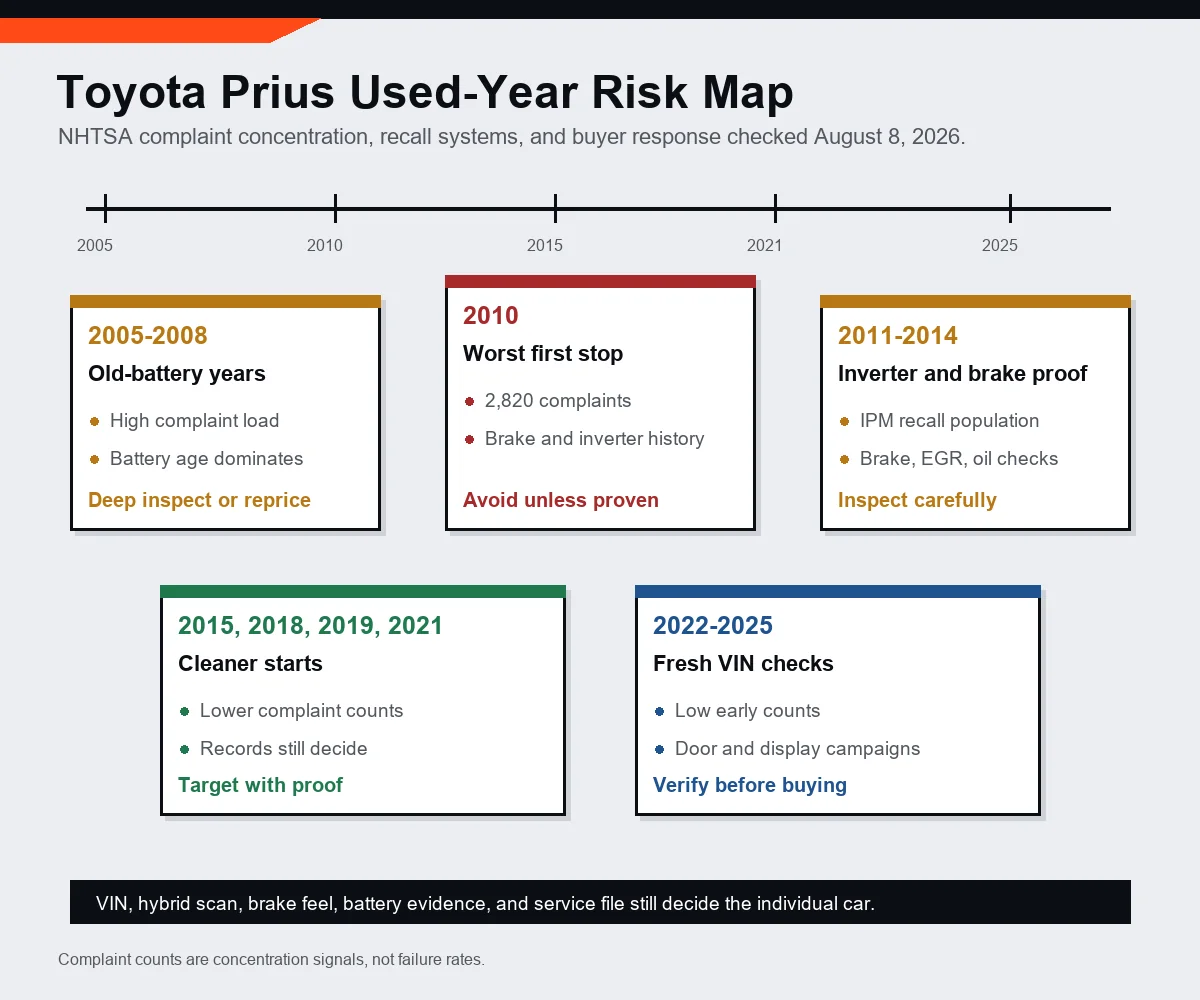
A 2010 that drives normally can still be worth inspecting, but it should not be priced like the safest Prius year. Start negotiations from the known risk stack, then let records and current test results earn any premium.
Why 2010 through 2014 need inverter and brake proof
The 2010 through 2014 Prius years share important recall history around the hybrid inverter. NHTSA campaign 14V053 covered certain 2010 through 2014 Prius vehicles because excessive voltage in the Intelligent Power Module could damage transistors.
NHTSA campaign 18V684 later covered certain 2010 through 2014 Prius and 2012 through 2014 Prius V vehicles. The filing says excessive voltage in the IPM could cause the hybrid system to shut down, which can reduce propulsion and increase crash risk.
Recall completion is the beginning of the check, not the end of it. Ask for dealer records that show the inverter software or remedy was performed on the exact VIN, then scan the hybrid control modules for stored faults.
Brake evidence matters too. The 2010 Prius appears in brake-related recall history, including NHTSA campaign 10V039 for ABS control-module programming and 13V235 for brake accumulator concerns on certain vehicles.
Test the brake pedal at parking-lot speed, city speed, and after repeated stops. The pedal should feel predictable, warning lights should prove out normally, and a scan should not show unresolved ABS, brake actuator, accumulator, or communication faults.
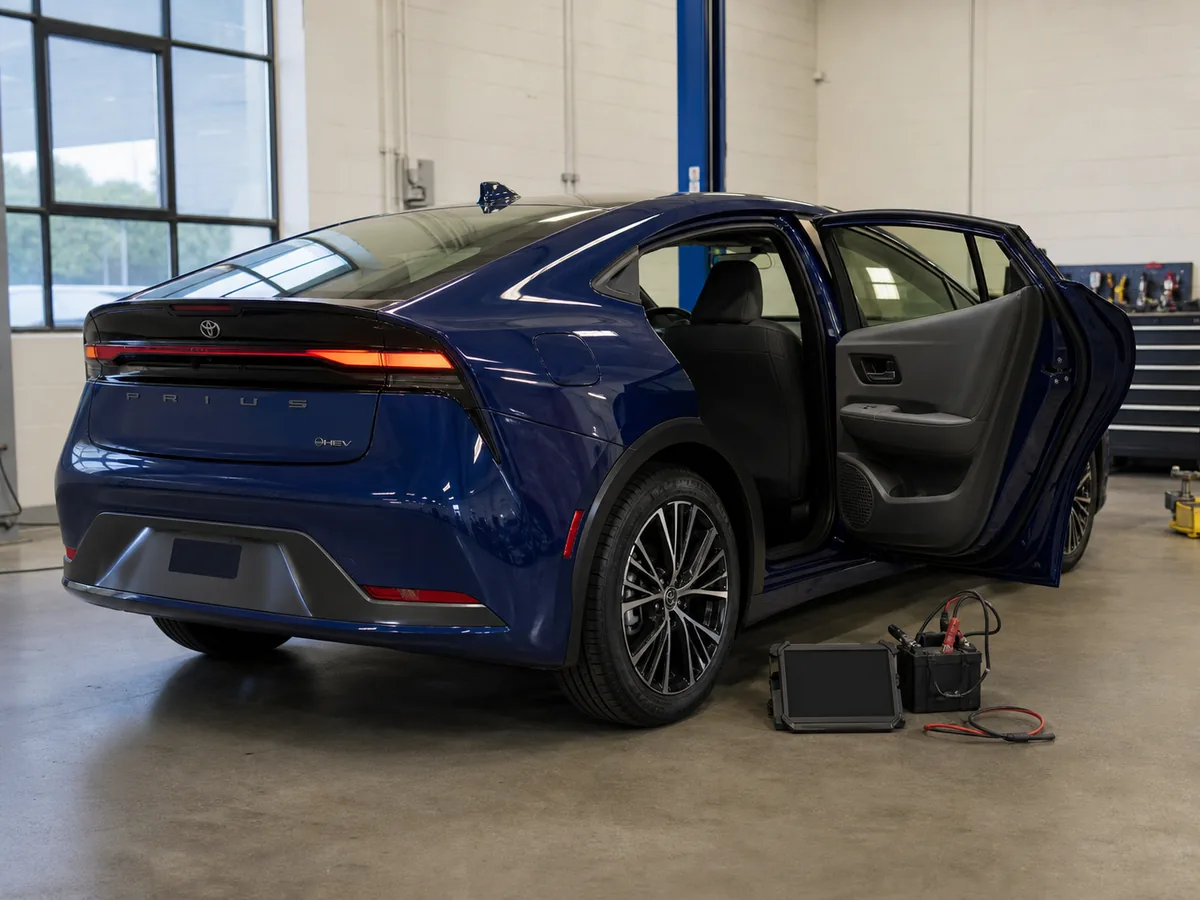
A completed recall does not erase age. Cooling pumps, wiring, 12-volt voltage, corroded connectors, low coolant, blocked battery vents, and previous warning-light history still affect the purchase.
The late second-generation Prius is old enough to be a battery decision
The 2005 through 2008 Prius years carry high NHTSA complaint counts, but age is the larger modern problem. Even a well-designed hybrid battery can be near the end of its economic life after roughly two decades of heat cycles, short trips, storage, and previous module repairs.
Do not judge these cars by odometer alone. A low-mile 2007 that sat for long periods can have weaker battery balance than a higher-mile car that was driven and maintained consistently.
The late second-generation cars also appear in steering, engine-cooling, and accelerator-pedal recall history. NHTSA campaigns 12V537, 12V536, and 09V388 appear in the 2007 and 2008 recall records, so the VIN record should match the specific car before purchase.
Battery evidence should be current. Ask for a hybrid-system scan that reports block voltage behavior, state-of-charge swings, cooling-fan operation, and trouble codes rather than relying on a seller's claim that the battery was replaced.
A rebuilt pack can be acceptable only when the invoice names the rebuilder, date, mileage, warranty, module strategy, and diagnostic result. A vague hybrid battery receipt with no warranty or block data should not carry the same value as a documented new or high-quality replacement pack.
These old years can still be cheap transportation when the price is honest and the battery evidence is real. They are poor buys when a seller asks clean-car money for a hybrid system you cannot verify.
Oil use and EGR symptoms change the third-generation deal
The third-generation Prius years after 2010 are not all equally risky, but they need a different inspection from the older cars. Oil consumption, EGR clogging, coolant loss, rough cold starts, and head-gasket suspicion matter most on higher-mile 2010 through 2015 cars.
The buyer's mistake is treating a hybrid as if the gasoline engine barely matters. The engine may run fewer hours in city use, but it still needs clean oil, stable coolant, clear EGR flow, and normal compression.
Check oil level before startup, then look for blue smoke, rough cold idle, misfire counts, coolant loss, milkiness under the oil cap, and recent cleaning around the engine bay. A seller who warmed the car before you arrived removed useful evidence.
A clogged EGR path can contribute to rough running and heat stress. Ask whether the EGR cooler, valve, intake passages, spark plugs, coolant, water pump, and PCV system were serviced, then match the claims to dates and mileage.
Third-generation Prius proof
- Cold start
- Smooth idle with no misfire counts or coolant loss
- Oil history
- Level stable between services, not just clean at sale time
- EGR evidence
- Cooler, valve, and intake service documented when mileage is high
- Inverter record
- VIN shows completed campaign work and scan is clean
- Brake system
- No ABS, accumulator, actuator, or brake-control warnings
The best third-generation target is usually a documented 2015 because it comes late in the generation and carries a lower NHTSA complaint count in the snapshot. That does not make it immune to age, but it gives you a better starting point than 2010.
The 2016 launch year needs a separate recall check
The 2016 Prius started the fourth generation, and its complaint count is far lower than 2010. That is good, but it does not make the 2016 a blind buy.
NHTSA returned 179 complaints and five recalls for 2016. The recall record includes 17V658 for a hybrid inverter capacitor concern, 18V579 for engine-wire-harness routing, airbag-related campaigns, and 16V741 for a parking-brake issue on certain 2016 and 2017 cars.
Those campaigns point to a different inspection path from the third-generation EGR and oil-use conversation. The 2016 buyer should verify VIN completion, warning-light behavior, parking-brake function, wiring condition, and hybrid scan history.
A clean 2016 can be a rational buy when its recall file is complete and the car behaves normally. It becomes weaker when the seller presents it only as a newer Prius and cannot document the launch-year campaign work.
The best Prius years are the ones that keep the evidence simple
A 2015 is the mature third-generation pick when budget matters and records are strong. NHTSA returned 161 complaints and one recall for that model year, which is a calmer starting point than 2010 through 2012.
The 2018 and 2019 fourth-generation cars are also strong targets in this snapshot. NHTSA returned 35 complaints and one recall for 2018, then 29 complaints and three recalls for 2019.
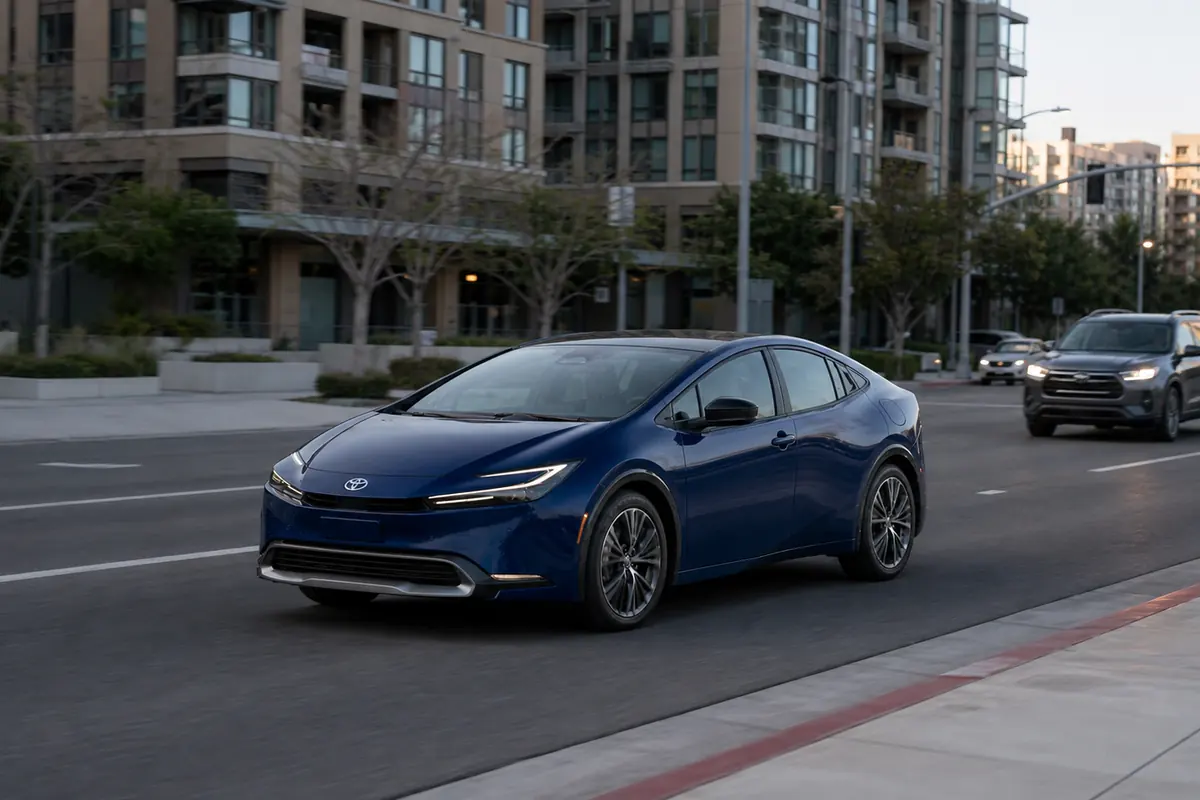
A 2021 has the lowest count in the checked range at six complaints and no recall result returned by the API query. Newer 2022 through 2025 cars show low complaint totals too, but they have less time in service and should be judged by VIN recalls, warranty status, and current condition.
The redesigned 2023 and 2024 Prius years need a specific door-handle recall check. NHTSA campaign 24V274 covers certain 2023 and 2024 Prius and Prius Prime vehicles because water can enter the rear door opener switch and allow a door to open while the vehicle is moving if it is not locked.
Later campaign data also shows 25V744 for display-function concerns on certain Toyota, Lexus, and related vehicles and 26V049 for rear-door switch corrosion on certain Prius populations. A low complaint count does not replace a VIN lookup on a new-generation car.
The Prius reliability decision is broader than a year list because it also asks how the battery, brakes, EGR, inverter, tires, and records look today. Use the year shortlist to decide where to start, then let the specific car pass or fail.
Inspect any Prius before trusting the year label
Start with the VIN, then inspect the systems the year points toward. Older second-generation cars need battery and recall proof, third-generation cars need inverter, brake, oil, EGR, and coolant proof, and newer cars need recall, warranty, door, camera, and scan proof.
Bring a scan tool or pay a hybrid-capable shop. Generic powertrain codes are not enough because a Prius can store hybrid-control, brake, ABS, battery, body, and communication faults outside a basic reader's view.
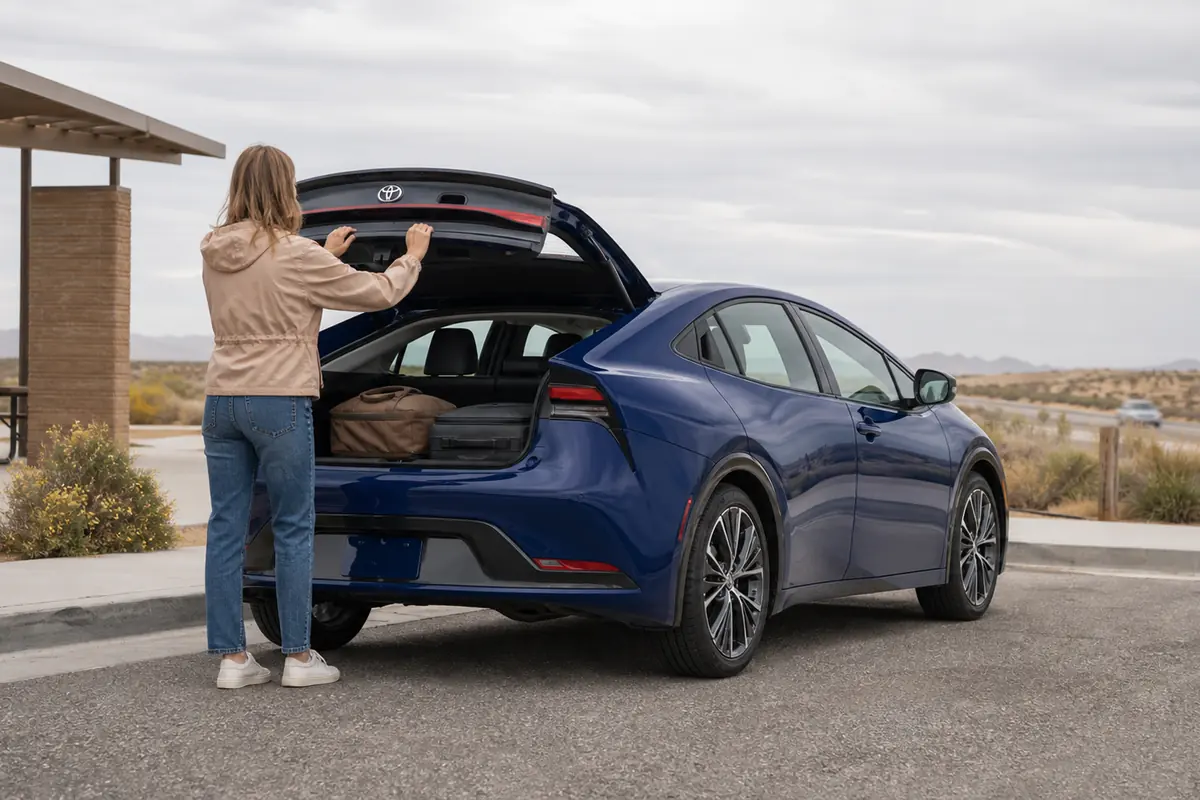
Drive from a cold start through city creep, steady suburban speed, a firm merge, repeated braking, and a hot restart. Watch for warning lights, harsh engine starts, brake noises, unstable pedal feel, fan noise from the rear battery area, or a state-of-charge display that swings quickly.
Service records should form a chronology by date and mileage. Oil changes, coolant, brake fluid, 12-volt battery, tires, inverter campaign work, hybrid battery work, EGR service, water pump, spark plugs, and recalls should tell one story.
Prius buy, reprice, or skip decision
Buy a Prius when the year is favorable, the VIN record is clean, the hybrid scan is clean, the brake system behaves normally, and the service file explains the mileage. A good year with missing evidence should be treated as an unfinished inspection, not a bargain.
A Prius can save real fuel money, but the wrong year can move that money into repairs. Pick the year that gives you the cleanest starting point, then buy only the car that proves it with records, scans, and a road test.
Sources
- NHTSA recall lookup and NHTSA complaint API snapshots checked August 8, 2026 for Toyota Prius model years 2004 through 2025
- Toyota Prius specifications for current powertrain, drivetrain, and fuel-economy context
- RepairPal Toyota Prius reliability data for ownership-cost and reliability context
- iSeeCars Toyota Prius reliability data for model longevity context