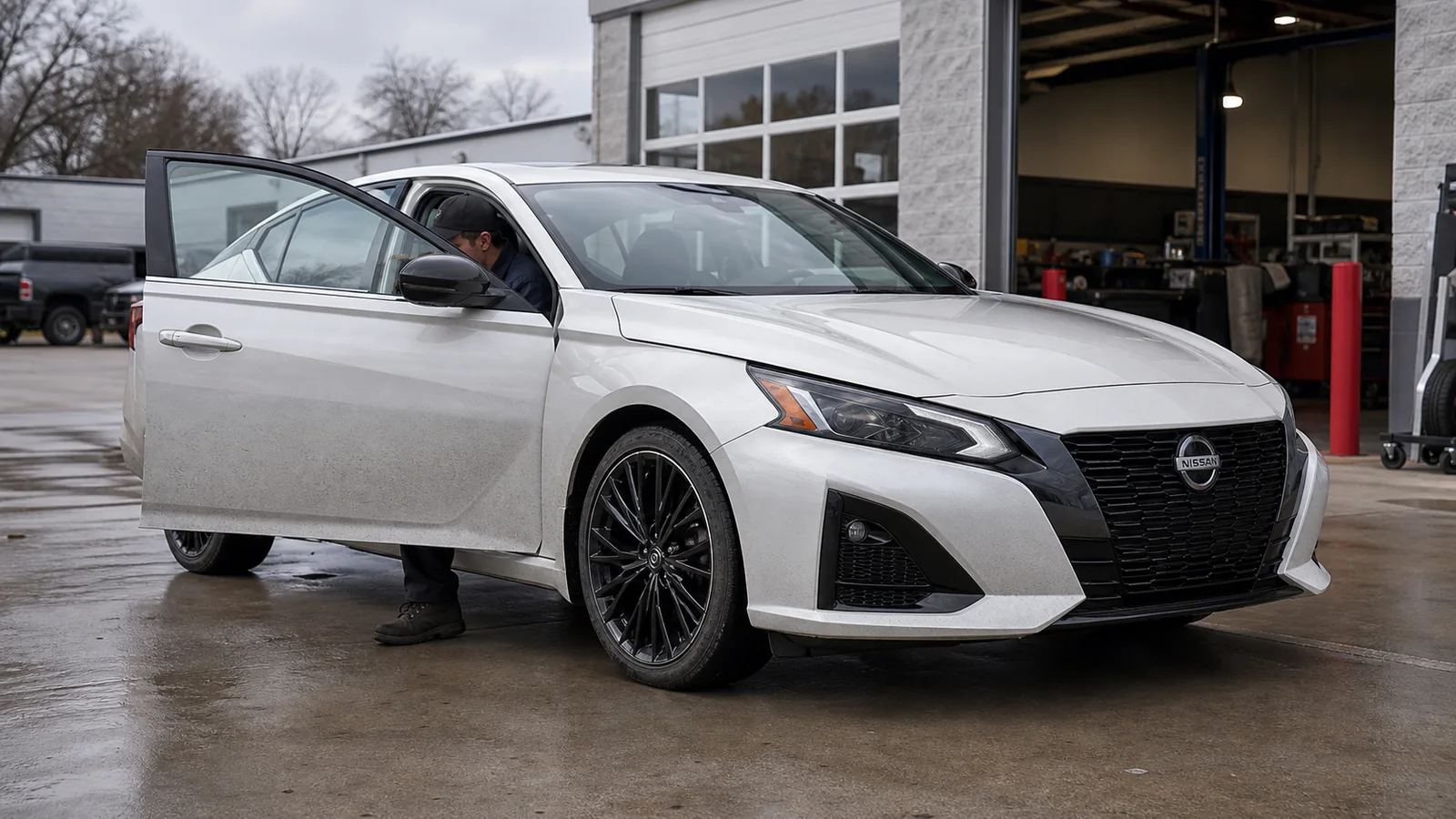
The CVT8 years define Altima risk
Almost every serious Altima problem traces back to one component. CarComplaints logs the continuously variable transmission as the recurring failure across the worst years, and RepairPal rates the car only average, held back by that same CVT.
A clean body and a comfortable cabin fool buyers into thinking any Altima is a safe used bet.
It is not the engine or the interior that ends these cars early, it is the gearbox. The 2.5L four-cylinder is generally durable and parts are cheap, so a good-year Altima is easy to live with.
That makes the CVT the one line item that decides whether a given car is a bargain or a money pit.
The trouble concentrates in the fifth generation and reaches back into the fourth:
- 2007-2012Fourth-gen Altima adopts the early Jatco CVT: usable but weak, and every car is now old
- 2013-2015Fifth-gen CVT8 is the worst stretch: violent shudder, hesitation, limp mode, outright failure
- 2016-2018Same CVT8 carries over with the same failures and its own class-action settlement
- 2019Sixth-gen redesign brings a stronger CVT and complaints drop sharply
- 2020-2022The dependable years to target on a used lot
2013-2018 requires transmission proof
The 2013 Altima is the single worst year to buy. It opened the fifth generation and drew the most complaints of any model year, with CarComplaints logging hundreds of CVT reports and the NHTSA fielding close to 2,300 filings for that year alone.
Owners describe a hard shudder under acceleration, a lag before the car moves, then loss of power.
Repairs on these cars average in the $3,000 to $4,000 range on CarComplaints, and a full CVT replacement can top that.
The 2014 and 2015 cars carry the identical failure. If you are looking at any 2013 to 2015 Altima, treat a documented CVT replacement as a requirement, not a bonus, and walk away from any shudder or delay on the test drive.
| Year or group | Starting verdict | Evidence | Required check |
|---|---|---|---|
| 2007-2012 | Inspect carefully | Early Jatco CVT plus age-related wear | Fluid history, cold engagement, and heat behavior |
| 2013-2015 | Avoid without replacement proof | Highest CVT complaint concentration | Judder, delay, codes, and replacement invoice |
| 2016 | Inspect carefully | Same generation and CVT settlement coverage | Service history and complete road test |
| 2017-2018 | Inspect carefully | Nissan issued separate CVT warranty extension | VIN eligibility and repair records |
| 2019 | Inspect launch year | Revised generation and transmission calibration | Cold and hot CVT behavior |
| 2020-2022 | Consider | Lower complaint concentration than 2013-2018 | Fluid records, codes, and current recalls |
| 2023+ | Consider by VIN | Newer age does not replace a CVT inspection | Warranty, software, and service status |
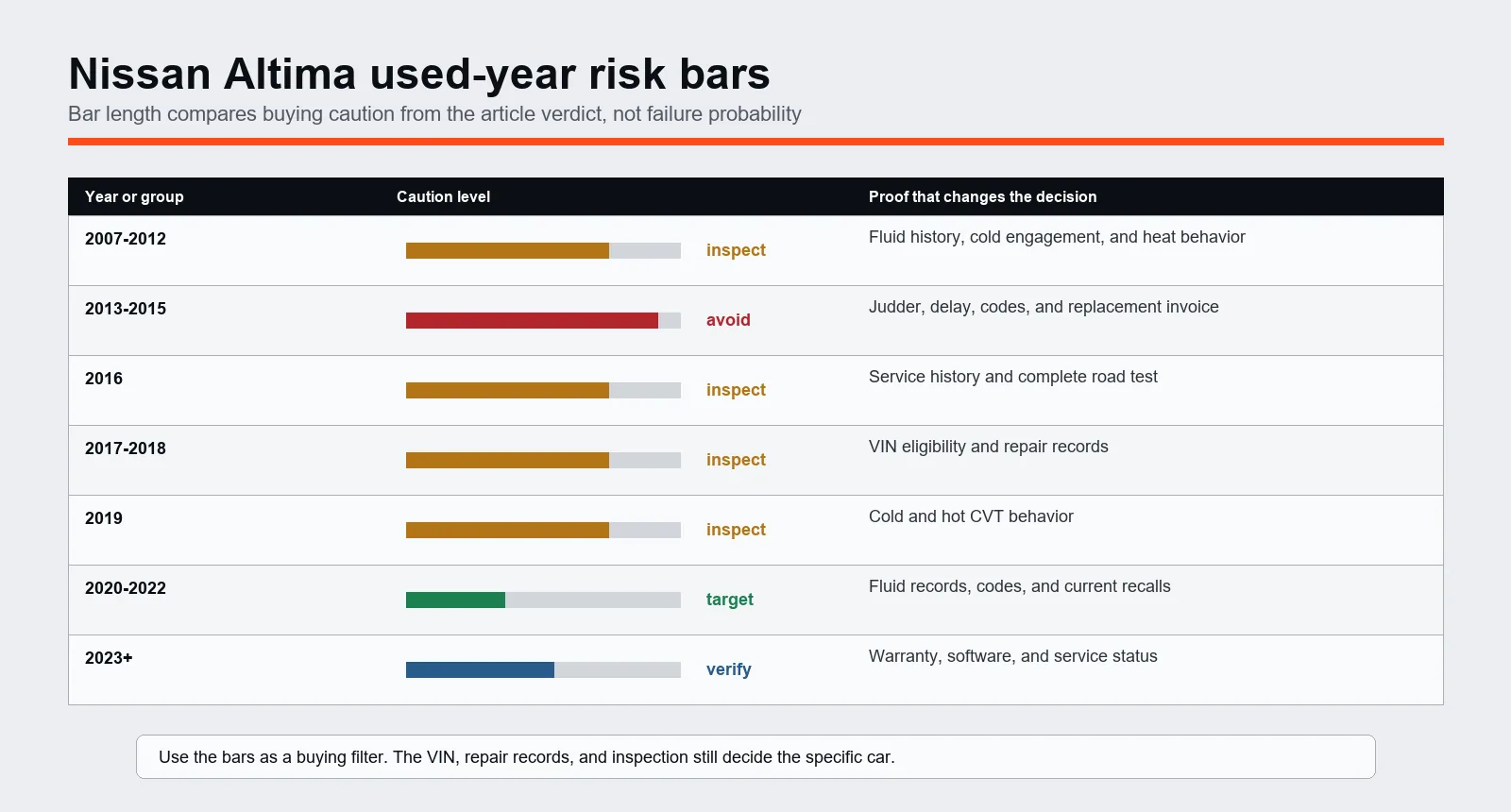
The Altima matrix sets a transmission test for each generation. Complaint concentration is not the probability that one CVT will fail.
Move a vehicle forward only when its VIN, repair history, and physical condition support the row.
Heat separates a weak CVT from a quiet cold drive
The 2007-2012 cars are a softer warning.
They introduced the CVT to the Altima, and while the earlier unit is less failure-prone than the 2013-2018 version, it is still a known weak point on cars that are now well over a decade old with high miles.
Nissan once extended CVT warranty coverage on some of these early cars, but that protection is long gone.
Buy one only at a low price, with proof the transmission has been serviced or replaced.
Later Altimas lower the reports but keep the same test
No overall Altima score can replace a cold and hot CVT evaluation.
Pros
- Buy a later Altima only after a clean cold and hot CVT test
- Give extra value to a documented replacement unit with service records
Cons
- Skip any car that judders, flares, delays engagement, or enters reduced-power mode
Let the road test and invoices decide whether a listed year stays in consideration.
A newer Altima lowers the old CVT complaint concentration but still has to pass hot testing.
The 2019 redesign brought a revised CVT with a beefier belt, and complaint volume fell hard: the 2020 through 2022 cars carry a fraction of the transmission reports the fifth-gen years drew, and the 2020 earned a top reliability mark from Consumer Reports.
These Altimas still ride comfortably, return strong highway mileage, and cost little to run. They also depreciate faster than a Camry or Accord, which means a well-kept two or three-year-old Altima is often the cheapest way into a roomy midsize sedan.
Even so, a CVT is a CVT, so a pre-purchase inspection and a check on any remaining powertrain warranty still matter on a 2019-and-newer car.
If you want a midsize sedan with a more proven transmission, cross-shop the Toyota Camry or Honda Accord, both of which use conventional automatics.
Cold engagement, hot pull, and scan results
A ten-minute drive is too short for an Altima CVT. Include a safe uphill pull and a hot restart before the transmission cools.
Start cold, include low-speed creep and steady acceleration, then repeat the checks after the transmission has reached operating temperature.
Nissan's CVT warranty notice identifies covered 2017-2018 Altimas and the extended terms. Most examples are now beyond that window, so the notice is evidence of scope rather than a promise of free repair.
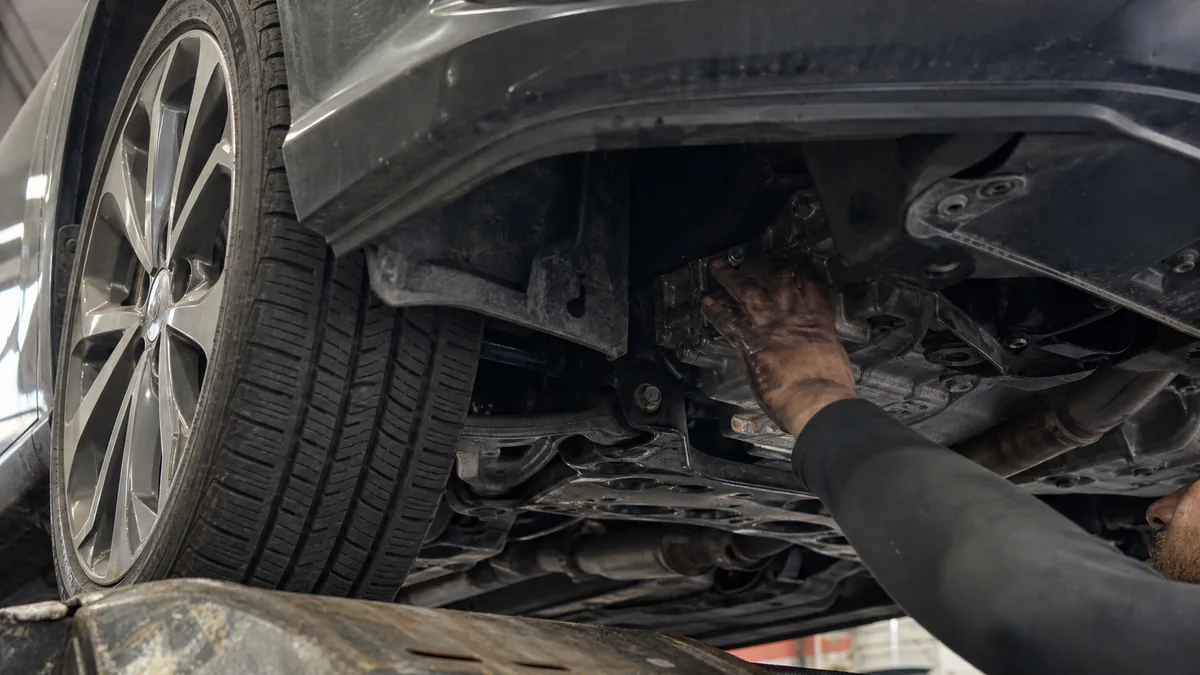
The Altima profile provides the generation and powertrain context that a seller listing often omits.
During the road test, watch engine speed and road speed together. Rising rpm without matching acceleration, a repeating vibration under light throttle, or a delayed response after a stop points back to the CVT even when no warning light appears.
Test the CVT in this order:
- Check Drive and Reverse engagement from a cold start
- Hold light throttle and watch for rpm flare or judder
- Scan transmission codes before and after the road test
- Confirm CVT fluid service with invoices, not a verbal claim
- Compare the example with the Nissan sedan range and used-car paperwork guide
Missing paperwork does not prove that a repair was unnecessary. Stop the deal when rpm behavior, stored codes, and service records do not support one another.
A CVT invoice must identify more than a fluid change
For a 2013-2018 Altima, ask whether the CVT is original, replaced, or rebuilt.
A useful invoice lists the unit, repair mileage, diagnostic codes, and fluid used.
A drain-and-fill is maintenance. It does not prove that belt, pulley, valve-body, or pressure-control wear was corrected.
Nissan's bulletin cited above helps frame diagnostic steps, but the individual car still needs a long drive and scan.
Begin cold and note how quickly Drive and Reverse engage. Then include city traffic, a sustained highway run, and a moderate uphill pull.
Repeat low-speed acceleration after the fluid is hot. Heat is part of the test because a weak CVT may behave better during the first few minutes.
Record shudder, rpm flare, droning without matching speed, delayed engagement, or warning messages.
CVT evidence that matters
- Unit history
- Original, rebuilt, or replaced with mileage
- Fluid service
- Correct specification and credible interval
- Hot drive
- Smooth pull without flare, shudder, or delay
- Scan
- No stored pressure, ratio, or temperature faults
Compare the transmission downside with the whole-car price
An inexpensive Altima can be rational only when the CVT evidence is strong enough to cap the risk. Tires, brakes, wheel bearings, control arms, and A/C are ordinary used-car costs that can be inspected and priced.
An uncertain CVT is different because the downside can exceed the savings between two cars. Do not spend the entire budget on a lower trim or higher mileage car with no transmission proof.
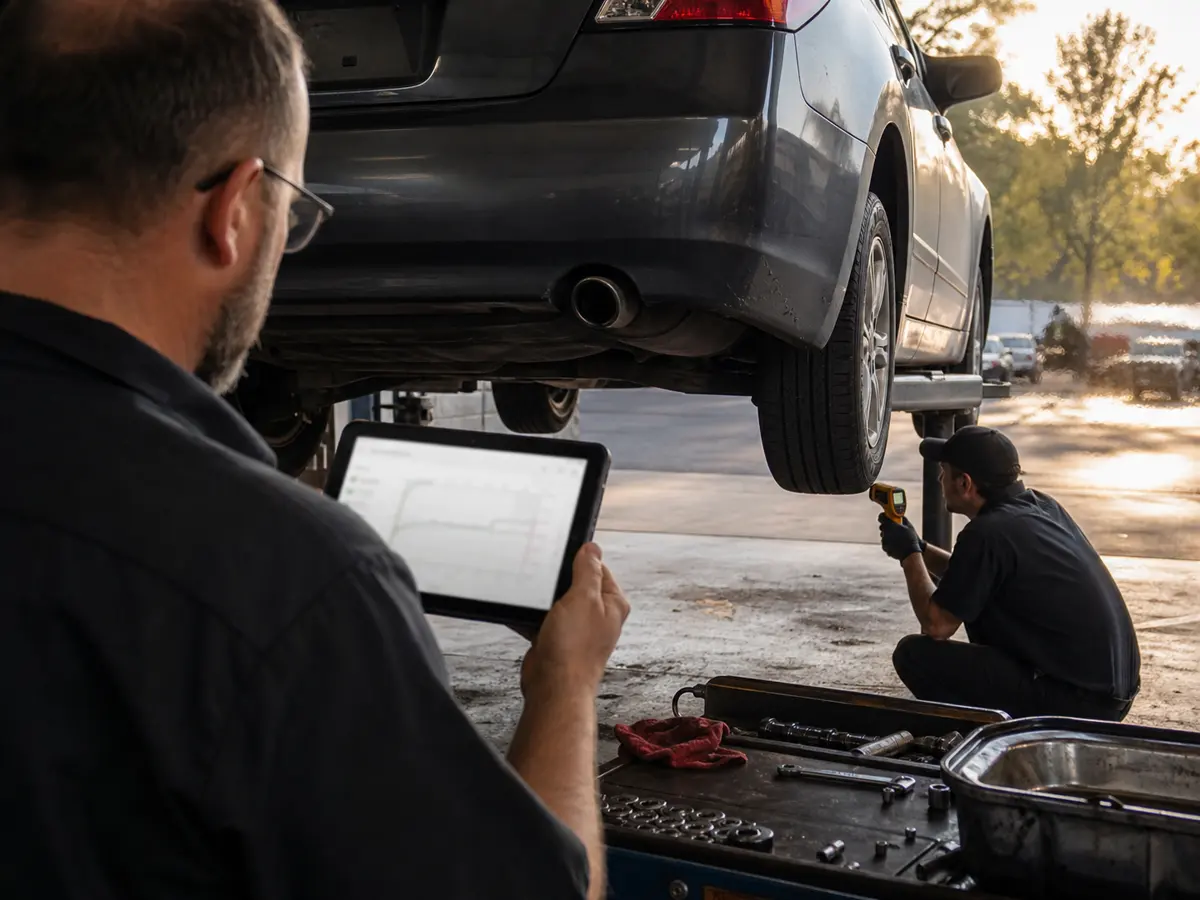
Ask for an inspection that scans all modules and looks underneath for leaks or collision repair.
Check tire match, steering response, braking, and straight tracking. A 2019-or-newer car still deserves the same hot sequence even if its year carries fewer reports.
The safer Altima is the one with a clean hot test and traceable CVT history, not merely the newest badge within budget.
Keep a simple CVT test record for every Altima candidate:
- Ambient temperature and whether the car was truly cold
- Delay into Drive and Reverse before the road test
- Engine speed and vehicle response during moderate acceleration
- Behavior after highway heat and a slow uphill pull
- Warning history and stored transmission codes
- Unit replacement, fluid, and repair mileage from invoices
A shop that understands Nissan CVTs can review pressure data and service history when the drive raises doubt.
Do not authorize a seller's quick fluid change as a substitute for diagnosis. Fresh fluid cannot reverse internal wear, and an additive can change behavior briefly.
A second Altima with a traceable unit may cost more up front and still carry less financial risk.
A fluid sample may support the history, but color alone cannot clear a CVT. Fresh-looking fluid can follow a recent service, and dark fluid does not identify the failed component by itself.
The inspector should combine fluid condition with temperature, pressure-related codes, engagement time, and road behavior. Ask whether the cooling path and radiator area are clear too, because heat control affects the test.
The decision should rest on several consistent observations, not one sample or one quiet drive today.
Know when the Altima CVT test is inconclusive
Some drives fail to produce a clear answer. Heavy traffic may prevent a sustained highway run.
Cold weather may keep fluid temperature low. A recently cleared computer may have little stored history.
The seller may also limit the route. In those cases, a quiet drive is inconclusive rather than reassuring.
Ask a Nissan-capable shop whether it can review CVT temperature, ratio, pressure-related data, stored faults, and service history while reproducing the complaint. The shop should also rule out engine misfire, mounts, wheel bearings, and axle vibration when the symptom is not clearly transmission-related.
Repeat or escalate the test when:
- The car arrived warm and cold engagement was missed
- The route never brought the CVT to stable operating temperature
- A warning light was recently cleared or the battery disconnected
- Judder appeared once but could not be repeated safely
- Fluid or unit history conflicts with the seller's description
Do not use an additive or last-minute fluid service to create a cleaner test.
The buyer needs the original behavior and diagnostic history. A second inspection costs time, but it is cheaper than treating missing evidence as proof of health.
If a complete hot test is impossible, compare another Altima whose condition can be verified.